QUESTION IMAGE
Question
hing exponential functions
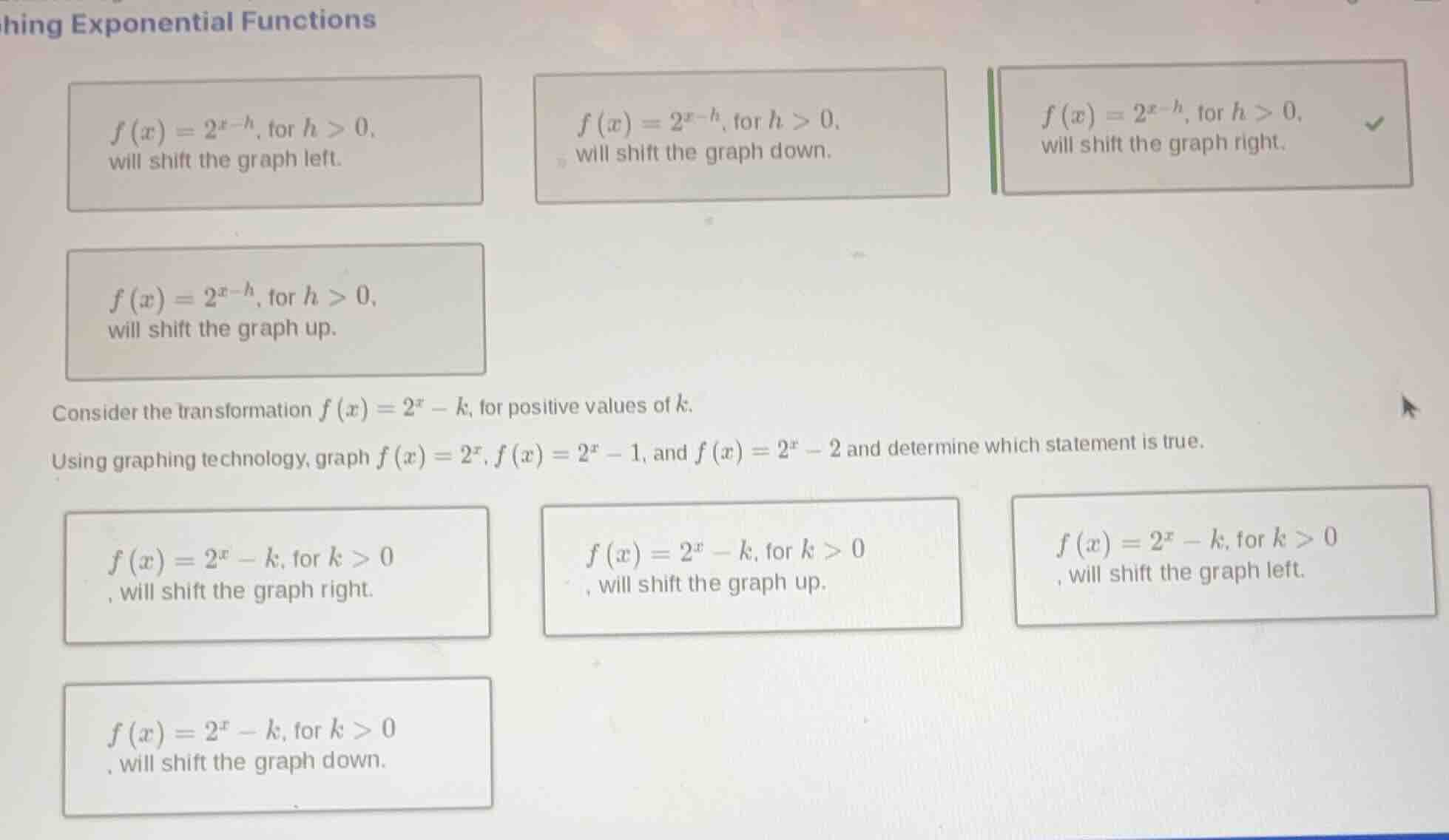
$f(x)=2^{x - h}$, for $h>0$, will shift the graph left.
$f(x)=2^{x - h}$, for $h>0$, will shift the graph down.
$f(x)=2^{x - h}$, for $h>0$, will shift the graph right.
$f(x)=2^{x - h}$, for $h>0$, will shift the graph up.
consider the transformation $f(x)=2^{x}-k$, for positive values of $k$.
using graphing technology, graph $f(x)=2^{x}$, $f(x)=2^{x}-1$, and $f(x)=2^{x}-2$ and determine which statement is true.
$f(x)=2^{x}-k$, for $k>0$, will shift the graph right.
$f(x)=2^{x}-k$, for $k>0$, will shift the graph up.
$f(x)=2^{x}-k$, for $k>0$, will shift the graph left.
$f(x)=2^{x}-k$, for $k>0$, will shift the graph down.
Step1: Recall Vertical Shift Rules
For a function \( y = f(x)+c \), if \( c>0 \), the graph shifts up; if \( c < 0 \), the graph shifts down. Here, the function is \( f(x)=2^{x}-k \) where \( k>0 \), so it can be written as \( f(x)=2^{x}+(-k) \) with \( -k < 0 \).
Step2: Analyze the Given Functions
- The parent function is \( y = 2^{x} \).
- For \( f(x)=2^{x}-1 \) (where \( k = 1>0 \)), compared to \( y = 2^{x} \), each \( y \)-value of \( y = 2^{x} \) is decreased by 1, so the graph shifts down.
- For \( f(x)=2^{x}-2 \) (where \( k = 2>0 \)), compared to \( y = 2^{x} \), each \( y \)-value of \( y = 2^{x} \) is decreased by 2, so the graph shifts down.
Step3: Determine the Correct Statement
From the analysis, for \( f(x)=2^{x}-k \) with \( k > 0 \), the graph of \( y = 2^{x} \) is shifted down.

Snap & solve any problem in the app
Get step-by-step solutions on Sovi AI
Photo-based solutions with guided steps
Explore more problems and detailed explanations
\( f(x)=2^{x}-k \), for \( k > 0 \), will shift the graph down.