QUESTION IMAGE
Question
homework assignment 3.3: power functions and polyno
score: 9/10 answered: 9/10
question 10
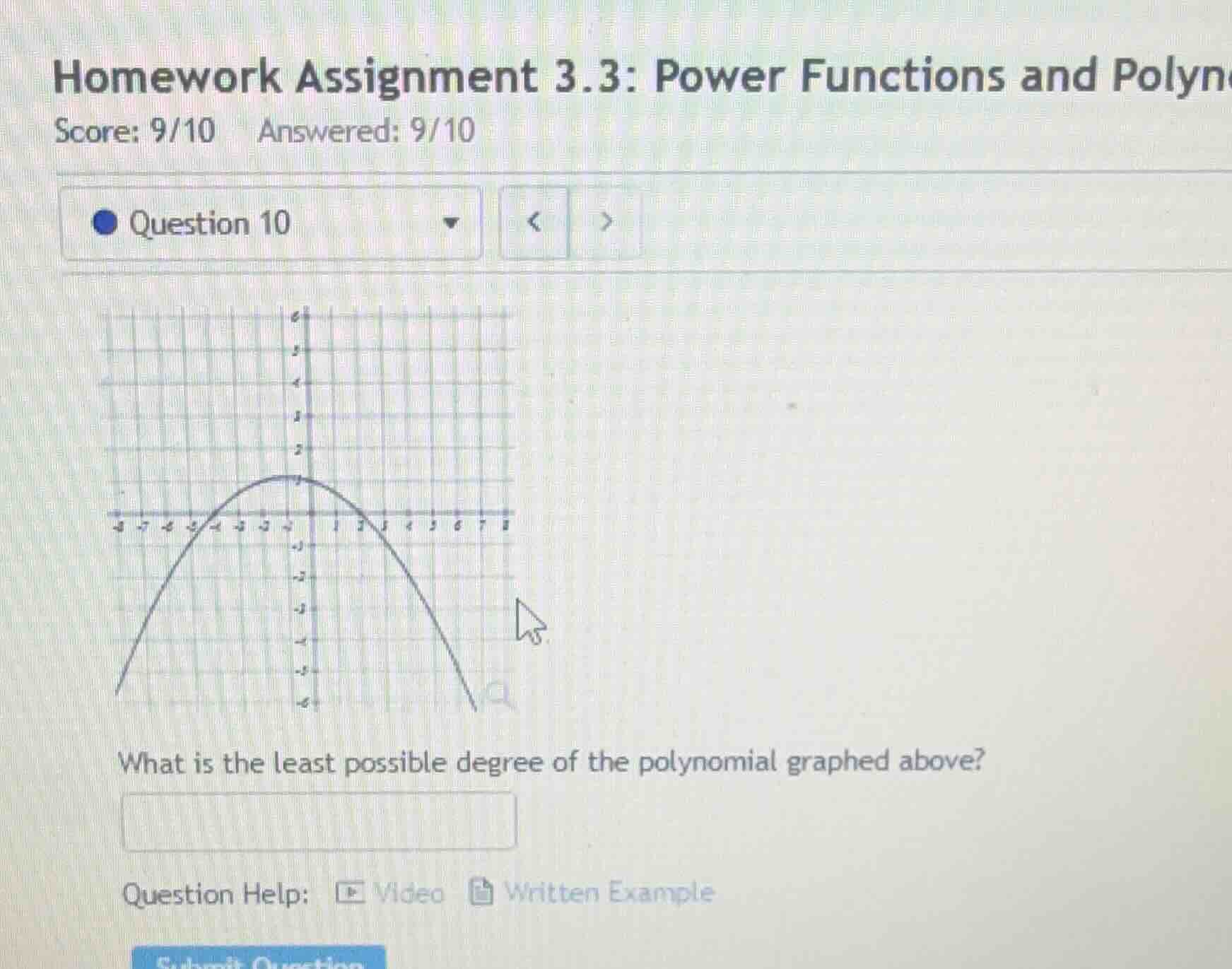
what is the least possible degree of the polynomial graphed above?
question help: video written example
Step1: Analyze the end - behavior of the polynomial graph
The end - behavior of a polynomial is determined by the leading term \(a_nx^n\), where \(n\) is the degree of the polynomial and \(a_n\) is the leading coefficient. For the given graph, as \(x\to+\infty\), \(y\to-\infty\) and as \(x\to-\infty\), \(y\to-\infty\). This means that the leading coefficient \(a_n\) is negative and the degree \(n\) of the polynomial is even (because for even - degree polynomials \(y = a_nx^n\), when \(a_n<0\), the graph goes down on both ends).
Step2: Analyze the number of turning points
The number of turning points of a polynomial function \(y = f(x)\) is at most \(n - 1\), where \(n\) is the degree of the polynomial. The given graph has a single turning point (a maximum point). If the number of turning points is \(T\), then \(T\leq n - 1\). Here, \(T = 1\), so \(n-1\geq1\), which implies \(n\geq2\). But we also know from the end - behavior that \(n\) is even. The smallest even integer greater than or equal to 2 is 2? Wait, no, wait. Wait, let's re - examine the graph. Wait, the graph crosses the \(x\) - axis at two points? Wait, no, looking at the graph, the graph touches or crosses the \(x\) - axis? Wait, the graph intersects the \(x\) - axis at two distinct points? Wait, no, the graph has a vertex (a maximum) and it crosses the \(x\) - axis at two points. Wait, but for a quadratic function (degree 2), the graph is a parabola, which has one turning point and two \(x\) - intercepts (if the discriminant is positive). But wait, the end - behavior: for a quadratic function \(y=ax^2 + bx + c\), if \(a<0\), as \(x\to\pm\infty\), \(y\to-\infty\), which matches the given graph. But wait, wait, the graph in the picture: let's count the number of \(x\) - intercepts. Wait, the graph crosses the \(x\) - axis at two points? Wait, no, maybe I made a mistake. Wait, the graph of a quadratic function (degree 2) has one turning point. But wait, the given graph: let's check the end - behavior again. Wait, as \(x\) approaches positive infinity, \(y\) approaches negative infinity, and as \(x\) approaches negative infinity, \(y\) approaches negative infinity. So the degree is even. The number of turning points: the graph has 1 turning point. The formula for the maximum number of turning points is \(n - 1\). So if \(n-1\geq1\), \(n\geq2\). But also, the graph intersects the \(x\) - axis at two points. For a quadratic function \(y = ax^2+bx + c\), the number of real roots is given by the discriminant \(\Delta=b^2 - 4ac\). If \(\Delta>0\), there are two distinct real roots. But wait, is the graph a quadratic? Wait, no, wait a second. Wait, the graph: let's look at the shape. Wait, a quadratic function (degree 2) has a parabola shape. But the given graph: wait, maybe I miscounted the turning points. Wait, no, the graph has one turning point (a maximum). But wait, the degree: let's think again. Wait, the end - behavior: both ends go down, so even degree. The number of turning points: 1. So \(n-1\geq1\) implies \(n\geq2\). But wait, is there a mistake here? Wait, no, the smallest even degree with at least 1 turning point is 2? Wait, no, wait, a quadratic function (degree 2) has exactly 1 turning point (when \(n = 2\), \(n-1=1\)). So the least possible degree is 2? Wait, no, wait, maybe I made a mistake. Wait, no, let's check the graph again. Wait, the graph: when \(x = 0\), \(y = 1\) (the y - intercept). The graph has a maximum at \(x = 0\) (since it's symmetric about the y - axis) and crosses the \(x\) - axis at two points. So this is a parabola, which is a quadratic…

Snap & solve any problem in the app
Get step-by-step solutions on Sovi AI
Photo-based solutions with guided steps
Explore more problems and detailed explanations
2