QUESTION IMAGE
Question
homework assignment 3.7: rational functions
score: 3/12 answered: 3/12
progress saved done
question 4
0/1 pt 3 99 details
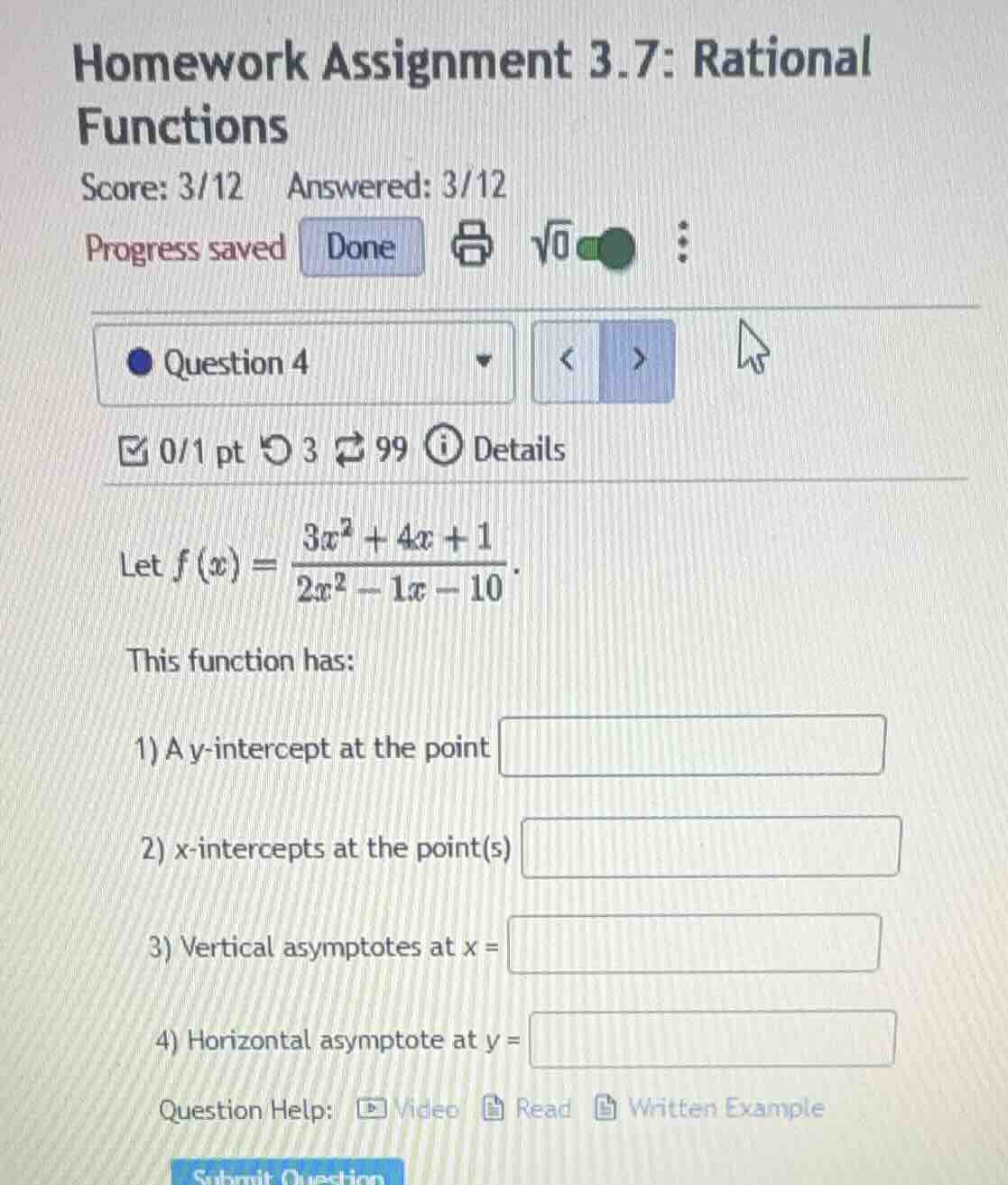
let $f(x)=\frac{3x^{2}+4x+1}{2x^{2}-1x-10}$.
this function has:
- a y-intercept at the point
- x-intercepts at the point(s)
- vertical asymptotes at x =
- horizontal asymptote at y =
question help: video read written example
Step1: Find y-intercept (set x=0)
Substitute $x=0$ into $f(x)$:
$$f(0)=\frac{3(0)^2+4(0)+1}{2(0)^2-1(0)-10}=\frac{1}{-10}=-\frac{1}{10}$$
So the y-intercept is the point $(0, -\frac{1}{10})$.
Step2: Find x-intercepts (set numerator=0)
Solve $3x^2+4x+1=0$:
Factor the quadratic:
$$(3x+1)(x+1)=0$$
Set each factor to 0:
$3x+1=0 \implies x=-\frac{1}{3}$; $x+1=0 \implies x=-1$
So x-intercepts are $(-1, 0)$ and $(-\frac{1}{3}, 0)$.
Step3: Find vertical asymptotes (set denominator=0)
Solve $2x^2-x-10=0$:
Factor the quadratic:
$$(2x-5)(x+2)=0$$
Set each factor to 0:
$2x-5=0 \implies x=\frac{5}{2}$; $x+2=0 \implies x=-2$
Step4: Find horizontal asymptote (compare degrees)
Numerator and denominator have same degree (2). Horizontal asymptote is ratio of leading coefficients:
$$y=\frac{3}{2}$$

Snap & solve any problem in the app
Get step-by-step solutions on Sovi AI
Photo-based solutions with guided steps
Explore more problems and detailed explanations
- $\boldsymbol{(0, -\frac{1}{10})}$
- $\boldsymbol{(-1, 0)}$ and $\boldsymbol{(-\frac{1}{3}, 0)}$
- $\boldsymbol{-2}$ and $\boldsymbol{\frac{5}{2}}$
- $\boldsymbol{\frac{3}{2}}$