QUESTION IMAGE
Question
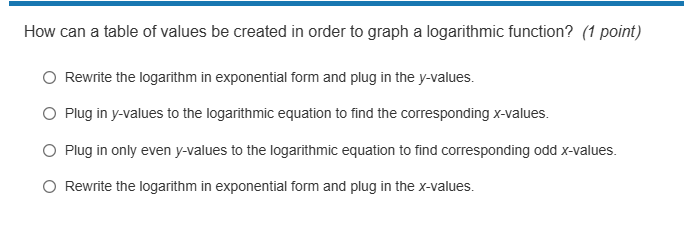
how can a table of values be created in order to graph a logarithmic function? (1 point)
rewrite the logarithm in exponential form and plug in the y - values.
plug in y - values to the logarithmic equation to find the corresponding x - values.
plug in only even y - values to the logarithmic equation to find corresponding odd x - values.
rewrite the logarithm in exponential form and plug in the x - values.
To create a table of values for a logarithmic function \( y = \log_b(x) \) (where \( b>0, b
eq1 \)), we can use the relationship between logarithms and exponents. The logarithmic equation \( y=\log_b(x) \) can be rewritten in exponential form as \( x = b^y \). To find the corresponding \( x \)-values for a graph, we typically plug in \( y \)-values (choosing convenient values like integers) into the exponential form (or the logarithmic equation) to solve for \( x \). Let's analyze each option:
- Option 1: Rewriting the logarithm in exponential form and plugging in \( y \)-values to find \( x \) is a valid method. For example, if \( y = \log_2(x) \), rewrite as \( x = 2^y \). If we choose \( y = 0 \), then \( x = 2^0=1 \); \( y = 1 \), \( x = 2^1 = 2 \), etc. This helps in finding \( x \)-values for plotting.
- Option 2: Plugging \( y \)-values into the logarithmic equation directly to find \( x \) is also a way, but it's often easier to use the exponential form (since solving \( y=\log_b(x) \) for \( x \) is equivalent to using the exponential form). However, the key here is the process. But let's check other options.
- Option 3: There's no rule that we should only plug in even \( y \)-values to get odd \( x \)-values. This is an incorrect approach as we can choose any \( y \)-values (integers, fractions, etc.) that make calculating \( x \) easy, and there's no inherent connection between even \( y \)-values and odd \( x \)-values for logarithmic functions.
- Option 4: If we rewrite the logarithm in exponential form, plugging in \( x \)-values would not help us find the corresponding \( y \)-values for the table (since we need to find \( x \) for given \( y \) or vice versa, but typically we fix \( y \) and find \( x \) or fix \( x \) and find \( y \). But when creating a table to graph, we often choose \( y \)-values (outputs) and find \( x \)-values (inputs) or choose \( x \)-values in the domain (but the domain of \( \log_b(x) \) is \( x>0 \)). However, the correct method is to rewrite in exponential form and plug in \( y \)-values (as in Option 1) or plug in \( y \)-values to the logarithmic equation (Option 2). Wait, let's re - examine the options. The standard method is: Given \( y = \log_b(x) \), which is equivalent to \( x = b^y \). So to create a table, we can choose \( y \)-values (like \( y=- 2,-1,0,1,2,\cdots \)) and then compute \( x = b^y \) for each \( y \). So we rewrite the logarithm in exponential form and plug in \( y \)-values (to find \( x \)). So Option 1 is correct. Option 2 says "plug in \( y \)-values to the logarithmic equation to find the corresponding \( x \)-values". Let's take an example: \( y=\log_2(x) \). If we plug \( y = 1 \) into the logarithmic equation: \( 1=\log_2(x)\), which means \( x = 2^1=2 \), same as using the exponential form. So both Option 1 and Option 2 seem related, but let's check the wording. Option 1 says "rewrite the logarithm in exponential form and plug in the \( y \)-values" (to find \( x \)), which is a clear and standard method. Option 2 says "plug in \( y \)-values to the logarithmic equation to find the corresponding \( x \)-values" which is also correct, but let's check the options again. Wait, the first option is "Rewrite the logarithm in exponential form and plug in the \( y \)-values" (to find \( x \)), which is the standard approach. Option 4 says "Rewrite the logarithm in exponential form and plug in the \( x \)-values". If we plug in \( x \)-values into the exponential form \( x = b^y \), we would be solving for \( y \), but when creating a table, we can also choose…

Snap & solve any problem in the app
Get step-by-step solutions on Sovi AI
Photo-based solutions with guided steps
Explore more problems and detailed explanations
A. Rewrite the logarithm in exponential form and plug in the \( y \)-values.