QUESTION IMAGE
Question
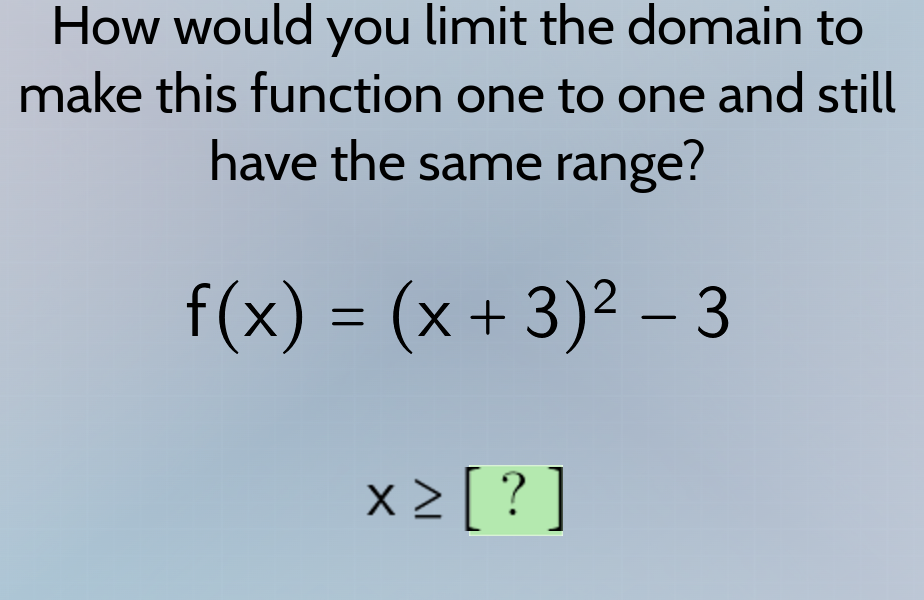
how would you limit the domain to make this function one to one and still have the same range?
$f(x) = (x + 3)^2 - 3$
$x \geq ?$
Step1: Analyze the function type
The function \( f(x)=(x + 3)^2-3 \) is a quadratic function, and its graph is a parabola. The general form of a quadratic function is \( y = a(x - h)^2 + k \), where \((h,k)\) is the vertex of the parabola. For \( f(x)=(x + 3)^2-3 \), we can rewrite it as \( f(x)=1\times(x - (-3))^2+(-3) \), so the vertex of the parabola is \((-3,-3)\), and since \( a = 1>0 \), the parabola opens upwards.
Step2: Determine the axis of symmetry and the behavior of the function
The axis of symmetry of the parabola \( y=a(x - h)^2 + k \) is the vertical line \( x = h \). For our function, the axis of symmetry is \( x=-3 \). For a parabola that opens upwards, the function is decreasing on the left - hand side of the axis of symmetry (\( x < h \)) and increasing on the right - hand side of the axis of symmetry (\( x>h \)).
To make the function one - to - one, we need to restrict the domain such that the function is either strictly increasing or strictly decreasing on that domain. Since we want to keep the same range, and the range of the original function \( f(x)=(x + 3)^2-3 \) is \( y\geq - 3\) (because the square term \((x + 3)^2\geq0\), so \((x + 3)^2-3\geq - 3\)).
If we take the domain as \( x\geq - 3\), the function \( f(x)=(x + 3)^2-3 \) is increasing (because for \( x_1>x_2\geq - 3\), \((x_1 + 3)^2-3-((x_2 + 3)^2-3)=(x_1 + 3)^2-(x_2 + 3)^2=(x_1 + 3 - x_2 - 3)(x_1 + 3+x_2 + 3)=(x_1 - x_2)(x_1 + x_2+6)\). Since \( x_1>x_2\geq - 3\), \( x_1 - x_2>0\) and \( x_1 + x_2+6\geq - 3-3 + 6 = 0\), and when \( x_1=x_2=-3\), \( x_1 + x_2+6 = 0\), but as \( x_1>x_2\geq - 3\), \( x_1 + x_2+6>0\), so \( f(x_1)-f(x_2)>0\), so the function is increasing on \( x\geq - 3\)). When the function is increasing on an interval, it is one - to - one (because if \( f(x_1)=f(x_2)\), then \( x_1=x_2\) for an increasing function). Also, when \( x\geq - 3\), the range of the function is still \( y\geq - 3\) (because when \( x=-3\), \( f(-3)=(-3 + 3)^2-3=-3\), and as \( x\) increases, \((x + 3)^2\) increases, so \( f(x)\) increases).

Snap & solve any problem in the app
Get step-by-step solutions on Sovi AI
Photo-based solutions with guided steps
Explore more problems and detailed explanations
\(-3\)