QUESTION IMAGE
Question
hw 2.2
score: 0/8 answered: 0/8
question 1
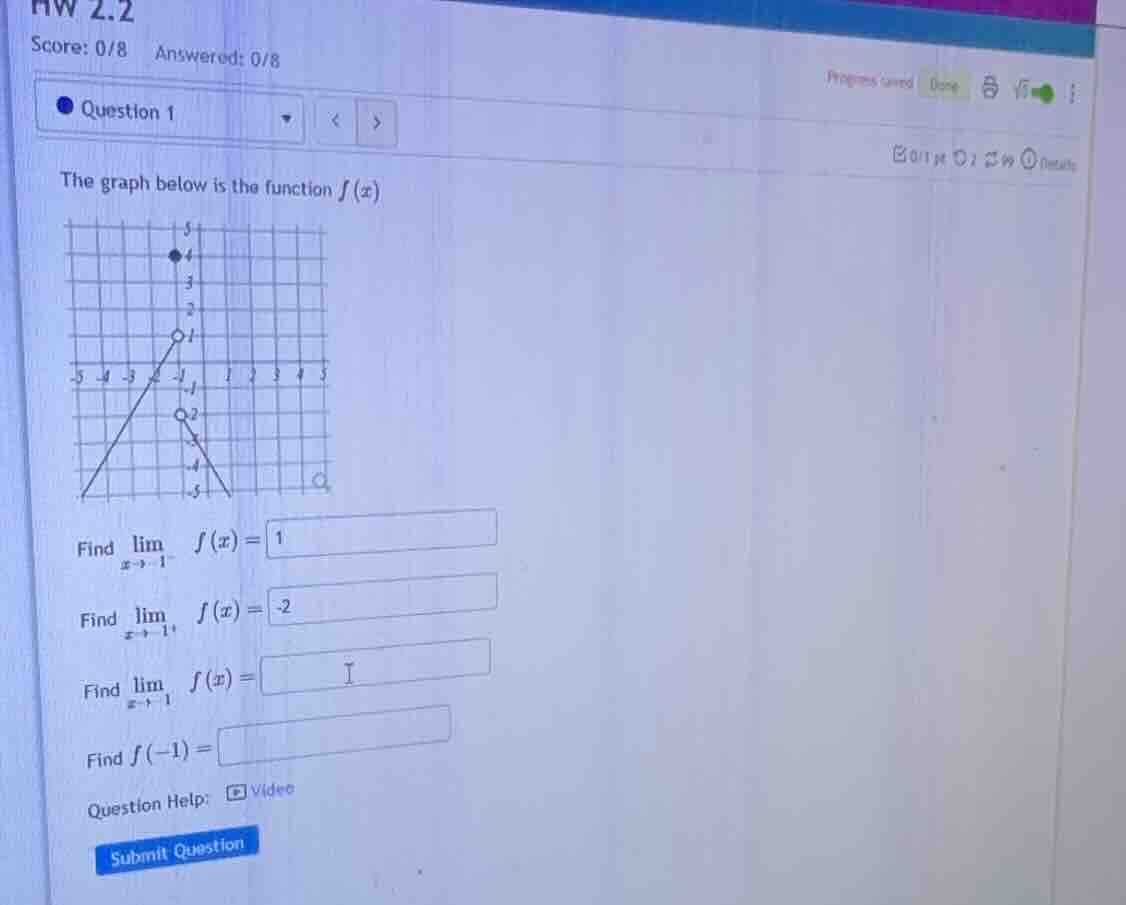
the graph below is the function f(x)
graph
find \\( \lim_{x \to -1^-} f(x) = \\)
find \\( \lim_{x \to -1^+} f(x) = \\)
find \\( \lim_{x \to -1} f(x) = \\)
find \\( f(-1) = \\)
question help: video
submit question
For $\boldsymbol{\lim_{x \to -1} f(x)}$:
To find the limit as \( x \to -1 \), we need to check the left - hand limit (\( \lim_{x \to -1^{-}} f(x) \)) and the right - hand limit (\( \lim_{x \to -1^{+}} f(x) \)).
We know that \( \lim_{x \to -1^{-}} f(x)=1 \) (the left - hand limit, as \( x \) approaches - 1 from values less than - 1, the function approaches 1) and \( \lim_{x \to -1^{+}} f(x)= - 2 \) (the right - hand limit, as \( x \) approaches - 1 from values greater than - 1, the function approaches - 2).
For the limit \( \lim_{x \to a} f(x) \) to exist, we need \( \lim_{x \to a^{-}} f(x)=\lim_{x \to a^{+}} f(x) \). But here \( \lim_{x \to -1^{-}} f(x) = 1\) and \( \lim_{x \to -1^{+}} f(x)=-2 \), and \( 1
eq - 2 \). So, \( \lim_{x \to -1} f(x) \) does not exist.
For \( f(-1) \):
To find \( f(-1) \), we look at the graph of the function at \( x = - 1 \). The filled - in dot at \( x=-1 \) gives the value of the function at that point. From the graph, the filled - in dot at \( x = - 1 \) is at \( y = 4 \). So, \( f(-1)=4 \).
Final Answers:
- \( \lim_{x \to -1} f(x) \): Does not exist
- \( f(-1)=4 \)

Snap & solve any problem in the app
Get step-by-step solutions on Sovi AI
Photo-based solutions with guided steps
Explore more problems and detailed explanations
For $\boldsymbol{\lim_{x \to -1} f(x)}$:
To find the limit as \( x \to -1 \), we need to check the left - hand limit (\( \lim_{x \to -1^{-}} f(x) \)) and the right - hand limit (\( \lim_{x \to -1^{+}} f(x) \)).
We know that \( \lim_{x \to -1^{-}} f(x)=1 \) (the left - hand limit, as \( x \) approaches - 1 from values less than - 1, the function approaches 1) and \( \lim_{x \to -1^{+}} f(x)= - 2 \) (the right - hand limit, as \( x \) approaches - 1 from values greater than - 1, the function approaches - 2).
For the limit \( \lim_{x \to a} f(x) \) to exist, we need \( \lim_{x \to a^{-}} f(x)=\lim_{x \to a^{+}} f(x) \). But here \( \lim_{x \to -1^{-}} f(x) = 1\) and \( \lim_{x \to -1^{+}} f(x)=-2 \), and \( 1
eq - 2 \). So, \( \lim_{x \to -1} f(x) \) does not exist.
For \( f(-1) \):
To find \( f(-1) \), we look at the graph of the function at \( x = - 1 \). The filled - in dot at \( x=-1 \) gives the value of the function at that point. From the graph, the filled - in dot at \( x = - 1 \) is at \( y = 4 \). So, \( f(-1)=4 \).
Final Answers:
- \( \lim_{x \to -1} f(x) \): Does not exist
- \( f(-1)=4 \)