QUESTION IMAGE
Question
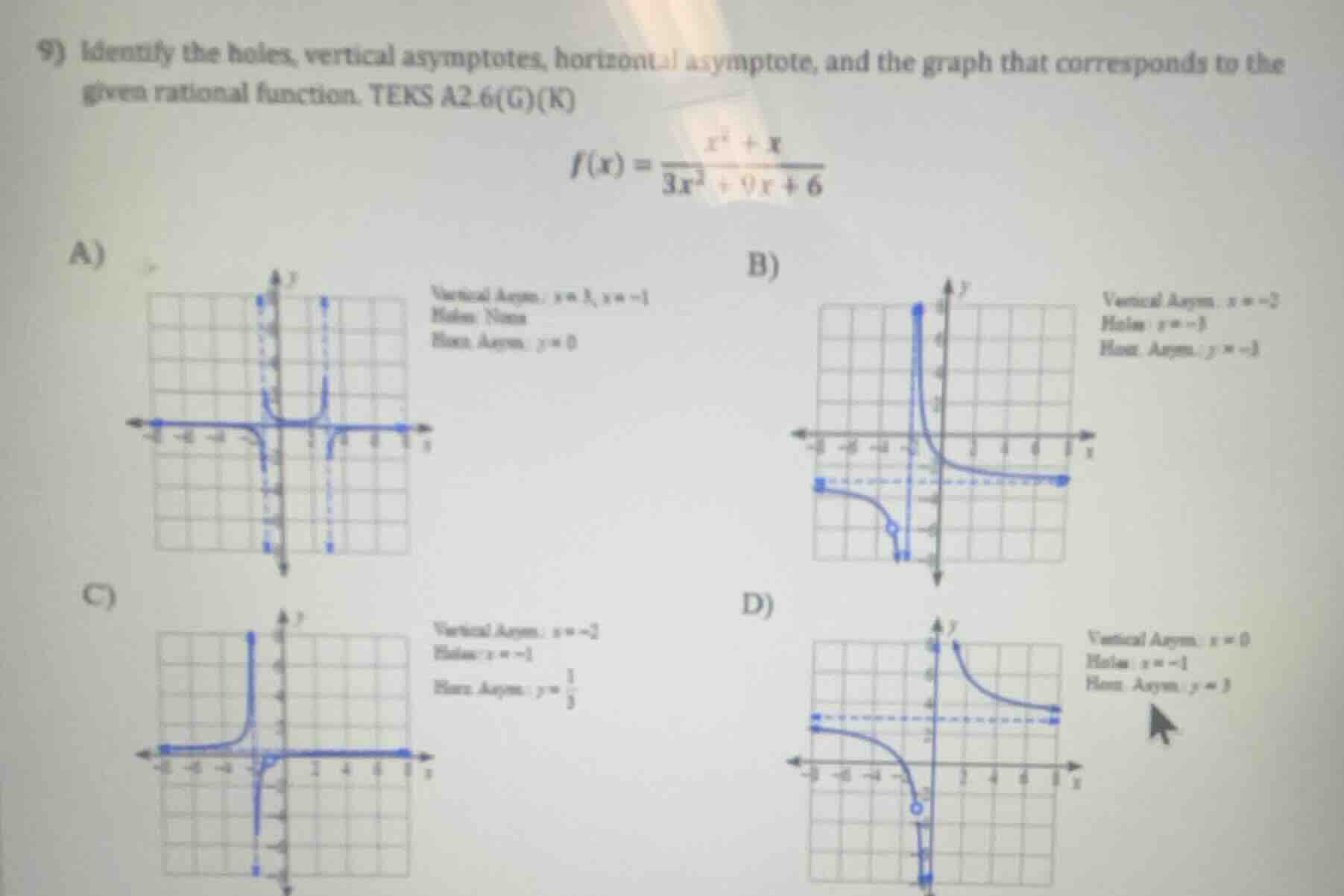
- identify the holes, vertical asymptotes, horizontal asymptote, and the graph that corresponds to the given rational function. teks a2.6(g)(k)
$f(x) = \frac{x^2 + x}{3x^2 + 9x + 6}$
a) graph and description: vertical asym: $x = 3, x = -1$; holes: none; horiz. asym: $y = 0$
b) graph and description: vertical asym: $x = -2$; holes: $x = -1$; horiz. asym: $y = -1$
c) graph and description: vertical asym: $x = -2$; holes: $x = -1$; horiz. asym: $y = \frac{1}{3}$
d) graph and description: vertical asym: $x = 0$; holes: $x = -1$; horiz. asym: $y = 3$
Step 1: Factor the numerator and denominator
First, factor the numerator \(x^2 + x\) and the denominator \(3x^2 + 9x + 6\).
- Numerator: \(x^2 + x = x(x + 1)\)
- Denominator: \(3x^2 + 9x + 6 = 3(x^2 + 3x + 2) = 3(x + 1)(x + 2)\)
So the function becomes \(f(x)=\frac{x(x + 1)}{3(x + 1)(x + 2)}\)
Step 2: Identify holes
A hole occurs when there is a common factor in the numerator and denominator. Here, the common factor is \((x + 1)\). We set \(x + 1 = 0\), so \(x = -1\) is the x - value of the hole. To find the y - value of the hole, we cancel the common factor \((x + 1)\) (for \(x
eq - 1\)) and substitute \(x=-1\) into the simplified function. The simplified function is \(f(x)=\frac{x}{3(x + 2)}\) (for \(x
eq - 1\)). Substituting \(x = - 1\) into \(\frac{x}{3(x + 2)}\), we get \(\frac{-1}{3(-1 + 2)}=\frac{-1}{3(1)}=-\frac{1}{3}\). Wait, but let's check the vertical asymptotes and horizontal asymptote.
Step 3: Find vertical asymptotes
After canceling the common factor \((x + 1)\), the denominator of the simplified function is \(3(x + 2)\). We set the denominator equal to zero: \(3(x + 2)=0\), so \(x=-2\) is the vertical asymptote.
Step 4: Find horizontal asymptote
To find the horizontal asymptote, we compare the degrees of the numerator and denominator. The degree of the numerator (after canceling) is 1 (from \(x\)) and the degree of the denominator is 1 (from \(x\) in \(3(x + 2)=3x + 6\)). When the degrees are equal, the horizontal asymptote is the ratio of the leading coefficients. The leading coefficient of the numerator is 1, and the leading coefficient of the denominator is 3. So the horizontal asymptote is \(y=\frac{1}{3}\).
Now let's check the options:
- Option A: Vertical asymptotes \(x = 3,x=-1\) (incorrect, our vertical asymptote is \(x=-2\)), so A is wrong.
- Option B: Horizontal asymptote \(y=-1\) (incorrect, our horizontal asymptote is \(y = \frac{1}{3}\)), so B is wrong.
- Option C: Vertical asymptote \(x=-2\), hole at \(x=-1\) (we found hole at \(x = - 1\)), horizontal asymptote \(y=\frac{1}{3}\). This matches our calculations.
- Option D: Vertical asymptote \(x = 0\) (incorrect, our vertical asymptote is \(x=-2\)), so D is wrong.

Snap & solve any problem in the app
Get step-by-step solutions on Sovi AI
Photo-based solutions with guided steps
Explore more problems and detailed explanations
C