QUESTION IMAGE
Question
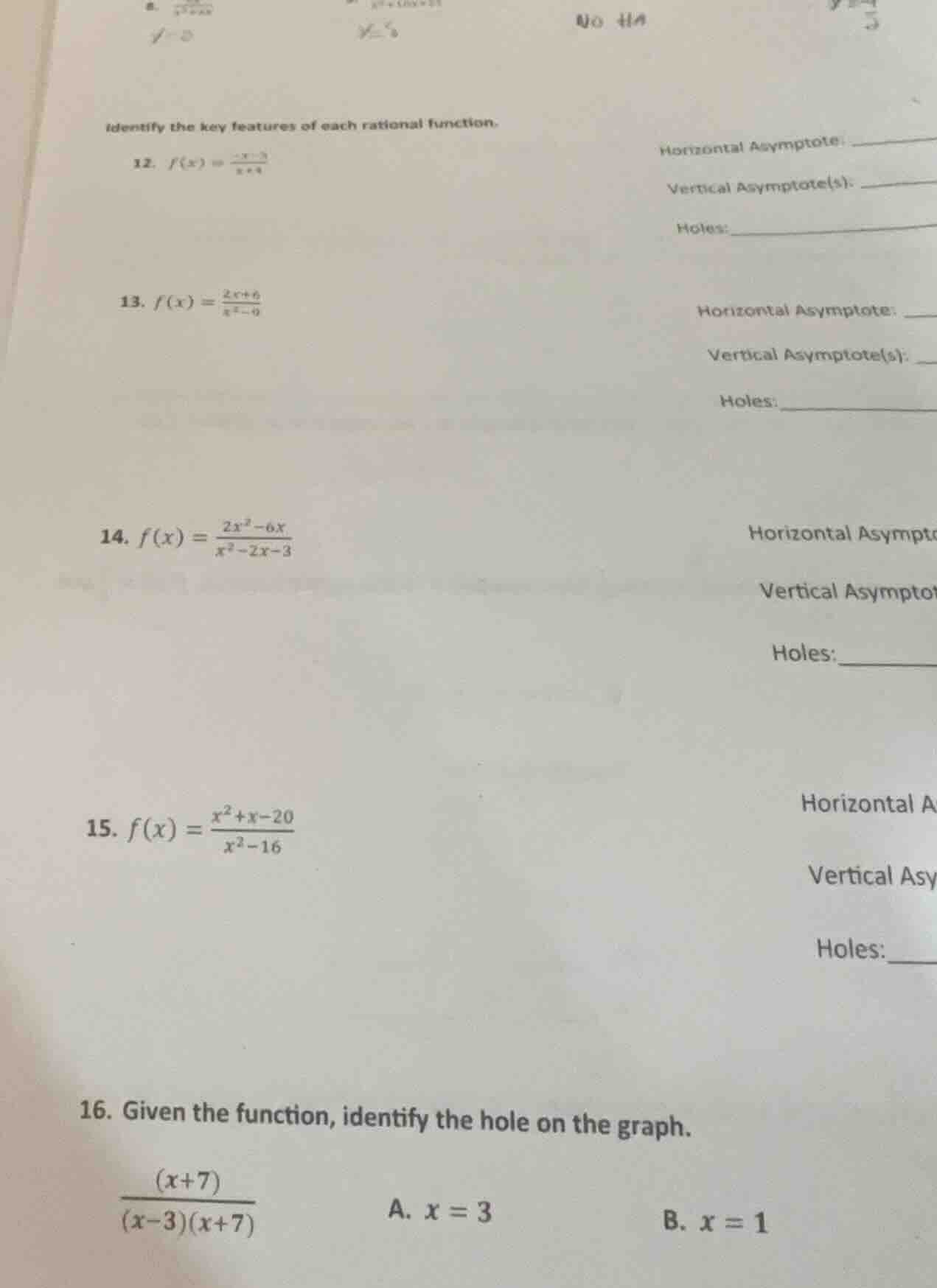
identify the key features of each rational function.
- $f(x)=\frac{-x - 3}{x + 4}$
horizontal asymptote:
vertical asymptote(s):
holes:
- $f(x)=\frac{2(x + 6)}{x^2 - 9}$
horizontal asymptote:
vertical asymptote(s):
holes:
- $f(x)=\frac{2x^2 - 6x}{x^2 - 2x - 3}$
horizontal asymptote:
vertical asymptote:
holes:
- $f(x)=\frac{x^2 + x - 20}{x^2 - 16}$
horizontal asymptote:
vertical asymptote:
holes:
- given the function, identify the hole on the graph.
$\frac{(x + 7)}{(x - 3)(x + 7)}$
a. $x = 3$
b. $x = 1$
Problem 12: \( f(x) = \frac{-x - 3}{x + 4} \)
Step 1: Horizontal Asymptote
For a rational function \( f(x) = \frac{N(x)}{D(x)} \), if the degrees of \( N(x) \) and \( D(x) \) are equal, the horizontal asymptote is \( y=\frac{\text{leading coefficient of } N(x)}{\text{leading coefficient of } D(x)} \). Here, both numerator and denominator are degree 1. Leading coefficient of numerator is -1, denominator is 1. So horizontal asymptote is \( y = -1 \).
Step 2: Vertical Asymptote
Vertical asymptotes occur where \( D(x)=0 \) and \( N(x)
eq0 \) at that point. Solve \( x + 4 = 0 \), so \( x=-4 \). Check numerator at \( x=-4 \): \( -(-4)-3=4 - 3 = 1
eq0 \). So vertical asymptote is \( x=-4 \).
Step 3: Holes
Holes occur when there are common factors in numerator and denominator. Here, numerator \( -x - 3=-(x + 3) \) and denominator \( x + 4 \) have no common factors. So no holes.
Step 1: Factor Numerator and Denominator
Numerator: \( 2x + 6 = 2(x + 3) \)
Denominator: \( x^{2}-9=(x - 3)(x + 3) \)
So \( f(x)=\frac{2(x + 3)}{(x - 3)(x + 3)} \) (for \( x
eq - 3,3 \))
Step 2: Horizontal Asymptote
Degree of numerator (1) < degree of denominator (2). So horizontal asymptote is \( y = 0 \) (x - axis).
Step 3: Vertical Asymptote
After canceling \( (x + 3) \), denominator is \( x - 3 \). Set \( x - 3=0 \), so \( x = 3 \).
Step 4: Holes
Common factor is \( (x + 3) \). Set \( x + 3 = 0\Rightarrow x=-3 \). So hole at \( x=-3 \).
Step 1: Factor Numerator and Denominator
Numerator: \( 2x^{2}-6x = 2x(x - 3) \)
Denominator: \( x^{2}-2x - 3=(x - 3)(x + 1) \)
So \( f(x)=\frac{2x(x - 3)}{(x - 3)(x + 1)} \) (for \( x
eq3,-1 \))
Step 2: Horizontal Asymptote
Degrees of numerator and denominator are equal (degree 2). Leading coefficient of numerator: 2, denominator: 1. So horizontal asymptote \( y=\frac{2}{1}=2 \).
Step 3: Vertical Asymptote
After canceling \( (x - 3) \), denominator is \( x + 1 \). Set \( x + 1 = 0\Rightarrow x=-1 \).
Step 4: Holes
Common factor is \( (x - 3) \). Set \( x - 3 = 0\Rightarrow x = 3 \). So hole at \( x = 3 \).

Snap & solve any problem in the app
Get step-by-step solutions on Sovi AI
Photo-based solutions with guided steps
Explore more problems and detailed explanations
Horizontal Asymptote: \( y = -1 \)
Vertical Asymptote(s): \( x = -4 \)
Holes: None