QUESTION IMAGE
Question
lesson 4
using function notation
to describe rules (part 1)
lets look at some rules that describe functions
and write some too.
warm-up notice and wonder: two functions
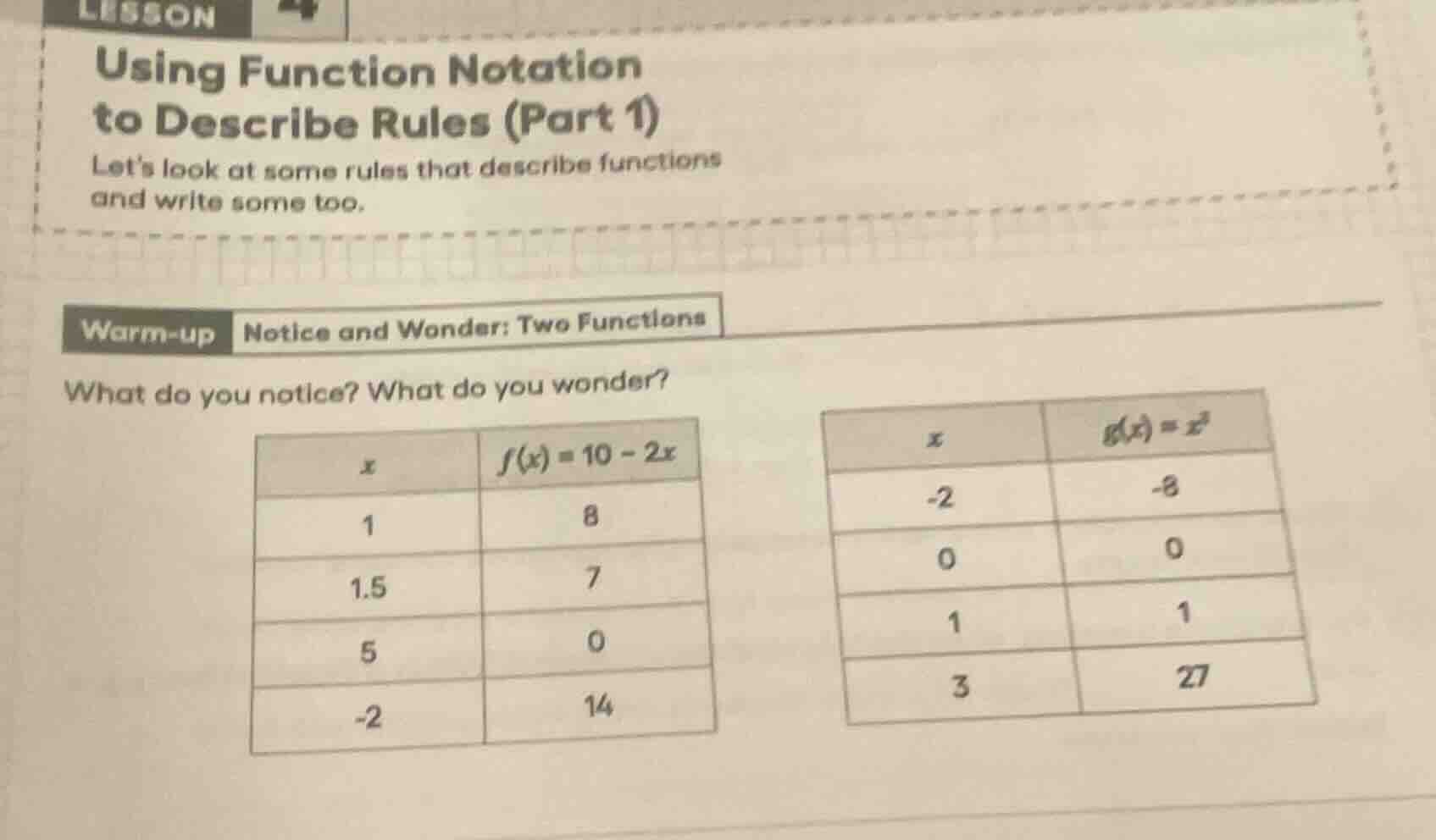
what do you notice? what do you wonder?
| x | $f(x)=10 - 2x$ |
|---|---|
| 1.5 | 7 |
| 5 | 0 |
| -2 | 14 |
| x | $g(x)=x^3$ |
|---|---|
| 0 | 0 |
| 1 | 1 |
| 3 | 27 |
Brief Explanations
For the function \( f(x) = 10 - 2x \):
- Notice: When \( x \) increases, \( f(x) \) decreases (since the coefficient of \( x \) is -2, it's a linear function with a negative slope). For example, as \( x \) goes from 1 to 1.5 to 5, \( f(x) \) goes from 8 to 7 to 0. Also, when \( x=-2 \), \( f(-2)=10 - 2\times(-2)=14 \), which follows the linear rule.
- Wonder: How does the rate of change (slope) affect the values? What if the coefficient of \( x \) was positive?
For the function \( g(x)=x^{3} \):
- Notice: The outputs are the cubes of the inputs. For \( x = - 2 \), \( (-2)^{3}=-8 \); \( x = 0 \), \( 0^{3}=0 \); \( x = 1 \), \( 1^{3}=1 \); \( x = 3 \), \( 3^{3}=27 \). Also, the function is odd (symmetric about the origin) since \( g(-x)=(-x)^{3}=-x^{3}=-g(x) \) (as seen with \( x = - 2 \), \( g(-2)=-8=-g(2) \) if we consider \( x = 2 \), \( g(2)=8 \)).
- Wonder: How does the graph of \( g(x)=x^{3} \) look? How does it compare to the graph of \( f(x) = 10 - 2x \)? What happens to the output when \( x \) is a fraction?

Snap & solve any problem in the app
Get step-by-step solutions on Sovi AI
Photo-based solutions with guided steps
Explore more problems and detailed explanations
Notices:
- For \( f(x)=10 - 2x \): It is a linear function with a negative slope (\( - 2 \)), so as \( x \) increases, \( f(x) \) decreases. The values of \( f(x) \) follow the rule \( f(x)=10-2x \) (e.g., \( f(1)=10 - 2\times1 = 8 \), \( f(1.5)=10-2\times1.5 = 7 \), etc.).
- For \( g(x)=x^{3} \): The output \( g(x) \) is the cube of the input \( x \) (e.g., \( g(-2)=(-2)^{3}=-8 \), \( g(3)=3^{3}=27 \), etc.). The function is odd ( \( g(-x)=-g(x) \) ).
Wonders:
- For \( f(x)=10 - 2x \): How would the function change if the slope (coefficient of \( x \)) was positive? What is the \( y \)-intercept of the function and what does it represent?
- For \( g(x)=x^{3} \): How does the graph of \( g(x) \) behave for negative, zero, and positive \( x \) values? What is the rate of change of \( g(x) \) compared to \( f(x) \)?