QUESTION IMAGE
Question
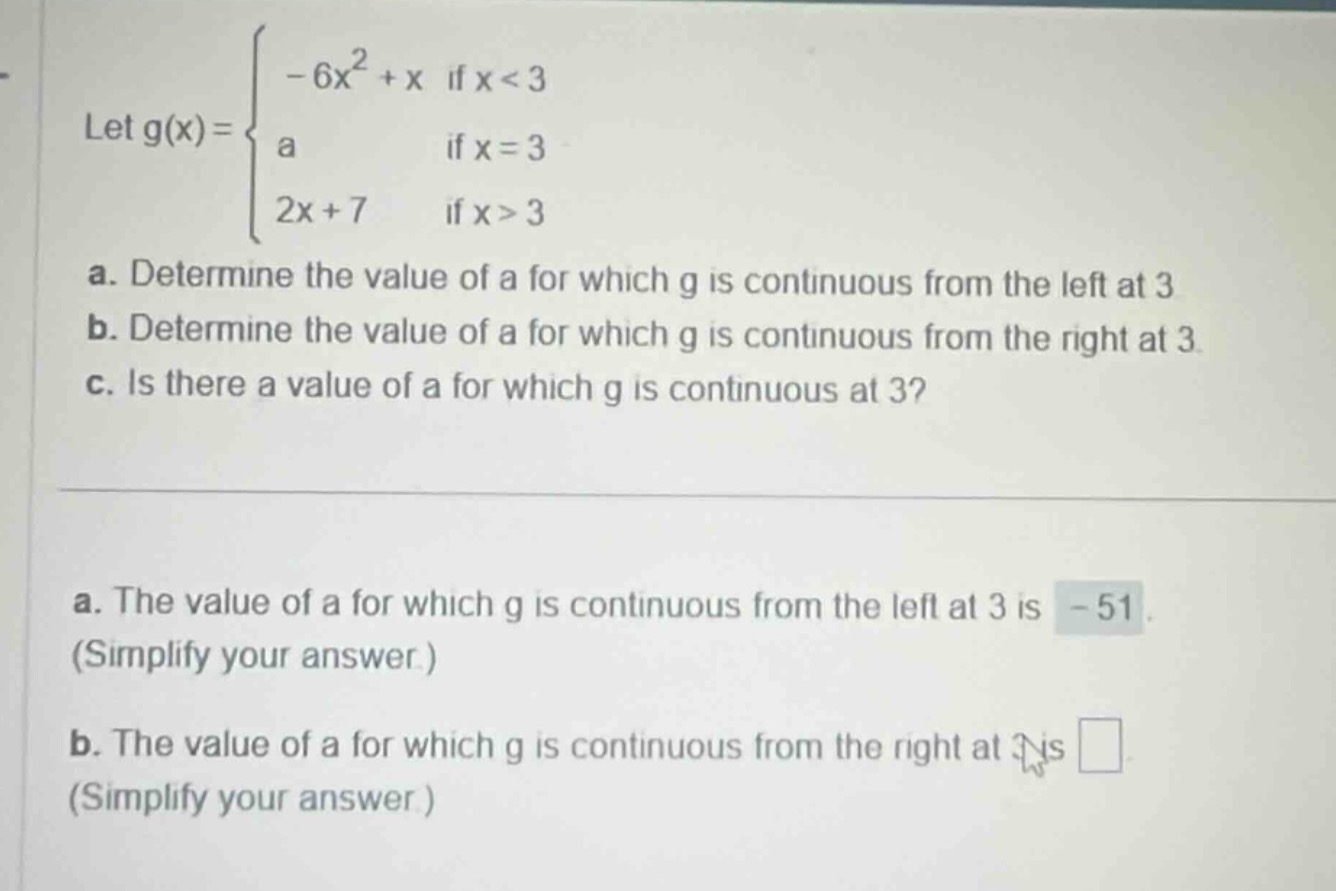
let $g(x)=\
$
a. determine the value of $a$ for which $g$ is continuous from the left at $3$
b. determine the value of $a$ for which $g$ is continuous from the right at $3$
c. is there a value of $a$ for which $g$ is continuous at $3$
a. the value of $a$ for which $g$ is continuous from the left at $3$ is $-51$.
(simplify your answer.)
b. the value of $a$ for which $g$ is continuous from the right at $3$ is $\square$
(simplify your answer.)
Part b
Step1: Recall right - continuity definition
A function \(y = g(x)\) is continuous from the right at \(x = c\) if \(\lim_{x
ightarrow c^{+}}g(x)=g(c)\).
For our function \(g(x)\), when \(x
ightarrow3^{+}\), we use the piece of the function \(g(x)=2x + 7\) (since \(x>3\) in this piece). And \(g(3)=a\).
Step2: Calculate \(\lim_{x
ightarrow3^{+}}g(x)\)
We calculate the limit \(\lim_{x
ightarrow3^{+}}(2x + 7)\). Using the direct substitution property of limits (since \(y = 2x+7\) is a polynomial function, and polynomial functions are continuous everywhere), we substitute \(x = 3\) into \(2x + 7\).
\(\lim_{x
ightarrow3^{+}}(2x + 7)=2\times3+7\)
First, calculate \(2\times3 = 6\), then \(6 + 7=13\).
Since for right - continuity \(\lim_{x
ightarrow3^{+}}g(x)=g(3)\), and \(\lim_{x
ightarrow3^{+}}g(x) = 13\) and \(g(3)=a\), we have \(a = 13\).
A function \(y = g(x)\) is continuous at \(x = c\) if \(\lim_{x
ightarrow c^{-}}g(x)=\lim_{x
ightarrow c^{+}}g(x)=g(c)\).
From part (a), we found that for left - continuity, \(a=- 51\) (since \(\lim_{x
ightarrow3^{-}}g(x)=-6(3)^{2}+3=-54 + 3=-51\) and \(g(3)=a\), so \(a=-51\) for left - continuity).
From part (b), we found that for right - continuity, \(a = 13\) (since \(\lim_{x
ightarrow3^{+}}g(x)=13\) and \(g(3)=a\), so \(a = 13\) for right - continuity).
Since \(-51
eq13\), there is no single value of \(a\) that can satisfy both \(\lim_{x
ightarrow3^{-}}g(x)=g(3)\) and \(\lim_{x
ightarrow3^{+}}g(x)=g(3)\) at the same time. So there is no value of \(a\) for which \(g\) is continuous at \(3\).

Snap & solve any problem in the app
Get step-by-step solutions on Sovi AI
Photo-based solutions with guided steps
Explore more problems and detailed explanations
13