QUESTION IMAGE
Question
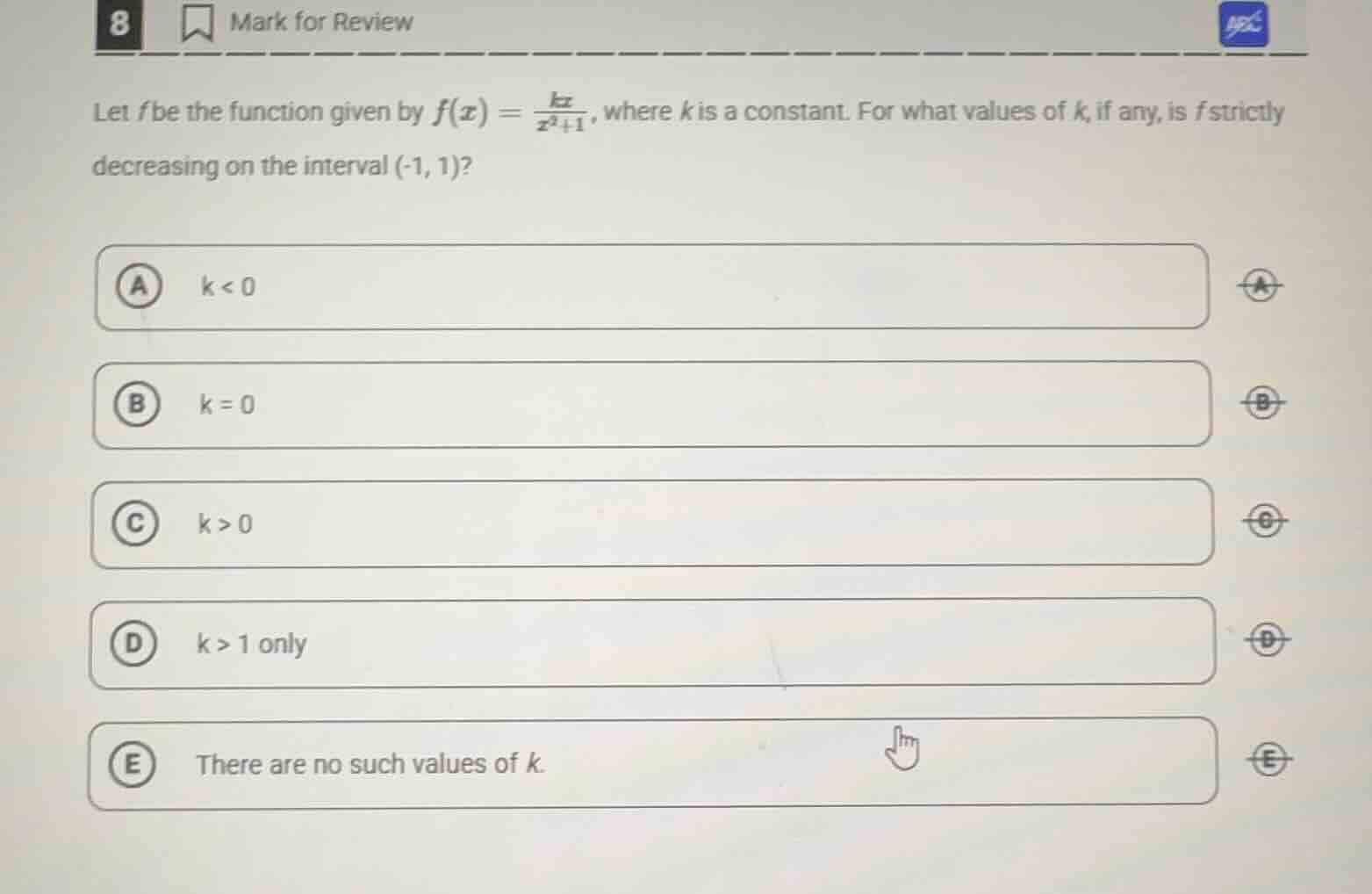
let f be the function given by $f(x) = \frac{kx}{x^2 + 1}$, where k is a constant. for what values of k, if any, is f strictly decreasing on the interval (-1, 1)?
a) $k < 0$
b) $k = 0$
c) $k > 0$
d) $k > 1$ only
e) there are no such values of k.
Step1: Find the derivative of \( f(x) \)
To determine where a function is strictly decreasing, we first find its derivative. We use the quotient rule: if \( f(x) = \frac{u}{v} \), then \( f'(x) = \frac{u'v - uv'}{v^2} \). Here, \( u = kx \) and \( v = x^2 + 1 \). So, \( u' = k \) and \( v' = 2x \). Then,
\[
f'(x) = \frac{k(x^2 + 1) - kx(2x)}{(x^2 + 1)^2} = \frac{kx^2 + k - 2kx^2}{(x^2 + 1)^2} = \frac{k - kx^2}{(x^2 + 1)^2} = \frac{k(1 - x^2)}{(x^2 + 1)^2}
\]
Step2: Analyze the sign of \( f'(x) \) on \( (-1, 1) \)
First, note that the denominator \( (x^2 + 1)^2 \) is always positive for all real \( x \) because \( x^2 + 1 \geq 1 > 0 \), so squaring it keeps it positive. Now, consider the numerator \( k(1 - x^2) \). On the interval \( (-1, 1) \), \( x^2 < 1 \), so \( 1 - x^2 > 0 \). So the sign of \( f'(x) \) is determined by the sign of \( k \). For \( f(x) \) to be strictly decreasing on \( (-1, 1) \), we need \( f'(x) < 0 \) for all \( x \in (-1, 1) \). Since \( 1 - x^2 > 0 \) and \( (x^2 + 1)^2 > 0 \) on \( (-1, 1) \), we need \( k(1 - x^2) < 0 \). Because \( 1 - x^2 > 0 \) on \( (-1, 1) \), this implies \( k < 0 \) (since a positive number times \( k \) is negative only if \( k \) is negative).

Snap & solve any problem in the app
Get step-by-step solutions on Sovi AI
Photo-based solutions with guided steps
Explore more problems and detailed explanations
A. \( k < 0 \)