QUESTION IMAGE
Question
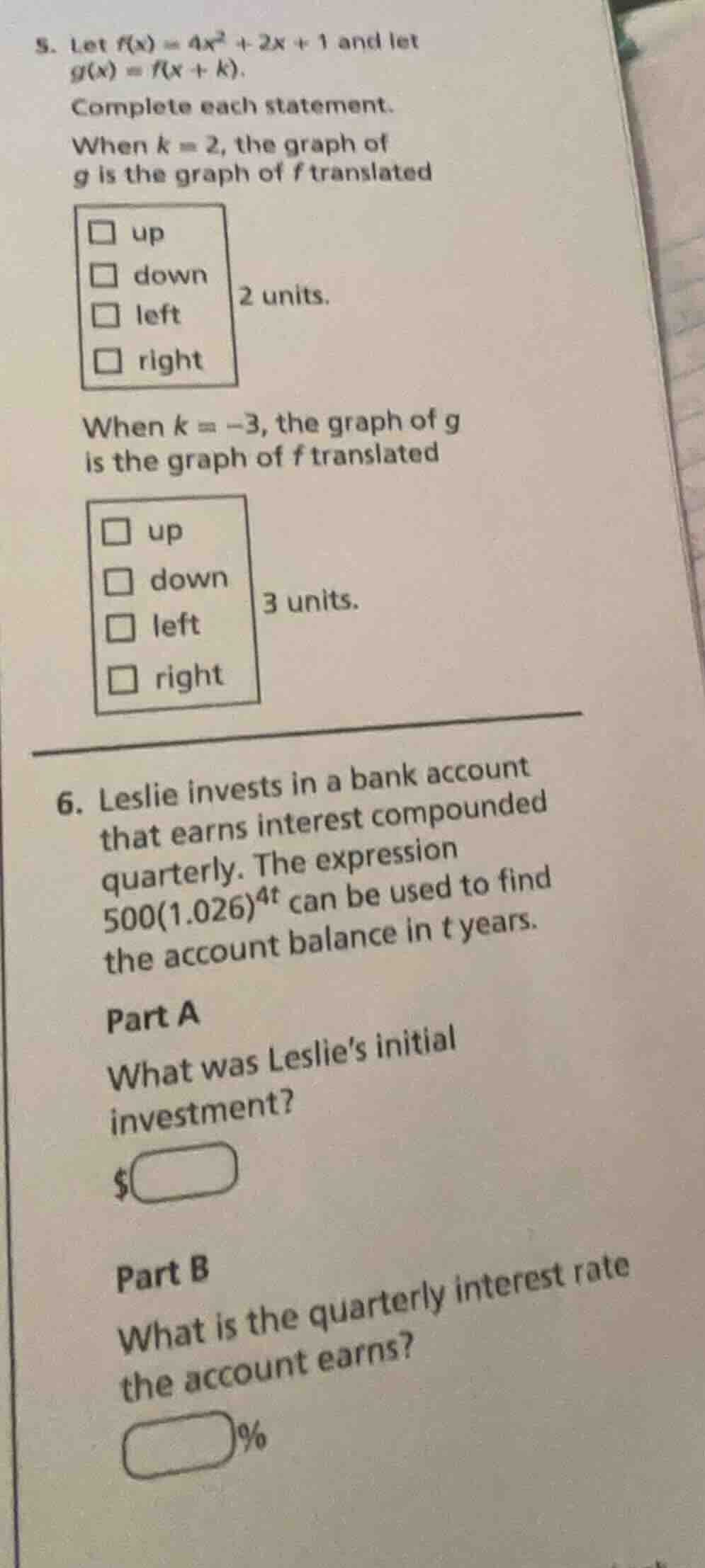
- let $f(x) = 4x^2 + 2x + 1$ and let $g(x) = f(x + k)$. complete each statement. when $k = 2$, the graph of $g$ is the graph of $f$ translated \
2 units. when $k = -3$, the graph of $g$ is the graph of $f$ translated \
3 units. 6. leslie invests in a bank account that earns interest compounded quarterly. the expression $500(1.026)^{4t}$ can be used to find the account balance in $t$ years. part a what was leslie’s initial investment? $\boxed{}$ part b what is the quarterly interest rate the account earns? $\boxed{}$%
---
Problem 5
Step1: Recall horizontal translation rule
For $g(x)=f(x+k)$, if $k>0$, shift left $k$ units; if $k<0$, shift right $|k|$ units.
Step2: Solve for $k=2$
Since $k=2>0$, graph shifts left 2 units.
Step3: Solve for $k=-3$
Since $k=-3<0$, graph shifts right 3 units.
Step1: Identify compound interest formula
The standard compound interest formula is $A=P(1+\frac{r}{n})^{nt}$, where $P$ = initial investment, $\frac{r}{n}$ = periodic rate.
Step2: Find initial investment (Part A)
Compare $500(1.026)^{4t}$ to the formula: $P=500$.
Step3: Find quarterly rate (Part B)
In $1+\frac{r}{n}=1.026$, the quarterly rate is $1.026-1=0.026$, or $2.6\%$.

Snap & solve any problem in the app
Get step-by-step solutions on Sovi AI
Photo-based solutions with guided steps
Explore more problems and detailed explanations
When $k=2$: left
When $k=-3$: right
---