QUESTION IMAGE
Question
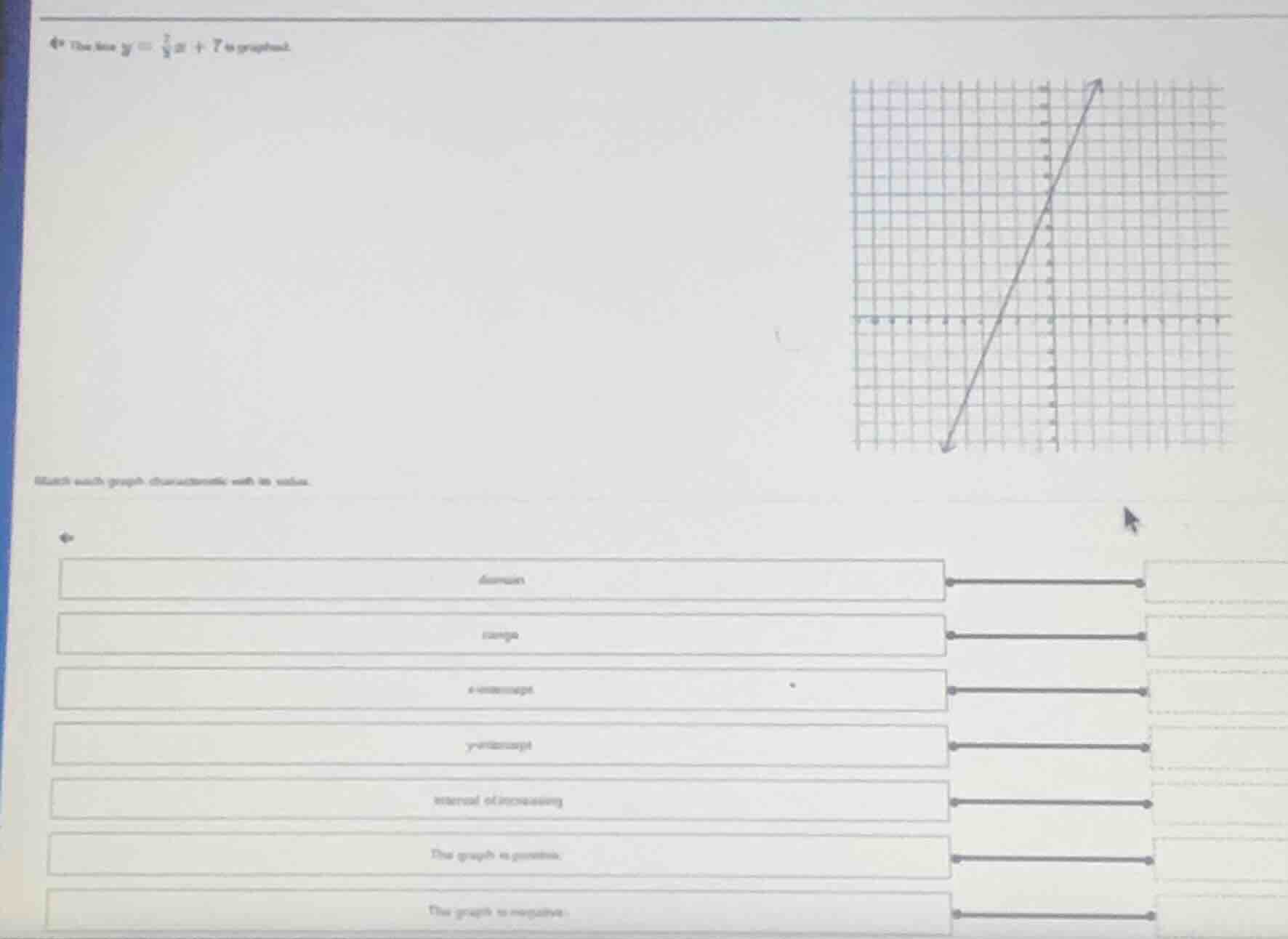
- the line ( y = \frac{2}{3}x + 7 ) is graphed.
match each graph characteristic with its value.
- domain
- range
- x - intercept
- y - intercept
- interval of increasing
- the graph is positive.
- the graph is negative.
Step1: Recall the slope - intercept form
The equation of a line in slope - intercept form is \(y = mx + b\), where \(m\) is the slope and \(b\) is the \(y\) - intercept. For the line \(y=\frac{2}{3}x + 7\), the slope \(m=\frac{2}{3}\) and the \(y\) - intercept \(b = 7\).
Step2: Find the \(x\) - intercept
To find the \(x\) - intercept, we set \(y = 0\) and solve for \(x\):
\[
\]
Step3: Determine the domain
For a linear function of the form \(y = mx + b\), the domain is all real numbers, \((-\infty,\infty)\), because there are no restrictions on the values that \(x\) can take.
Step4: Determine the range
Since the line is a straight line with a non - zero slope, as \(x\) takes on all real values, \(y\) will also take on all real values. So the range is \((-\infty,\infty)\).
Step5: Determine the interval of increasing
The slope \(m=\frac{2}{3}>0\). For a linear function \(y = mx + b\), if \(m>0\), the function is increasing for all real values of \(x\). So the interval of increasing is \((-\infty,\infty)\).
Step6: Determine where the graph is positive/negative
The graph is positive when \(y>0\), i.e., \(\frac{2}{3}x + 7>0\). Solving \(\frac{2}{3}x+7>0\) gives \(\frac{2}{3}x>-7\) or \(x>-\frac{21}{2}=- 10.5\). The graph is negative when \(y < 0\), i.e., \(\frac{2}{3}x + 7<0\) or \(x<-\frac{21}{2}=-10.5\).
Domain:
The domain of a linear function \(y=\frac{2}{3}x + 7\) is all real numbers. So domain: \((-\infty,\infty)\)
Range:
The range of a linear function with non - zero slope is all real numbers. So range: \((-\infty,\infty)\)
\(x\) - intercept:
We found when \(y = 0\), \(x=-\frac{21}{2}=-10.5\). So \(x\) - intercept: \(x =-\frac{21}{2}\) (or \(x=- 10.5\))
\(y\) - intercept:
From the equation \(y=\frac{2}{3}x + 7\), when \(x = 0\), \(y = 7\). So \(y\) - intercept: \(y = 7\)
Interval of increasing:
Since the slope \(m=\frac{2}{3}>0\), the function is increasing for all real \(x\). So interval of increasing: \((-\infty,\infty)\)
The graph is positive:
The graph is positive when \(x>-\frac{21}{2}\) (or \(x > - 10.5\))
The graph is negative:
The graph is negative when \(x<-\frac{21}{2}\) (or \(x < - 10.5\))

Snap & solve any problem in the app
Get step-by-step solutions on Sovi AI
Photo-based solutions with guided steps
Explore more problems and detailed explanations
- Domain: \(\boldsymbol{(-\infty,\infty)}\)
- Range: \(\boldsymbol{(-\infty,\infty)}\)
- \(x\) - intercept: \(\boldsymbol{x =-\frac{21}{2}}\) (or \(x=-10.5\))
- \(y\) - intercept: \(\boldsymbol{y = 7}\)
- Interval of increasing: \(\boldsymbol{(-\infty,\infty)}\)
- The graph is positive: \(\boldsymbol{x>-\frac{21}{2}}\) (or \(x > - 10.5\))
- The graph is negative: \(\boldsymbol{x<-\frac{21}{2}}\) (or \(x < - 10.5\))