QUESTION IMAGE
Question
linear & exponential functions exponential d
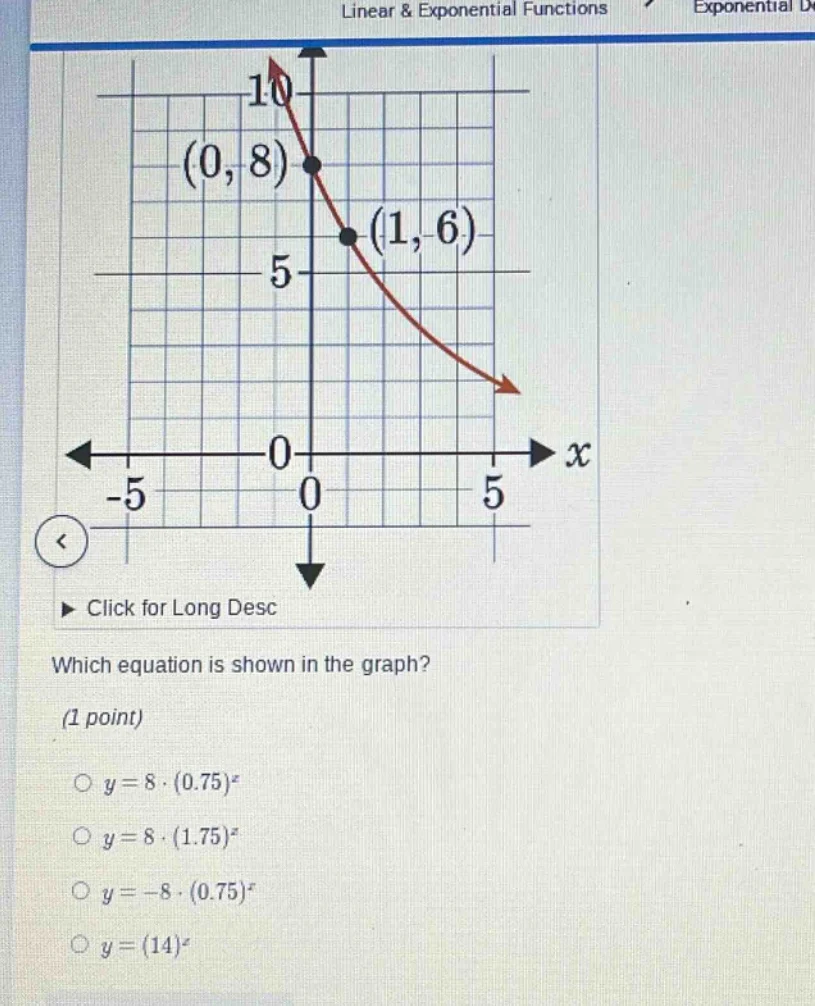
(0, 8)
(1, 6)
click for long desc
which equation is shown in the graph?
(1 point)
○ $y = 8 \cdot (0.75)^x$
○ $y = 8 \cdot (1.75)^x$
○ $y = -8 \cdot (0.75)^x$
○ $y = (14)^x$
Step1: Recall exponential function form
The general form of an exponential function is \( y = a \cdot b^x \), where \( a \) is the initial value (when \( x = 0 \)) and \( b \) is the base.
Step2: Find the initial value \( a \)
From the point \( (0, 8) \), when \( x = 0 \), \( y = 8 \). Substituting into \( y = a \cdot b^x \), we get \( 8 = a \cdot b^0 \). Since \( b^0 = 1 \), this simplifies to \( a = 8 \). So the function should have \( a = 8 \), eliminating the option \( y=-8\cdot(0.75)^x \) and \( y=(14)^x \).
Step3: Determine the base \( b \)
We have another point \( (1, 6) \). Substitute \( x = 1 \), \( y = 6 \), and \( a = 8 \) into \( y = a \cdot b^x \): \( 6 = 8 \cdot b^1 \). Solving for \( b \), we divide both sides by 8: \( b = \frac{6}{8} = 0.75 \).

Snap & solve any problem in the app
Get step-by-step solutions on Sovi AI
Photo-based solutions with guided steps
Explore more problems and detailed explanations
\( y = 8 \cdot (0.75)^x \) (the first option)