QUESTION IMAGE
Question
7 mark for review
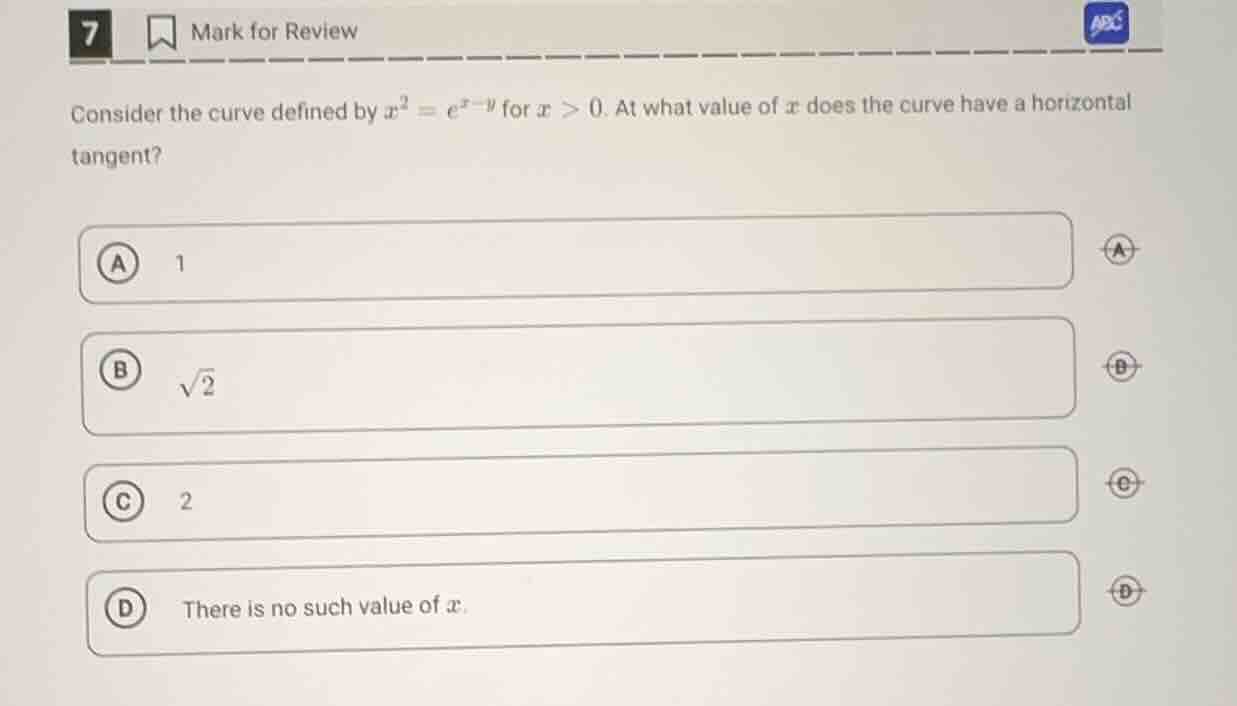
consider the curve defined by $x^2 = e^{x - y}$ for $x > 0$. at what value of $x$ does the curve have a horizontal tangent?
a 1
b $sqrt{2}$
c 2
d there is no such value of $x$.
Step1: Rewrite the equation to solve for y
Start with the given equation \( x^2 = e^{x - y} \). Take the natural logarithm of both sides: \( \ln(x^2) = \ln(e^{x - y}) \). Using logarithm properties, this simplifies to \( 2\ln(x) = x - y \) (since \( \ln(e^a)=a \) and \( \ln(x^n)=n\ln(x) \)). Then, solve for \( y \): \( y = x - 2\ln(x) \).
Step2: Find the derivative of y with respect to x
To find where the tangent is horizontal, we need to find where \( \frac{dy}{dx} = 0 \). Differentiate \( y = x - 2\ln(x) \) with respect to \( x \). The derivative of \( x \) with respect to \( x \) is \( 1 \), and the derivative of \( -2\ln(x) \) with respect to \( x \) is \( -\frac{2}{x} \). So, \( \frac{dy}{dx} = 1 - \frac{2}{x} \).
Step3: Set the derivative equal to zero and solve for x
Set \( \frac{dy}{dx} = 0 \): \( 1 - \frac{2}{x} = 0 \). Add \( \frac{2}{x} \) to both sides: \( 1 = \frac{2}{x} \). Then, multiply both sides by \( x \) (since \( x>0 \), we don't have to worry about division by zero or sign changes): \( x = 2 \).
We should also check if this value is valid in the original equation. Substitute \( x = 2 \) into the original equation \( x^2 = e^{x - y} \). From \( y = x - 2\ln(x) \), when \( x = 2 \), \( y = 2 - 2\ln(2) \). Then \( x^2 = 4 \), and \( e^{x - y} = e^{2 - (2 - 2\ln(2))} = e^{2\ln(2)} = (e^{\ln(2)})^2 = 2^2 = 4 \). So, it is valid.

Snap & solve any problem in the app
Get step-by-step solutions on Sovi AI
Photo-based solutions with guided steps
Explore more problems and detailed explanations
C. 2