QUESTION IMAGE
Question
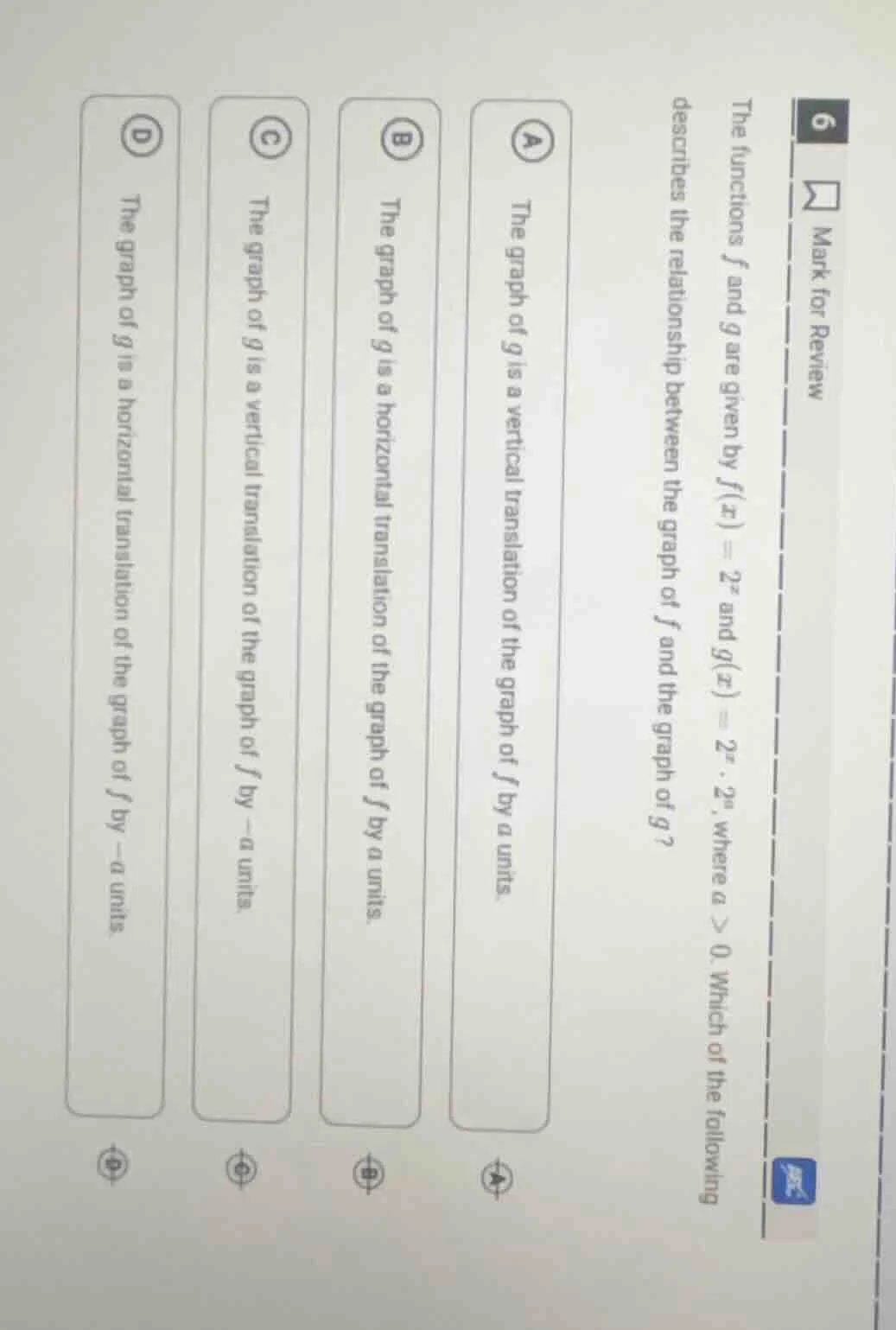
6 mark for review the functions ( f ) and ( g ) are given by ( f(x) = 2^x ) and ( g(x) = 2^x cdot 2^a ), where ( a > 0 ). which of the following describes the relationship between the graph of ( f ) and the graph of ( g )?
a the graph of ( g ) is a vertical translation of the graph of ( f ) by ( a ) units.
b the graph of ( g ) is a horizontal translation of the graph of ( f ) by ( a ) units.
c the graph of ( g ) is a vertical translation of the graph of ( f ) by ( -a ) units.
d the graph of ( g ) is a horizontal translation of the graph of ( f ) by ( -a ) units.
Step 1: Recall Exponent Rules
We know the exponent rule \(a^m \cdot a^n = a^{m + n}\). For \(g(x)=2^x\cdot2^a\), we can apply this rule.
So, \(g(x)=2^{x + a}\) (since \(2^x\cdot2^a = 2^{x + a}\) by the product rule of exponents \(a^m\times a^n=a^{m + n}\) where \(a = 2\), \(m=x\), \(n = a\)).
Step 2: Recall Horizontal Translation Rule
The transformation rule for a horizontal translation of a function \(y = f(x)\) is \(y=f(x - h)\), where \(h\) is the horizontal shift. If \(h>0\), the shift is to the right; if \(h<0\), the shift is to the left.
We have \(f(x)=2^x\) and \(g(x)=2^{x + a}=2^{x-(-a)}\). Comparing with \(y = f(x - h)\), here \(h=-a\). Since \(a>0\), \(-a<0\), which means the graph of \(g(x)\) is a horizontal translation of the graph of \(f(x)\) by \(-a\) units (or equivalently, a horizontal translation to the left by \(a\) units). Wait, no, wait. Wait, the standard form is \(y = f(x + k)=f(x-(-k))\), so if we have \(g(x)=f(x + a)\) (since \(f(x)=2^x\), \(f(x + a)=2^{x + a}\)), the horizontal translation rule: the function \(y = f(x + a)\) is a horizontal translation of \(y = f(x)\) by \(-a\) units (or a shift to the left by \(a\) units). But let's re - check the options. Wait, the options for horizontal translation: option D says "The graph of \(g\) is a horizontal translation of the graph of \(f\) by \(-a\) units". Let's verify again.
Wait, another way: Let's consider the general form of horizontal translation. If we have \(y = f(x)\) and \(y=f(x - h)\), then \(h\) is the horizontal shift. For \(g(x)=2^{x + a}=2^{x-(-a)}\), so \(h=-a\). So the graph of \(g\) is \(f(x - (-a))\), which is a horizontal translation of \(f(x)\) by \(-a\) units. So the graph of \(g\) is a horizontal translation of the graph of \(f\) by \(-a\) units.
Wait, but let's check the options:
Option A: Vertical translation (vertical translation is of the form \(y=f(x)+k\), which is not our case since we have a change in the exponent, not in the whole function's value added or subtracted).
Option B: Horizontal translation by \(a\) units. If \(g(x)\) were \(2^{x - a}\), then it would be a horizontal translation by \(a\) units to the right. But our \(g(x)=2^{x + a}\), so B is incorrect.
Option C: Vertical translation (vertical translation is \(y = f(x)+k\), but our transformation is in the exponent, so it's not vertical).
Option D: Horizontal translation by \(-a\) units. Since \(g(x)=2^{x + a}=f(x + a)\) (because \(f(x)=2^x\), so \(f(x + a)=2^{x + a}\)), and the horizontal translation of \(y = f(x)\) to \(y = f(x + a)\) is a horizontal translation by \(-a\) units (using the formula \(y=f(x - h)\), here \(h=-a\)). So the graph of \(g\) is a horizontal translation of the graph of \(f\) by \(-a\) units.

Snap & solve any problem in the app
Get step-by-step solutions on Sovi AI
Photo-based solutions with guided steps
Explore more problems and detailed explanations
D. The graph of \(g\) is a horizontal translation of the graph of \(f\) by \(-a\) units