QUESTION IMAGE
Question
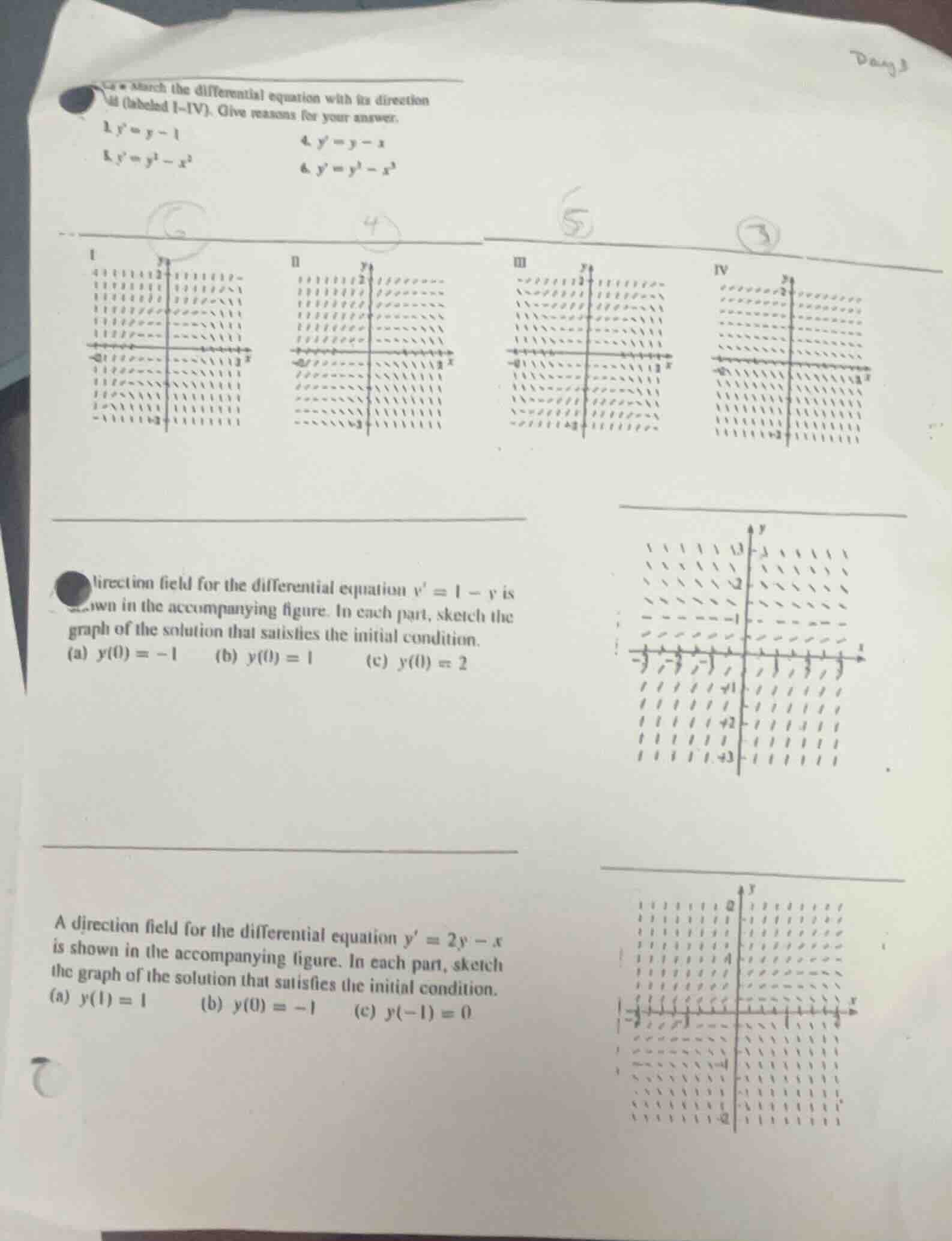
match the differential equation with its direction field (labeled i-iv). give reasons for your answer.
- $y = y - 1$
- $y = y^2 - x^2$
- $y = y - x$
- $y = y^3 - x^3$
i ii iii iv
direction field for the differential equation $y = 1 - y$ is shown in the accompanying figure. in each part, sketch the graph of the solution that satisfies the initial condition.
(a) $y(0) = -1$ (b) $y(0) = 1$ (c) $y(1) = 2$
a direction field for the differential equation $y = 2y - x$ is shown in the accompanying figure. in each part, sketch the graph of the solution that satisfies the initial condition.
(a) $y(1) = 1$ (b) $y(0) = -1$ (c) $y(-1) = 0$
Part 1: Match Differential Equations to Direction Fields
Step1: Analyze $y'=y-1$
Set $y'=0$: $y-1=0 \implies y=1$. This is a horizontal line where slopes are 0. Direction Field III has horizontal segments along $y=1$, so this matches III.
Step2: Analyze $y'=y^2-x^2$
Factor: $y'=(y-x)(y+x)$. Slopes are 0 when $y=x$ or $y=-x$. Direction Field I has 0 slopes along these two lines, so this matches I.
Step3: Analyze $y'=y-x$
Set $y'=0$: $y-x=0 \implies y=x$. This is a line where slopes are 0. Direction Field II has horizontal segments along $y=x$, so this matches II.
Step4: Analyze $y'=y^3-x^3$
Factor: $y'=(y-x)(y^2+xy+x^2)$. Slopes are 0 only when $y=x$ (since $y^2+xy+x^2>0$ for all real $x,y$ not both 0). Direction Field IV has 0 slopes only along $y=x$, so this matches IV.
Part 2: Sketch Solutions for $y'=1-y$
- (a) Start at $(0,-1)$, follow direction field: the solution is an increasing curve approaching $y=1$ as $x\to\infty$, decreasing as $x\to-\infty$.
- (b) Start at $(0,1)$: this is the equilibrium solution, so the graph is the horizontal line $y=1$.
- (c) Start at $(1,2)$, follow direction field: the solution is a decreasing curve approaching $y=1$ as $x\to\infty$, increasing as $x\to-\infty$.
Part 3: Sketch Solutions for $y'=2y-x$
- (a) Start at $(1,1)$, follow direction field: the solution is an increasing curve that grows as $x\to\infty$ and decreases as $x\to-\infty$.
- (b) Start at $(0,-1)$, follow direction field: the solution is a curve that decreases as $x\to-\infty$ and grows as $x\to\infty$, approaching the line $y=\frac{x}{2}+\frac{1}{4}$ (the equilibrium solution) asymptotically.
- (c) Start at $(-1,0)$, follow direction field: the solution is an increasing curve that grows as $x\to\infty$ and decreases as $x\to-\infty$.

Snap & solve any problem in the app
Get step-by-step solutions on Sovi AI
Photo-based solutions with guided steps
Explore more problems and detailed explanations
- Matching:
- $y'=y-1$ $
ightarrow$ III
- $y'=y^2-x^2$ $
ightarrow$ I
- $y'=y-x$ $
ightarrow$ II
- $y'=y^3-x^3$ $
ightarrow$ IV
- For $y'=1-y$:
- (a) Curve starting at $(0,-1)$, approaching $y=1$
- (b) Horizontal line $y=1$
- (c) Curve starting at $(1,2)$, approaching $y=1$
- For $y'=2y-x$:
- (a) Curve starting at $(1,1)$, growing as $x\to\infty$
- (b) Curve starting at $(0,-1)$, approaching $y=\frac{x}{2}+\frac{1}{4}$
- (c) Curve starting at $(-1,0)$, growing as $x\to\infty$