QUESTION IMAGE
Question
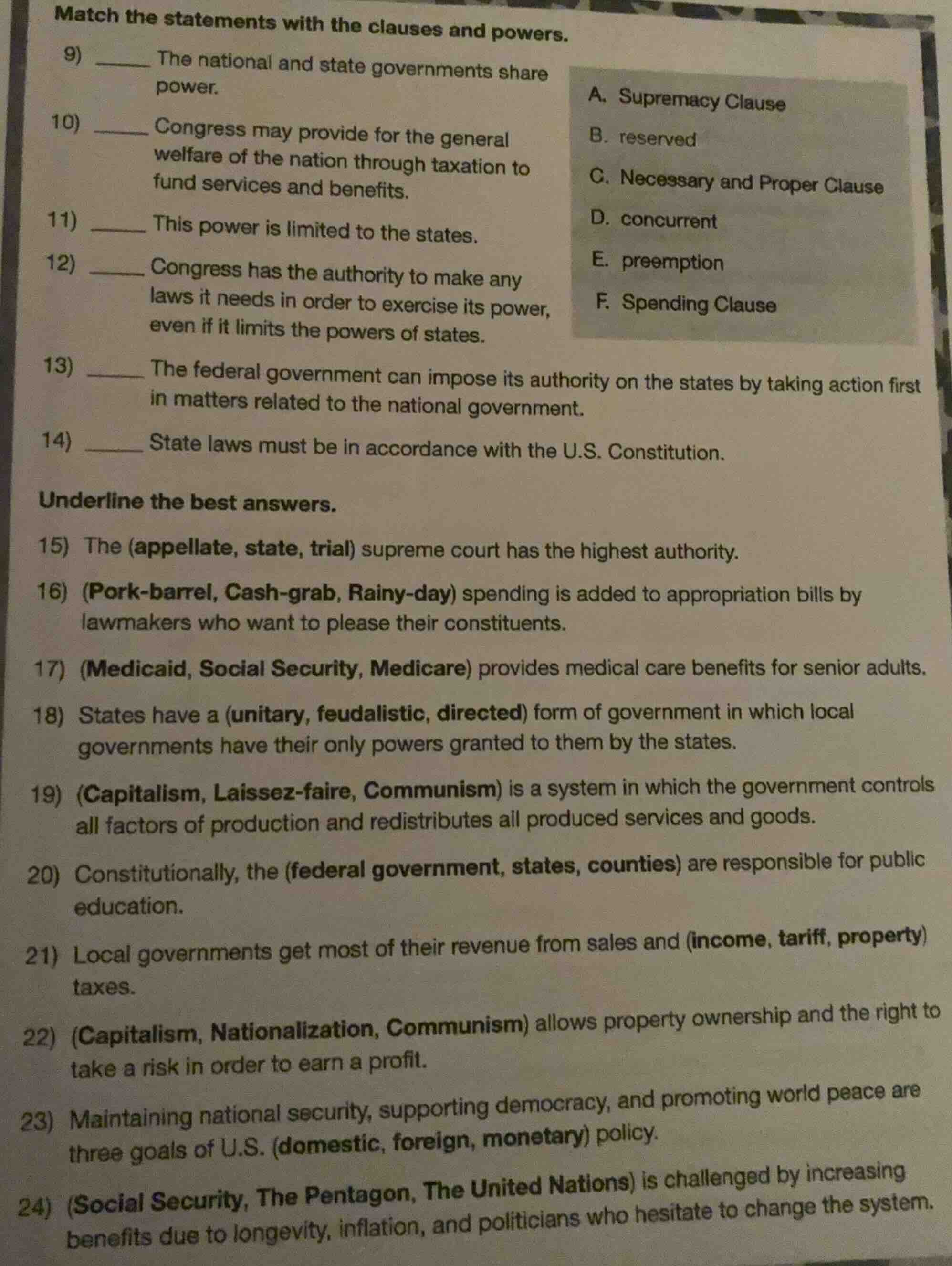
match the statements with the clauses and powers.
- ______ the national and state governments share power.
- ______ congress may provide for the general welfare of the nation through taxation to fund services and benefits.
- ______ this power is limited to the states.
- ______ congress has the authority to make any laws it needs in order to exercise its power, even if it limits the powers of states.
- ______ the federal government can impose its authority on the states by taking action first in matters related to the national government.
- ______ state laws must be in accordance with the u.s. constitution.
underline the best answers.
- the (appellate, state, trial) supreme court has the highest authority.
- (pork - barrel, cash - grab, rainy - day) spending is added to appropriation bills by lawmakers who want to please their constituents.
- (medicaid, social security, medicare) provides medical care benefits for senior adults.
- states have a (unitary, feudalistic, directed) form of government in which local governments have their only powers granted to them by the states.
- (capitalism, laissez - faire, communism) is a system in which the government controls all factors of production and redistributes all produced services and goods.
- constitutionally, the (federal government, states, counties) are responsible for public education.
- local governments get most of their revenue from sales and (income, tariff, property) taxes.
- (capitalism, nationalization, communism) allows property ownership and the right to take a risk in order to earn a profit.
- maintaining national security, supporting democracy, and promoting world peace are three goals of u.s. (domestic, foreign, monetary) policy.
- (social security, the pentagon, the united nations) is challenged by increasing benefits due to longevity, inflation, and politicians who hesitate to change the system.
a. supremacy clause
b. reserved
c. necessary and proper clause
d. concurrent
e. preemption
f. spending clause
Brief Explanations
For the matching section:
- Concurrent powers are shared by national and state governments.
- The Spending Clause allows Congress to tax for national welfare.
- Reserved powers are exclusive to state governments.
- The Necessary and Proper Clause lets Congress make laws to exercise its powers.
- Preemption lets the federal government act first to override state authority.
- The Supremacy Clause requires state laws to align with the U.S. Constitution.
For the underline section:
- State supreme courts hold the highest authority in state judicial systems.
- Pork-barrel spending is added to bills to benefit lawmakers' constituents.
- Medicare provides medical care for senior adults.
- U.S. states have a unitary government structure with local powers granted by the state.
- Communism is a system with full government control of production and distribution.
- Public education is constitutionally the responsibility of state governments.
- Local governments rely heavily on sales and property taxes for revenue.
- Capitalism allows private property ownership and profit-seeking through risk.
- National security, supporting democracy, and world peace are goals of U.S. foreign policy.
- Social Security faces challenges from increased longevity, inflation, and political inaction.

Snap & solve any problem in the app
Get step-by-step solutions on Sovi AI
Photo-based solutions with guided steps
Explore more problems and detailed explanations
Matching Section:
- D. concurrent
- F. Spending Clause
- B. reserved
- C. Necessary and Proper Clause
- E. preemption
- A. Supremacy Clause
Underline Section:
- The (appellate, state, trial) supreme court has the highest authority.
- (Pork-barrel, Cash-grab, Rainy-day) spending is added to appropriation bills by lawmakers who want to please their constituents.
- (Medicaid, Social Security, Medicare) provides medical care benefits for senior adults.
- States have a (unitary, feudalistic, directed) form of government in which local governments have their only powers granted to them by the states.
- (Capitalism, Laissez-faire, Communism) is a system in which the government controls all factors of production and redistributes all produced services and goods.
- Constitutionally, the (federal government, states, counties) are responsible for public education.
- Local governments get most of their revenue from sales and (income, tariff, property) taxes.
- (Capitalism, Nationalization, Communism) allows property ownership and the right to take a risk in order to earn a profit.
- Maintaining national security, supporting democracy, and promoting world peace are three goals of U.S. (domestic, foreign, monetary) policy.
- (Social Security, The Pentagon, The United Nations) is challenged by increasing benefits due to longevity, inflation, and politicians who hesitate to change the system.