QUESTION IMAGE
Question
math foundations 30 – unit 6 math lab
name: abubakar date: /43 =
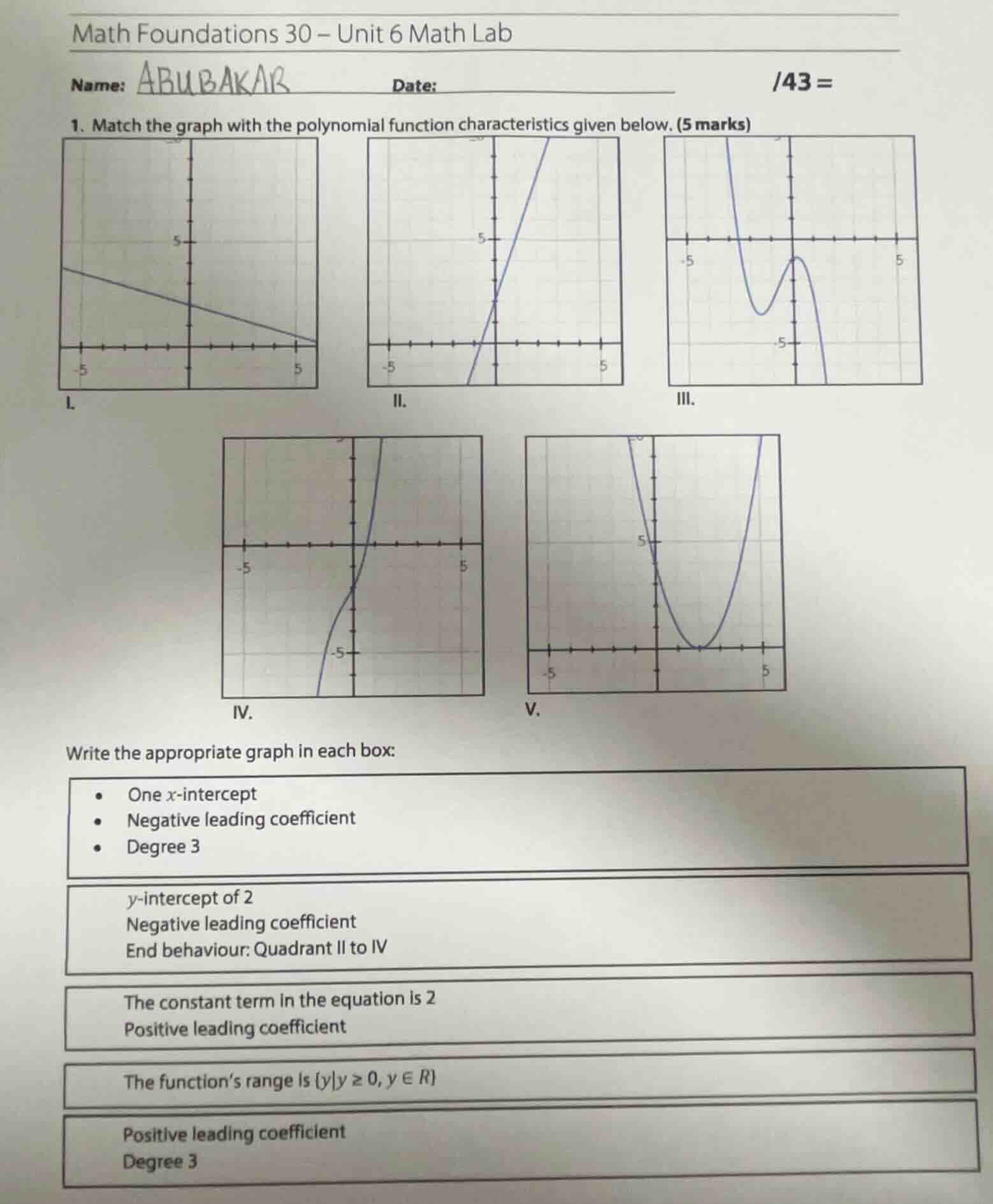
- match the graph with the polynomial function characteristics given below. (5 marks)
five graphs labeled i, ii, iii, iv, v
write the appropriate graph in each box:
- one ( x )-intercept, negative leading coefficient, degree 3
- ( y )-intercept of 2, negative leading coefficient, end behaviour: quadrant ii to iv
- the constant term in the equation is 2, positive leading coefficient
- the function’s range is ( {y|y geq 0, y in r} )
- positive leading coefficient, degree 3
First Box (One \( x \)-intercept, Negative leading coefficient, Degree 3)
Step 1: Analyze Degree 3 (Cubic)
A cubic function (\( \text{degree} = 3 \)) has a graph with end - behaviors that go in opposite directions (one end up, one end down) or both ends in the same direction depending on the leading coefficient. If the leading coefficient is negative, as \( x
ightarrow+\infty \), \( y
ightarrow-\infty \) and as \( x
ightarrow-\infty \), \( y
ightarrow+\infty \) (or vice - versa, but the key is opposite end - behaviors). Also, a cubic function can have 1, 2, or 3 \( x \)-intercepts. We are looking for a cubic with one \( x \)-intercept and negative leading coefficient.
Graph IV: It is a cubic - like graph (since it has the shape of a cubic with one \( x \)-intercept) and the leading coefficient is negative (as \( x
ightarrow+\infty \), \( y
ightarrow+\infty \)? Wait, no. Wait, let's re - check. Wait, for a cubic \( f(x)=ax^{3}+bx^{2}+cx + d \), if \( a<0 \), as \( x
ightarrow+\infty \), \( f(x)
ightarrow-\infty \) and as \( x
ightarrow-\infty \), \( f(x)
ightarrow+\infty \). Graph IV: Let's see the end - behavior. As \( x
ightarrow+\infty \), the graph goes up, as \( x
ightarrow-\infty \), it goes down? Wait, no. Wait, maybe I made a mistake. Wait, Graph IV: Let's check the \( x \)-intercept. It has one \( x \)-intercept. Let's check the other graphs. Graph III: It has two \( x \)-intercepts? No, three? Wait, no. Wait, the first box: one \( x \)-intercept, negative leading coefficient, degree 3. Graph IV: It is a cubic (degree 3) with one \( x \)-intercept and negative leading coefficient? Wait, no, maybe Graph IV is the one. Wait, let's move to the second box.
Second Box (\( y \)-intercept of 2, Negative leading coefficient, End behaviour: Quadrant II to IV)
Step 1: Analyze End - behavior (Quadrant II to IV)
A function with end - behavior from Quadrant II to IV has a negative leading coefficient and is a linear or even - degree function? Wait, no. Wait, a linear function \( y = mx + b \) with \( m<0 \) has a graph that goes from Quadrant II (when \( x<0 \), \( y>0 \)) to Quadrant IV (when \( x>0 \), \( y<0 \)). The \( y \)-intercept is \( b = 2 \). Graph I: It is a linear graph (a straight line) with \( y \)-intercept 2 (it crosses the \( y \)-axis at \( y = 2 \)) and a negative slope (so it goes from Quadrant II to Quadrant IV) and the leading coefficient (slope) is negative.
Third Box (The constant term in the equation is 2, Positive leading coefficient)
Step 1: Analyze the constant term and leading coefficient
The constant term of a polynomial \( f(x)=a_{n}x^{n}+a_{n - 1}x^{n - 1}+\cdots+a_{1}x + a_{0} \) is \( a_{0} \), which is the \( y \)-intercept (when \( x = 0 \), \( f(0)=a_{0} \)). So the \( y \)-intercept is 2. A positive leading coefficient means that for a polynomial, if it's a linear function, the slope is positive; if it's a quadratic, it opens upwards; if it's a cubic, as \( x
ightarrow+\infty \), \( y
ightarrow+\infty \) and as \( x
ightarrow-\infty \), \( y
ightarrow-\infty \). Graph II: It is a linear function with \( y \)-intercept 2 (since it crosses the \( y \)-axis at \( y = 2 \)) and positive leading coefficient (slope is positive), but wait, the second box has negative leading coefficient. Wait, no, the third box: constant term 2 (so \( y \)-intercept 2) and positive leading coefficient. Graph II: \( y \)-intercept is 2 (crosses \( y \)-axis at \( y = 2 \)) and positive leading coefficient (slope is positive).
Fourth Box (The function’s range is \( \{y|y\geq0,y\in R\} \))
###…

Snap & solve any problem in the app
Get step-by-step solutions on Sovi AI
Photo-based solutions with guided steps
Explore more problems and detailed explanations
- One \( x \)-intercept, Negative leading coefficient, Degree 3: \(\boldsymbol{\text{Graph IV}}\)
- \( y \)-intercept of 2, Negative leading coefficient, End behaviour: Quadrant II to IV: \(\boldsymbol{\text{Graph I}}\)
- The constant term in the equation is 2, Positive leading coefficient: \(\boldsymbol{\text{Graph II}}\)
- The function’s range is \( \{y|y\geq0,y\in R\} \): \(\boldsymbol{\text{Graph V}}\)
- Positive leading coefficient, Degree 3: \(\boldsymbol{\text{Graph III}}\)