QUESTION IMAGE
Question
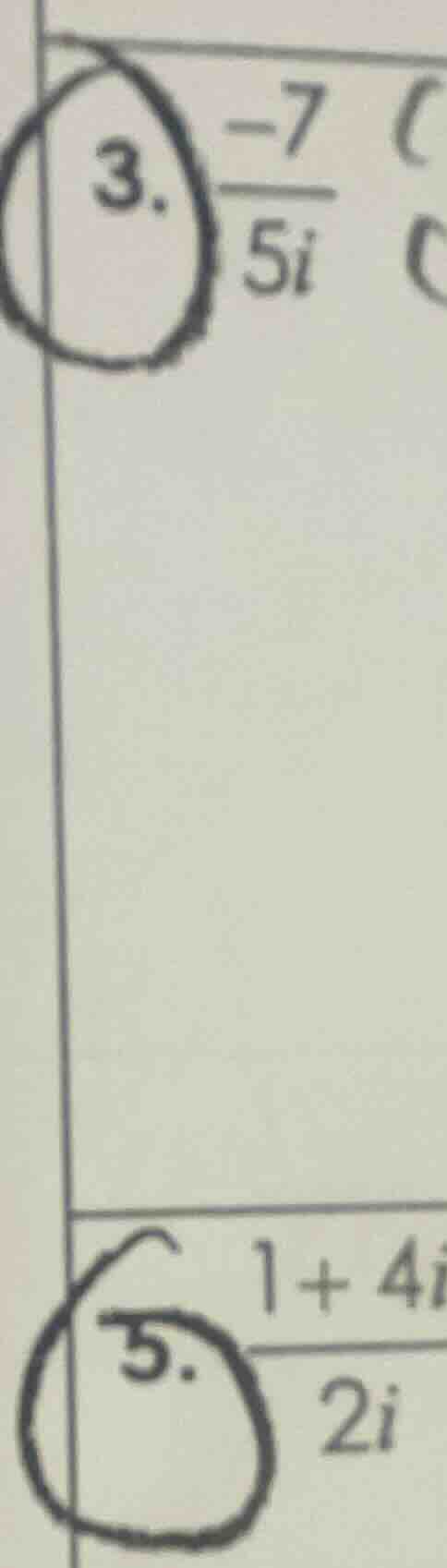
- \\(\frac{-7}{5i}\\) 5. \\(\frac{1 + 4i}{2i}\\)
To solve the problem of simplifying complex fractions involving imaginary numbers, we can use the method of multiplying the numerator and denominator by the conjugate of the denominator to eliminate the imaginary unit from the denominator. Let's take the first problem: \(\frac{-7}{5i}\)
Step 1: Multiply numerator and denominator by \(i\)
To eliminate \(i\) from the denominator, we multiply the numerator and denominator by \(i\) (since the conjugate of \(5i\) is \(-5i\), but multiplying by \(i\) also works here as \(i \times i = -1\)):
\[
\frac{-7}{5i} \times \frac{i}{i} = \frac{-7i}{5i^2}
\]
Step 2: Simplify \(i^2\)
Recall that \(i^2 = -1\), so substitute \(i^2\) with \(-1\):
\[
\frac{-7i}{5(-1)} = \frac{-7i}{-5} = \frac{7i}{5}
\]
Now let's take the second problem: \(\frac{1 + 4i}{2i}\)
Step 1: Multiply numerator and denominator by \(i\)
Multiply the numerator and denominator by \(i\) to eliminate \(i\) from the denominator:
\[
\frac{1 + 4i}{2i} \times \frac{i}{i} = \frac{(1 + 4i)i}{2i^2}
\]
Step 2: Distribute \(i\) in the numerator
Distribute \(i\) in the numerator:
\[
\frac{i + 4i^2}{2i^2}
\]
Step 3: Simplify \(i^2\)
Again, substitute \(i^2\) with \(-1\):
\[
\frac{i + 4(-1)}{2(-1)} = \frac{i - 4}{-2}
\]
Step 4: Separate the real and imaginary parts
Separate the real and imaginary parts in the numerator:
\[
\frac{-4 + i}{-2} = \frac{-4}{-2} + \frac{i}{-2} = 2 - \frac{i}{2}
\]
Final Answers
- \(\frac{-7}{5i} = \frac{7i}{5}\)
- \(\frac{1 + 4i}{2i} = 2 - \frac{i}{2}\)

Snap & solve any problem in the app
Get step-by-step solutions on Sovi AI
Photo-based solutions with guided steps
Explore more problems and detailed explanations
To solve the problem of simplifying complex fractions involving imaginary numbers, we can use the method of multiplying the numerator and denominator by the conjugate of the denominator to eliminate the imaginary unit from the denominator. Let's take the first problem: \(\frac{-7}{5i}\)
Step 1: Multiply numerator and denominator by \(i\)
To eliminate \(i\) from the denominator, we multiply the numerator and denominator by \(i\) (since the conjugate of \(5i\) is \(-5i\), but multiplying by \(i\) also works here as \(i \times i = -1\)):
\[
\frac{-7}{5i} \times \frac{i}{i} = \frac{-7i}{5i^2}
\]
Step 2: Simplify \(i^2\)
Recall that \(i^2 = -1\), so substitute \(i^2\) with \(-1\):
\[
\frac{-7i}{5(-1)} = \frac{-7i}{-5} = \frac{7i}{5}
\]
Now let's take the second problem: \(\frac{1 + 4i}{2i}\)
Step 1: Multiply numerator and denominator by \(i\)
Multiply the numerator and denominator by \(i\) to eliminate \(i\) from the denominator:
\[
\frac{1 + 4i}{2i} \times \frac{i}{i} = \frac{(1 + 4i)i}{2i^2}
\]
Step 2: Distribute \(i\) in the numerator
Distribute \(i\) in the numerator:
\[
\frac{i + 4i^2}{2i^2}
\]
Step 3: Simplify \(i^2\)
Again, substitute \(i^2\) with \(-1\):
\[
\frac{i + 4(-1)}{2(-1)} = \frac{i - 4}{-2}
\]
Step 4: Separate the real and imaginary parts
Separate the real and imaginary parts in the numerator:
\[
\frac{-4 + i}{-2} = \frac{-4}{-2} + \frac{i}{-2} = 2 - \frac{i}{2}
\]
Final Answers
- \(\frac{-7}{5i} = \frac{7i}{5}\)
- \(\frac{1 + 4i}{2i} = 2 - \frac{i}{2}\)