QUESTION IMAGE
Question
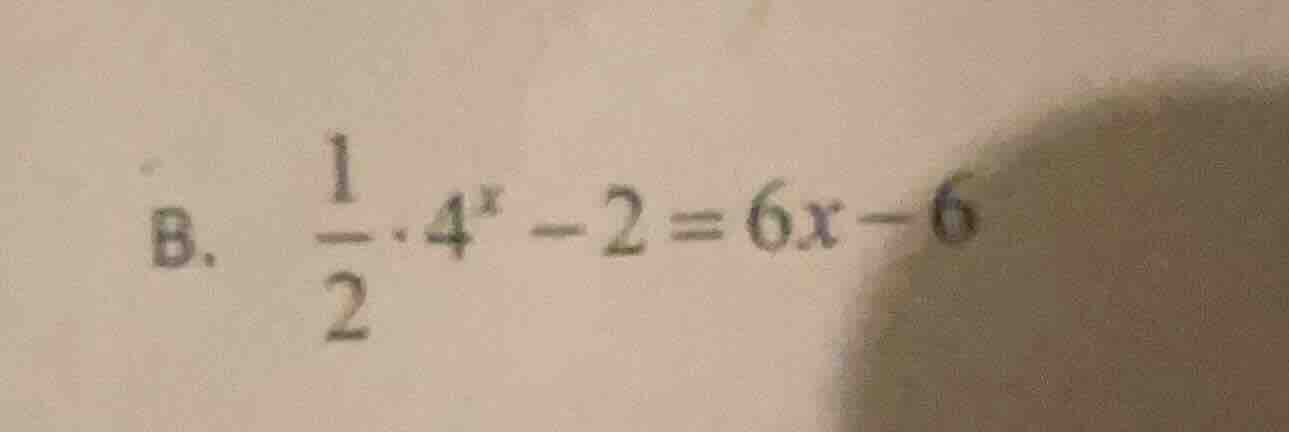
b. $\frac{1}{2} cdot 4^{x} - 2 = 6x - 6$
Step1: Simplify the exponential term
Note that $4^x = (2^2)^x = 2^{2x}$, so rewrite the equation:
$\frac{1}{2} \cdot 2^{2x} - 2 = 6x - 6$
Simplify $\frac{1}{2} \cdot 2^{2x}$ to $2^{2x-1}$:
$2^{2x-1} - 2 = 6x - 6$
Step2: Rearrange all terms to one side
Add 6 and subtract $6x$ from both sides to set the equation to zero:
$2^{2x-1} - 6x + 4 = 0$
Step3: Test integer values for $x$
Test $x=1$:
$2^{2(1)-1} - 6(1) + 4 = 2^1 - 6 + 4 = 2 - 2 = 0$
Test $x=2$:
$2^{2(2)-1} - 6(2) + 4 = 2^3 - 12 + 4 = 8 - 8 = 0$
Step4: Verify no other real roots
The function $f(x)=2^{2x-1}-6x+4$ has a positive second derivative (the exponential term grows faster than linear), so it is convex. A convex function can have at most 2 real roots, which we found as $x=1$ and $x=2$.

Snap & solve any problem in the app
Get step-by-step solutions on Sovi AI
Photo-based solutions with guided steps
Explore more problems and detailed explanations
$x=1$ and $x=2$