QUESTION IMAGE
Question
graph
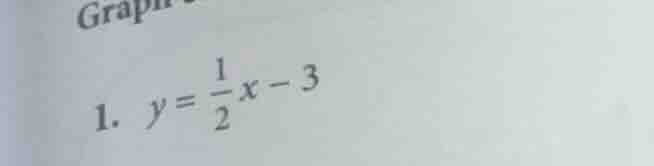
- $y = \frac{1}{2}x - 3$
To graph the linear equation \( y = \frac{1}{2}x - 3 \), we can use the slope - intercept form of a linear equation \( y=mx + b \), where \( m \) is the slope and \( b \) is the y - intercept.
Step 1: Identify the y - intercept
In the equation \( y=\frac{1}{2}x - 3 \), comparing with \( y = mx + b \), we have \( b=- 3 \). The y - intercept is the point where the line crosses the y - axis. So, when \( x = 0 \), \( y=-3 \). We can plot the point \( (0,-3) \) on the coordinate plane.
Step 2: Identify the slope
The slope \( m=\frac{1}{2} \). The slope is defined as \( m=\frac{\text{rise}}{\text{run}} \), which means for every 2 units we move to the right (run = 2) along the x - axis, we move up 1 unit (rise = 1) along the y - axis.
Starting from the point \( (0,-3) \), we can find another point on the line. Since the run is 2 and the rise is 1, we move 2 units to the right (from \( x = 0 \) to \( x=0 + 2=2 \)) and 1 unit up (from \( y=-3 \) to \( y=-3 + 1=-2 \)). So, the point \( (2,-2) \) is also on the line. We can plot this point as well.
Step 3: Draw the line
After plotting the two points \( (0,-3) \) and \( (2,-2) \) (we can find more points if needed by repeating the process of using the slope), we can draw a straight line passing through these points. This line represents the graph of the equation \( y=\frac{1}{2}x-3 \).
If we want to check using the x - intercept (the point where the line crosses the x - axis, i.e., when \( y = 0 \)):
Set \( y = 0 \) in the equation \( y=\frac{1}{2}x-3 \).
\[
\]
So, the x - intercept is \( (6,0) \), and we can also use this point \( (6,0) \) to verify our graph.
The graph of \( y=\frac{1}{2}x - 3 \) is a straight line with a y - intercept at \( (0,-3) \), an x - intercept at \( (6,0) \), and a slope of \( \frac{1}{2} \).

Snap & solve any problem in the app
Get step-by-step solutions on Sovi AI
Photo-based solutions with guided steps
Explore more problems and detailed explanations
To graph the linear equation \( y = \frac{1}{2}x - 3 \), we can use the slope - intercept form of a linear equation \( y=mx + b \), where \( m \) is the slope and \( b \) is the y - intercept.
Step 1: Identify the y - intercept
In the equation \( y=\frac{1}{2}x - 3 \), comparing with \( y = mx + b \), we have \( b=- 3 \). The y - intercept is the point where the line crosses the y - axis. So, when \( x = 0 \), \( y=-3 \). We can plot the point \( (0,-3) \) on the coordinate plane.
Step 2: Identify the slope
The slope \( m=\frac{1}{2} \). The slope is defined as \( m=\frac{\text{rise}}{\text{run}} \), which means for every 2 units we move to the right (run = 2) along the x - axis, we move up 1 unit (rise = 1) along the y - axis.
Starting from the point \( (0,-3) \), we can find another point on the line. Since the run is 2 and the rise is 1, we move 2 units to the right (from \( x = 0 \) to \( x=0 + 2=2 \)) and 1 unit up (from \( y=-3 \) to \( y=-3 + 1=-2 \)). So, the point \( (2,-2) \) is also on the line. We can plot this point as well.
Step 3: Draw the line
After plotting the two points \( (0,-3) \) and \( (2,-2) \) (we can find more points if needed by repeating the process of using the slope), we can draw a straight line passing through these points. This line represents the graph of the equation \( y=\frac{1}{2}x-3 \).
If we want to check using the x - intercept (the point where the line crosses the x - axis, i.e., when \( y = 0 \)):
Set \( y = 0 \) in the equation \( y=\frac{1}{2}x-3 \).
\[
\]
So, the x - intercept is \( (6,0) \), and we can also use this point \( (6,0) \) to verify our graph.
The graph of \( y=\frac{1}{2}x - 3 \) is a straight line with a y - intercept at \( (0,-3) \), an x - intercept at \( (6,0) \), and a slope of \( \frac{1}{2} \).