QUESTION IMAGE
Question
y = -(x - 1)^3
Step1: Analyze the function \( y = -(x - 1)^3 \)
The parent function is \( y = x^3 \), which has a cubic curve passing through the origin with a point of inflection at \( (0,0) \), increasing for all \( x \). The given function \( y = -(x - 1)^3 \) is a transformation of the parent function. The negative sign reflects the graph over the \( x \)-axis, and the \( (x - 1) \) shifts the graph 1 unit to the right.
Step2: Check the key points
- For the parent function \( y = x^3 \), when \( x = 0 \), \( y = 0 \); when \( x = 1 \), \( y = 1 \); when \( x = 2 \), \( y = 8 \); when \( x=-1 \), \( y=-1 \).
- For \( y = -(x - 1)^3 \):
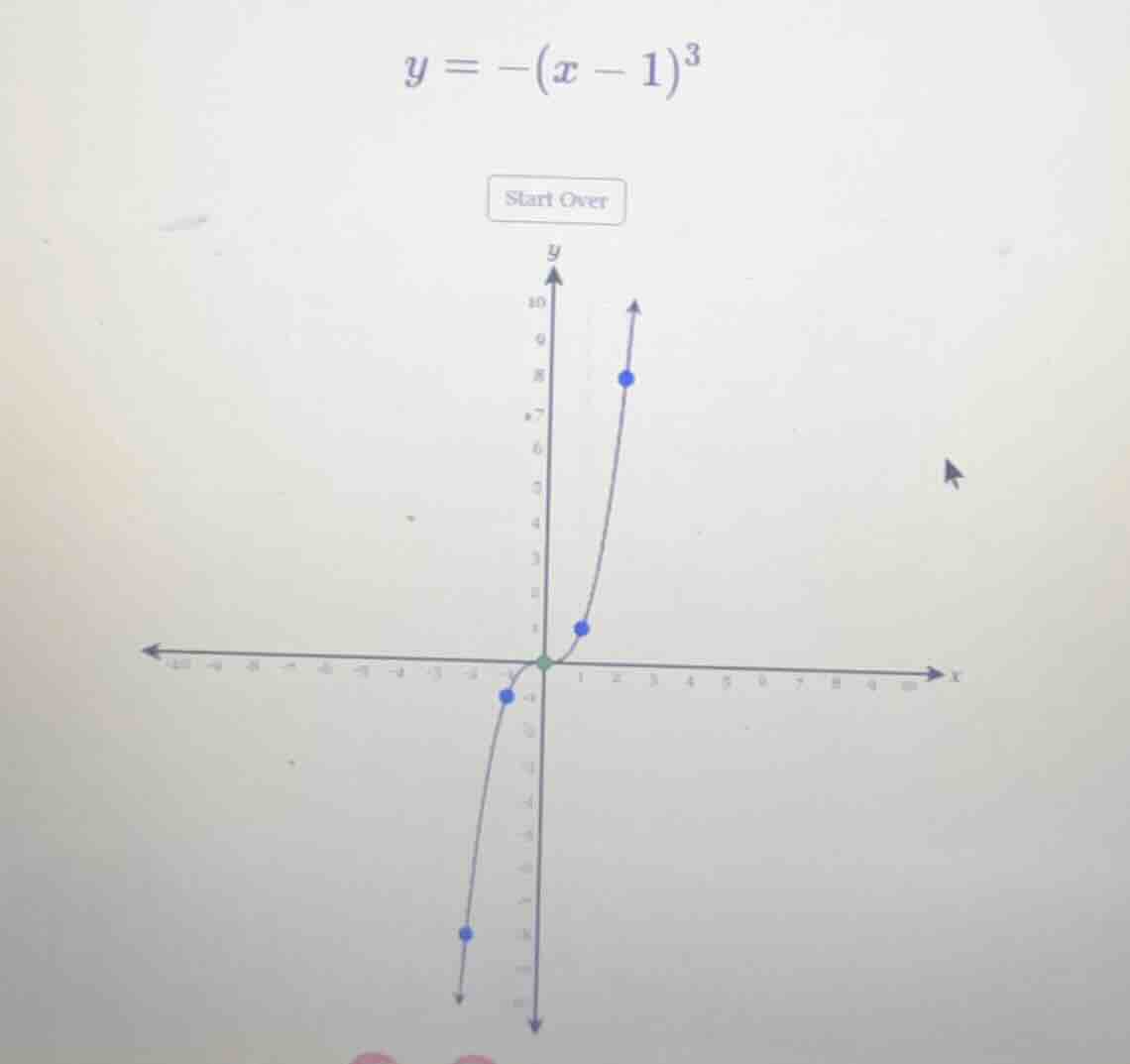
- When \( x = 1 \), \( y = -(1 - 1)^3 = 0 \) (so the point \( (1,0) \) should be on the graph, which matches the green dot at the origin? Wait, no, the green dot is at \( (0,0) \), which is incorrect for \( y = -(x - 1)^3 \). Wait, maybe the graph shown is not of \( y = -(x - 1)^3 \). Wait, let's recalculate:
Wait, if the function is \( y = -(x - 1)^3 \), let's find some points:
- When \( x = 1 \), \( y = 0 \)
- When \( x = 2 \), \( y = -(2 - 1)^3 = -1 \)
- When \( x = 0 \), \( y = -(0 - 1)^3 = -(-1)^3 = 1 \)
- When \( x=-1 \), \( y = -(-1 - 1)^3 = -(-2)^3 = 8 \)
But the graph shown has a point at \( (2,8) \), \( (1,1) \)? Wait, no, the blue dot at \( x = 2 \) has \( y = 8 \), at \( x = 1 \) has \( y = 1 \), at \( x=-1 \) has \( y=-8 \)? Wait, maybe the function is \( y=(x - 1)^3 \) instead of \( y = -(x - 1)^3 \). Let's check \( y=(x - 1)^3 \):
- When \( x = 1 \), \( y = 0 \)
- When \( x = 2 \), \( y = (2 - 1)^3 = 1 \)? No, \( (2 - 1)^3 = 1 \), but the blue dot at \( x = 2 \) is at \( y = 8 \). Wait, \( y=(x - 1)^3 \) when \( x = 3 \), \( y=(3 - 1)^3 = 8 \). Oh! Maybe the function is \( y=(x - 1)^3 \) (without the negative sign). Let's re - evaluate:
If the function is \( y=(x - 1)^3 \):
- When \( x = 1 \), \( y = 0 \)
- When \( x = 2 \), \( y=(2 - 1)^3 = 1 \)? No, the blue dot at \( x = 2 \) is at \( y = 8 \), so \( x = 3 \) would give \( y=(3 - 1)^3 = 8 \). So \( x = 3 \), \( y = 8 \).
Wait, maybe the function is \( y = x^3 \) shifted? Wait, the graph shown has a point at \( (2,8) \), which is \( 2^3 = 8 \), so \( y = x^3 \) has \( (2,8) \), \( (1,1) \), \( (0,0) \), \( (-1,-1) \). But the function given is \( y = -(x - 1)^3 \), which should have:
At \( x = 0 \), \( y = 1 \); \( x = 1 \), \( y = 0 \); \( x = 2 \), \( y=-1 \); \( x=-1 \), \( y = 8 \).
But the graph shown has a point at \( (2,8) \) (which would be \( x=-1 \) for \( y = -(x - 1)^3 \), since \( x=-1 \) gives \( y = 8 \)), a point at \( (1,1) \) (which is \( x = 0 \) for \( y = -(x - 1)^3 \), since \( x = 0 \) gives \( y = 1 \)), and a point at \( (-1,-8) \) (which is \( x = 2 \) for \( y = -(x - 1)^3 \), since \( x = 2 \) gives \( y=-1 \)). So there is a misalignment between the given function \( y = -(x - 1)^3 \) and the graph shown.
Assuming the question is to identify the error or analyze the graph:
Wait, maybe the function is supposed to be \( y=(x + 1)^3 \) or another function. Alternatively, if we consider the graph shown, it looks like \( y = x^3 \) (passing through \( (0,0) \), \( (1,1) \), \( (2,8) \), \( (-1,-1) \)), but the given function is \( y = -(x - 1)^3 \), which is different.
Wait, perhaps the task is to graph \( y = -(x - 1)^3 \) correctly. Let's list the correct points:
- \( x = 1 \), \( y = 0 \)
- \( x = 2 \), \( y=-1 \)
- \( x = 0 \), \( y = 1 \)
- \( x=-1 \), \( y = 8 \)
So the correct graph should have a point at \( (1,0) \), \( (2,-1) \), \( (0,1) \), \( (-1,8) \), with a cubic curve decreasing for all \(…

Snap & solve any problem in the app
Get step-by-step solutions on Sovi AI
Photo-based solutions with guided steps
Explore more problems and detailed explanations
The graph shown does not match the function \( y = -(x - 1)^3 \). The correct key points for \( y = -(x - 1)^3 \) are: when \( x = 1 \), \( y = 0 \); \( x = 2 \), \( y=-1 \); \( x = 0 \), \( y = 1 \); \( x=-1 \), \( y = 8 \), with a decreasing cubic curve (reflected over \( x \)-axis and shifted right 1 unit from \( y = x^3 \)).