QUESTION IMAGE
Question
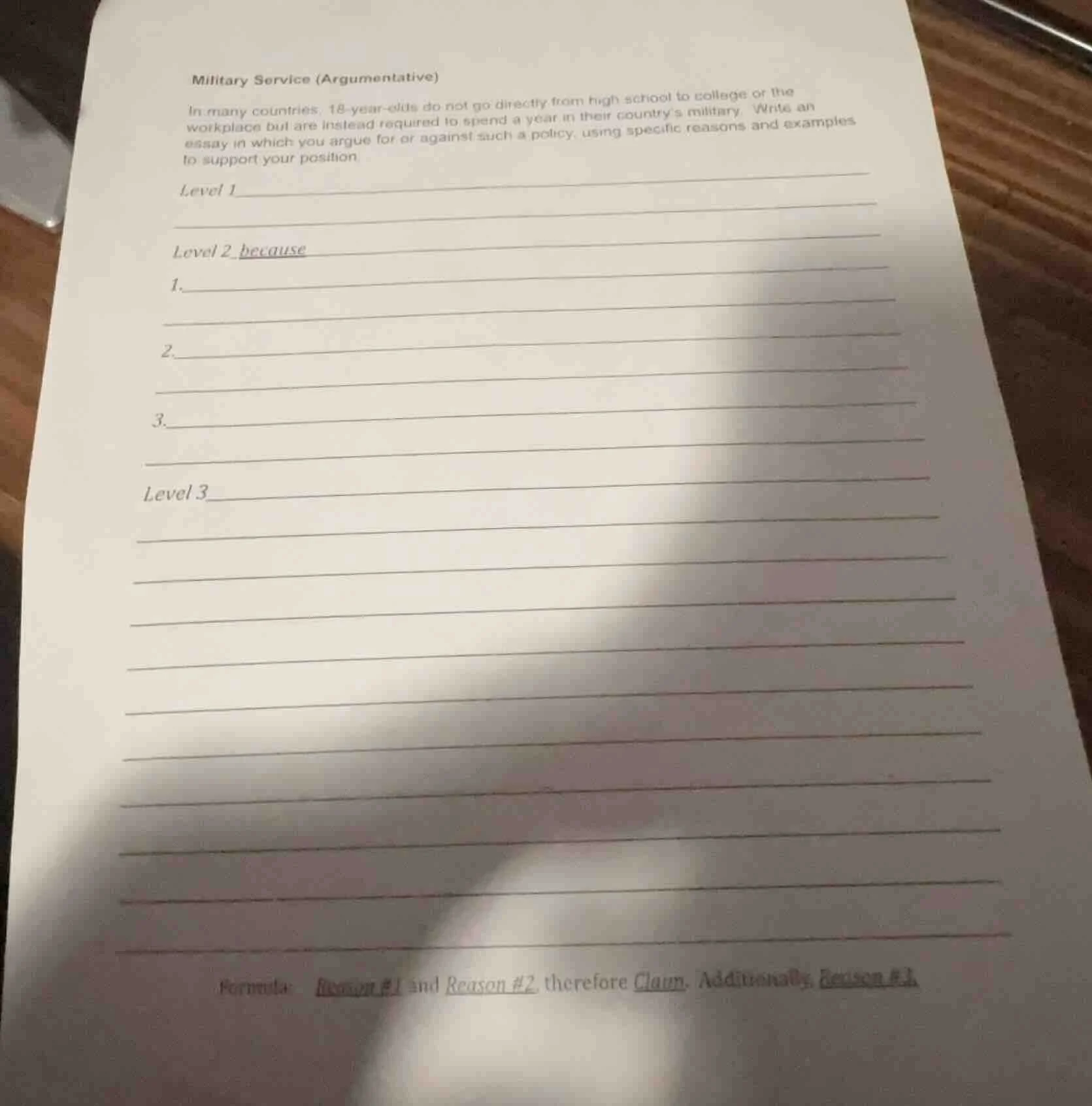
military service (argumentative)
in many countries, 18 - year - olds do not go directly from high school to college or the workplace but are instead required to spend a year in their countrys military. write an essay in which you argue for or against such a policy, using specific reasons and examples to support your position.
level 1
level 2 because
1.
2.
3.
level 3
formula: reason #1 and reason #2, therefore claim. additionally, reason #3
This is an outline for an argumentative essay opposing mandatory 1-year military service for 18-year-olds. Level 1 is the core claim, Level 2 lists supporting reasons, and Level 3 expands each reason with specific examples, following the given formula.

Snap & solve any problem in the app
Get step-by-step solutions on Sovi AI
Photo-based solutions with guided steps
Explore more problems and detailed explanations
Level 1: Mandatory 1-year military service for 18-year-olds should be abolished
Level 2 because
- It disrupts academic and career trajectories
- It imposes unnecessary mental health risks
- It ignores individual aptitude and personal goals
Level 3
- For example, a student accepted into a competitive engineering program would lose a year of progress, requiring them to catch up on coursework or delay graduation. This gap can also make it harder for them to secure internships or entry-level roles that prioritize continuous academic or professional experience, as seen in countries like South Korea where many young professionals report career setbacks due to mandatory service.
- Studies from the U.S. Department of Veterans Affairs show that young adults (18-20) are 30% more likely to develop PTSD after exposure to military training and deployment than older service members. In Israel, which has mandatory service, 1 in 5 young conscripts report symptoms of anxiety or depression following their service that interfere with post-military life.
- A young person pursuing a career in the arts or healthcare may not benefit from military training, and the year spent in service could prevent them from completing critical internships or certifications. For instance, a pre-med student would delay medical school entry, extending the time it takes to become a practicing doctor, which harms both their personal career goals and public access to healthcare providers.