QUESTION IMAGE
Question
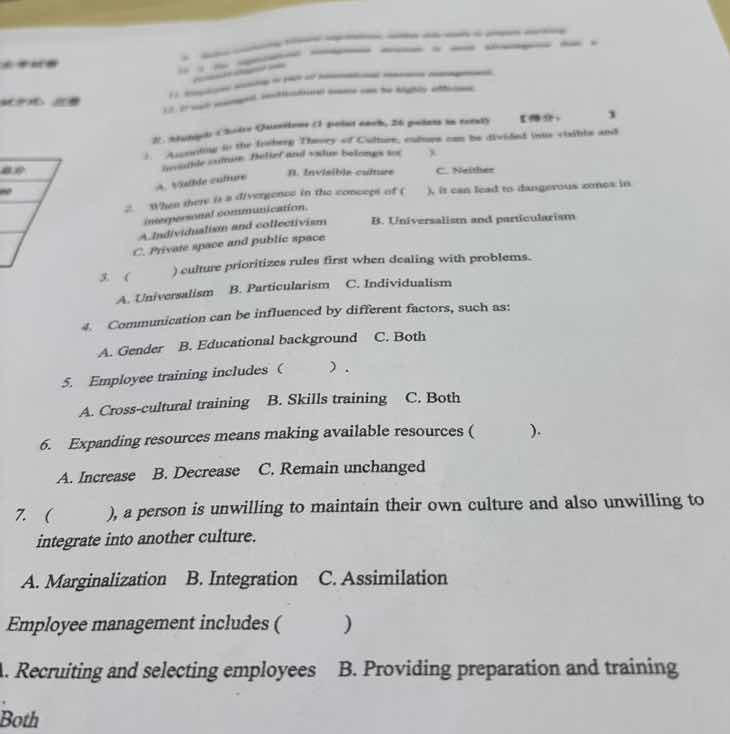
- multiple choice questions (3 points each, 24 points in total)【得分:】
- according to the iceberg theory of culture, culture can be divided into visible and invisible culture. belief and value belongs to ( ).
a. visible culture
b. invisible culture
c. neither
- when there is a divergence in the concept of ( ), it can lead to dangerous omens in interpersonal communication.
a. individualism and collectivism
b. universalism and particularism
c. private space and public space
- ( ) culture prioritizes rules first when dealing with problems.
a. universalism
b. particularism
c. individualism
- communication can be influenced by different factors, such as:
a. gender
b. educational background
c. both
- employee training includes ( ).
a. cross - cultural training
b. skills training
c. both
- expanding resources means making available resources ( ).
a. increase
b. decrease
c. remain unchanged
- ( ), a person is unwilling to maintain their own culture and also unwilling to integrate into another culture.
a. marginalization
b. integration
c. assimilation
employee management includes ( )
a. recruiting and selecting employees
b. providing preparation and training
c. both
Question 1
In the Iceberg Theory of Culture, invisible culture includes beliefs and values (while visible culture includes things like behaviors, artifacts). So belief and value belong to invisible culture.
The concepts of individualism and collectivism deal with how people prioritize self vs. group. A divergence in these can lead to dangerous conflicts in interpersonal communication. Universalism/particularism is about rules vs. relationships, private/public space is about spatial norms, not directly about interpersonal conflict drivers like individualism - collectivism.
Universalism culture prioritizes rules (like laws, formal procedures) when dealing with problems. Particularism prioritizes relationships/context, individualism is about self - interest, not rule - prioritization.

Snap & solve any problem in the app
Get step-by-step solutions on Sovi AI
Photo-based solutions with guided steps
Explore more problems and detailed explanations
B. Invisible culture