QUESTION IMAGE
Question
no calculator is allowed on this question.
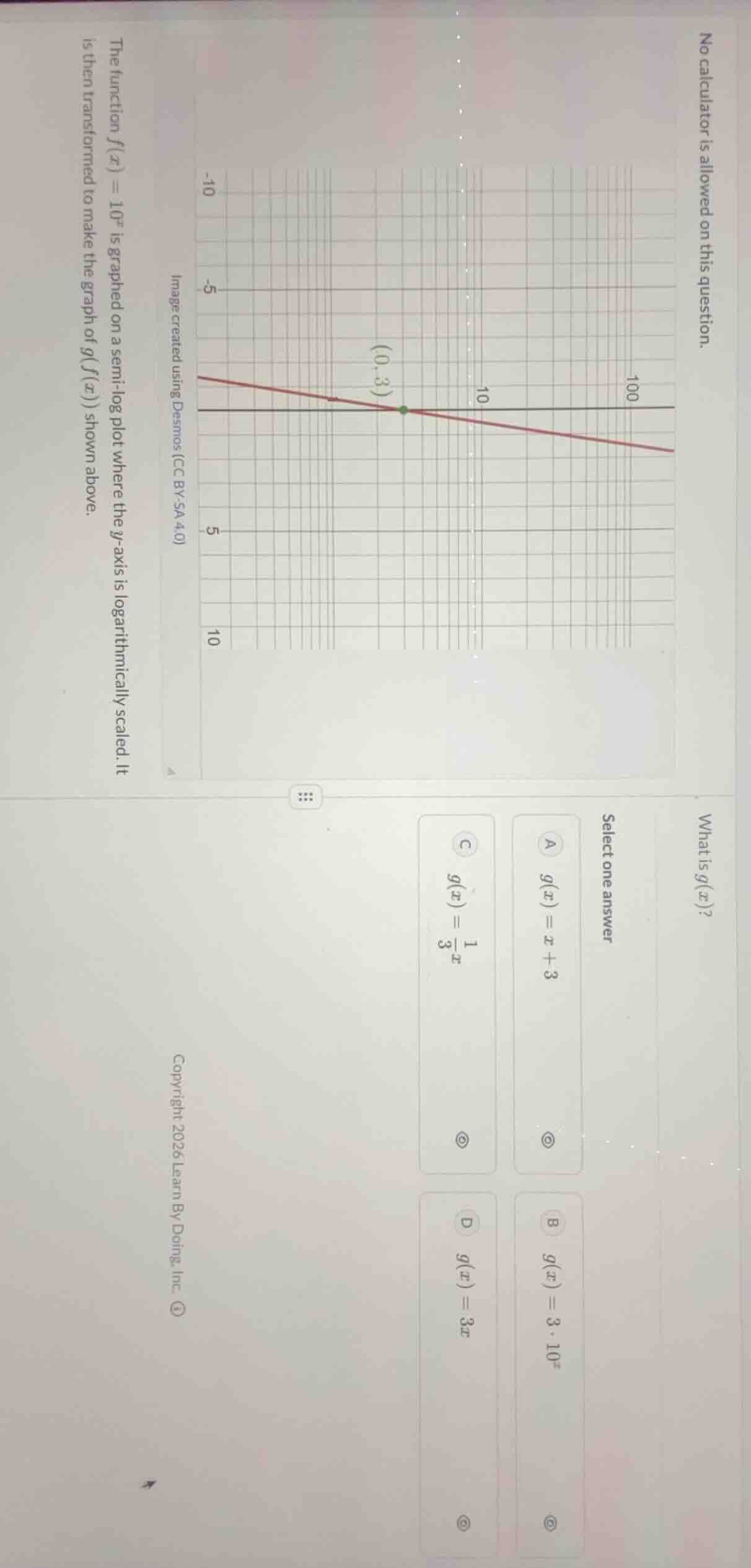
the function $f(x) = 10^x$ is graphed on a semi - log plot where the $y$-axis is logarithmically scaled. it is then transformed to make the graph of $g(f(x))$ shown above.
image created using desmos.(cc by - sa 4.0)
what is $g(x)$?
select one answer
a $g(x)=x + 3$
b $g(x)=3\cdot10^x$
c $g(x)=\frac{1}{3}x$
d $g(x)=3x$
We know \( f(x) = 10^x \), and the graph of \( g(f(x)) \) is on a semi - log plot (y - axis is logarithmically scaled). Let's analyze the form of \( g(f(x)) \). Since \( f(x)=10^x \), if we assume the equation of the line in the semi - log plot (where \( y = g(f(x)) \) and the y - axis is logarithmic, but when we consider the linearity of the graph, we can think in terms of the transformation.
The general form of a linear function is \( y=mx + b \). We know that when \( x = 0 \), \( f(0)=10^0 = 1 \), and from the graph, when \( x = 0 \), \( g(f(0))=g(1) = 3 \)? Wait, no, let's re - think. Wait, the function \( f(x)=10^x \), and we have \( g(f(x)) \). Let's let \( y = g(f(x)) \). Since the y - axis is logarithmically scaled? No, wait, the problem says "the function \( f(x)=10^x \) is graphed on a semi - log plot where the y - axis is logarithmically scaled. It is then transformed to make the graph of \( g(f(x)) \)". Wait, maybe a better approach: Let's suppose that \( g(f(x)) \) is a linear function. Let's assume the equation of the line is \( y=mx + b \). We know that when \( x = 0 \), \( f(0)=10^0=1 \), and from the graph, the point \( (0,3) \) is on \( g(f(x)) \). Also, let's consider the form of \( g \). If \( f(x)=10^x \), and we want to find \( g(x) \) such that \( g(f(x)) \) is linear. Let's test the options:
Option A: \( g(x)=x + 3 \). Then \( g(f(x))=g(10^x)=10^x+3 \). This is an exponential function, not linear, so A is wrong.
Option B: \( g(x)=3\cdot10^x \). Then \( g(f(x))=g(10^x)=3\cdot10^{10^x} \), which is not linear, so B is wrong.
Option C: \( g(x)=\frac{1}{3}x \). Then \( g(f(x))=g(10^x)=\frac{1}{3}\cdot10^x \), which is exponential, not linear, so C is wrong.
Option D: \( g(x) = 3x \). Then \( g(f(x))=g(10^x)=3\cdot10^x \)? Wait, no, wait, I made a mistake. Wait, let's re - express. Wait, the semi - log plot: when the y - axis is logarithmically scaled, the function \( f(x)=10^x \) on a semi - log plot (y - axis log) would be a straight line with slope 1. But we have \( g(f(x)) \). Wait, maybe the key is that if we let \( y = g(f(x)) \), and the graph of \( y \) vs \( x \) is linear. Let's assume \( y = g(f(x))=mx + b \). We know that when \( x = 0 \), \( f(0)=10^0 = 1 \), and \( g(f(0))=g(1)=3 \)? No, the point on the graph is \( (0,3) \). Wait, maybe the x - value in the graph is the x - value of \( f(x) \)? No, the x - axis is the same as the x - axis of \( f(x) \). Let's think differently. Let's suppose that \( g(x)=\log_{10}(x)\) - no, wait, let's test option D: \( g(x)=3x \). Then \( g(f(x))=g(10^x)=3\times10^x \)? No, that's not right. Wait, I think I messed up the semi - log plot idea. Wait, the semi - log plot: if the y - axis is logarithmically scaled, then plotting \( f(x)=10^x \) on a semi - log (y - log) plot would give a straight line with slope 1 (since \( \log_{10}(f(x))=\log_{10}(10^x)=x \)). Then, when we transform it to \( g(f(x)) \), and the graph is a straight line with a point \( (0,3) \). Wait, maybe \( g(x) \) is a linear function such that \( g(10^x) \) is linear. Let's assume that \( g(10^x)=mx + b \). When \( x = 0 \), \( 10^0 = 1 \), so \( g(1)=3 \). When \( x \) changes, if we consider the slope. Wait, another approach: Let's let \( t = f(x)=10^x \), so \( x=\log_{10}t \). Then \( g(t) \) should be a function such that when we plot \( g(t) \) vs \( \log_{10}t \), it's a straight line. The equation of the line in the plot (where the x - axis is \( x=\log_{10}t \) and y - axis is \( g(t) \)) is linear. From the graph, when \( x = 0 \) (i.e., \( t = 10^0=1 \)), \( g(t)=3 \), and if we…

Snap & solve any problem in the app
Get step-by-step solutions on Sovi AI
Photo-based solutions with guided steps
Explore more problems and detailed explanations
D. \( g(x) = 3x \)