QUESTION IMAGE
Question
no calculators
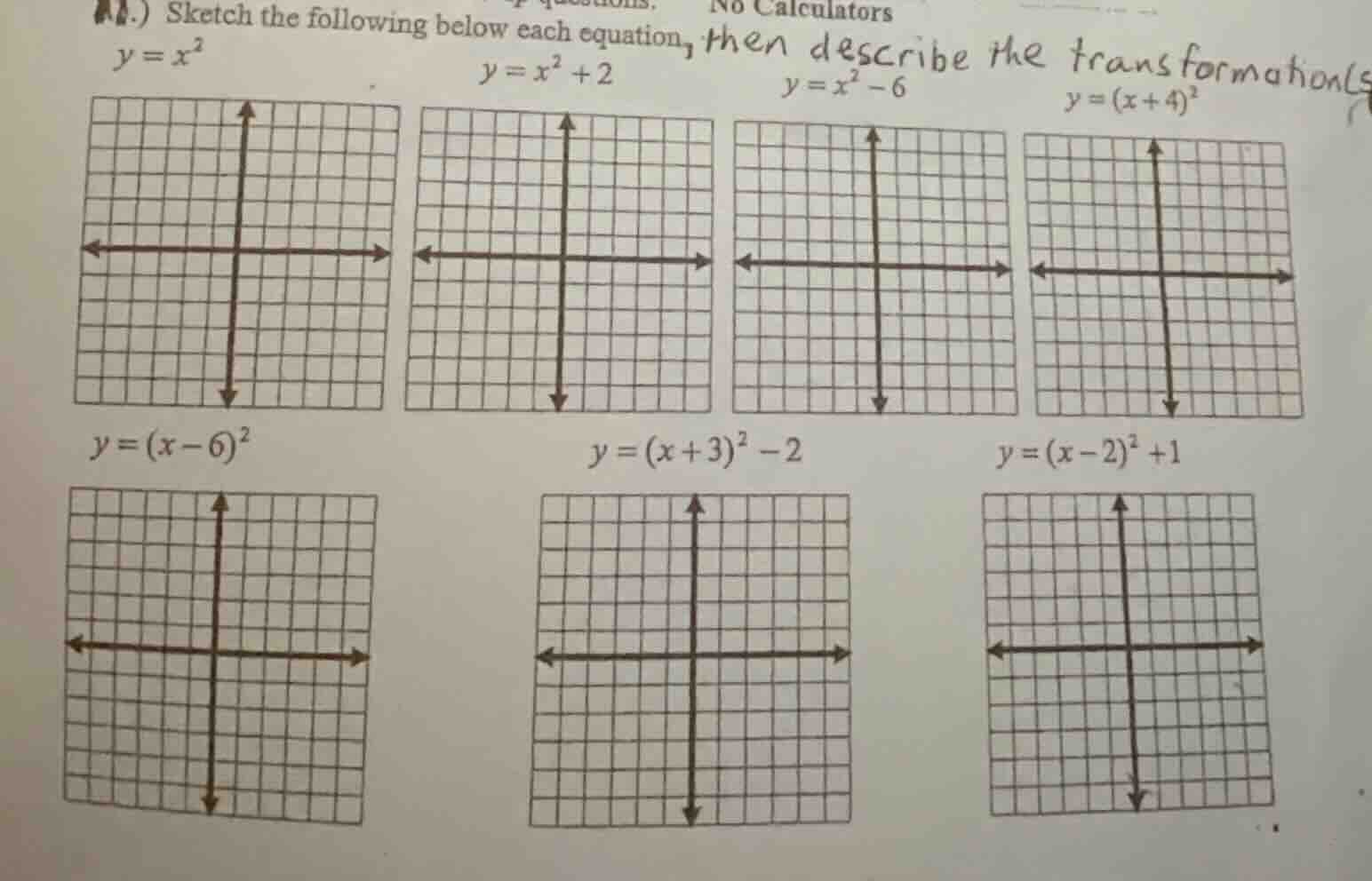
11.) sketch the following below each equation, then describe the transformation(s)
y = x²
y = x² + 2
y = x² - 6
y = (x + 4)²
y = (x - 6)²
y = (x + 3)² - 2
y = (x - 2)² + 1
For \( y = x^2 \)
Step1: Identify the parent function
The parent function is \( y = x^2 \), which is a parabola opening upwards with vertex at \((0,0)\). To sketch it, we can plot some points: when \( x = -2 \), \( y = (-2)^2 = 4 \); \( x = -1 \), \( y = 1 \); \( x = 0 \), \( y = 0 \); \( x = 1 \), \( y = 1 \); \( x = 2 \), \( y = 4 \). Then connect these points to form the parabola.
Step2: Describe the transformation (none for the parent function)
Since this is the parent function, there are no transformations applied other than the basic quadratic function.
For \( y = x^2 + 2 \)
Step1: Compare with parent function
The parent function is \( y = x^2 \). The new function is \( y = x^2 + 2 \).
Step2: Determine the transformation
For a function \( y = f(x) + k \), if \( k>0 \), it is a vertical shift up by \( k \) units. Here, \( k = 2 \), so the graph of \( y = x^2 \) is shifted up 2 units. The vertex moves from \((0,0)\) to \((0,2)\). To sketch, take the graph of \( y = x^2 \) and shift each point up 2 units.
For \( y = x^2 - 6 \)
Step1: Compare with parent function
Parent function is \( y = x^2 \). New function: \( y = x^2 - 6 \).
Step2: Determine the transformation
For \( y = f(x) + k \), when \( k=-6 \), it is a vertical shift down by 6 units. So the graph of \( y = x^2 \) is shifted down 6 units. Vertex moves from \((0,0)\) to \((0, - 6)\). Sketch by shifting \( y = x^2 \) down 6 units.
For \( y=(x + 4)^2 \)

Snap & solve any problem in the app
Get step-by-step solutions on Sovi AI
Photo-based solutions with guided steps
Explore more problems and detailed explanations
s (Descriptions of Transformations):
- \( y = x^2 \): Parent parabola, vertex \((0,0)\), no transformations.
- \( y = x^2 + 2 \): Vertical shift up 2 units, vertex \((0,2)\).
- \( y = x^2 - 6 \): Vertical shift down 6 units, vertex \((0,-6)\).
- \( y=(x + 4)^2 \): Horizontal shift left 4 units, vertex \((-4,0)\).
- \( y=(x - 6)^2 \): Horizontal shift right 6 units, vertex \((6,0)\).
- \( y=(x + 3)^2-2 \): Horizontal shift left 3 units, vertical shift down 2 units, vertex \((-3,-2)\).
- \( y=(x - 2)^2+1 \): Horizontal shift right 2 units, vertical shift up 1 unit, vertex \((2,1)\).
(Note: For sketching, follow the point - plotting and transformation steps as explained above. The key is to use the parent function \( y = x^2 \) and apply the appropriate vertical/horizontal shifts based on the form of the given function.)