QUESTION IMAGE
Question
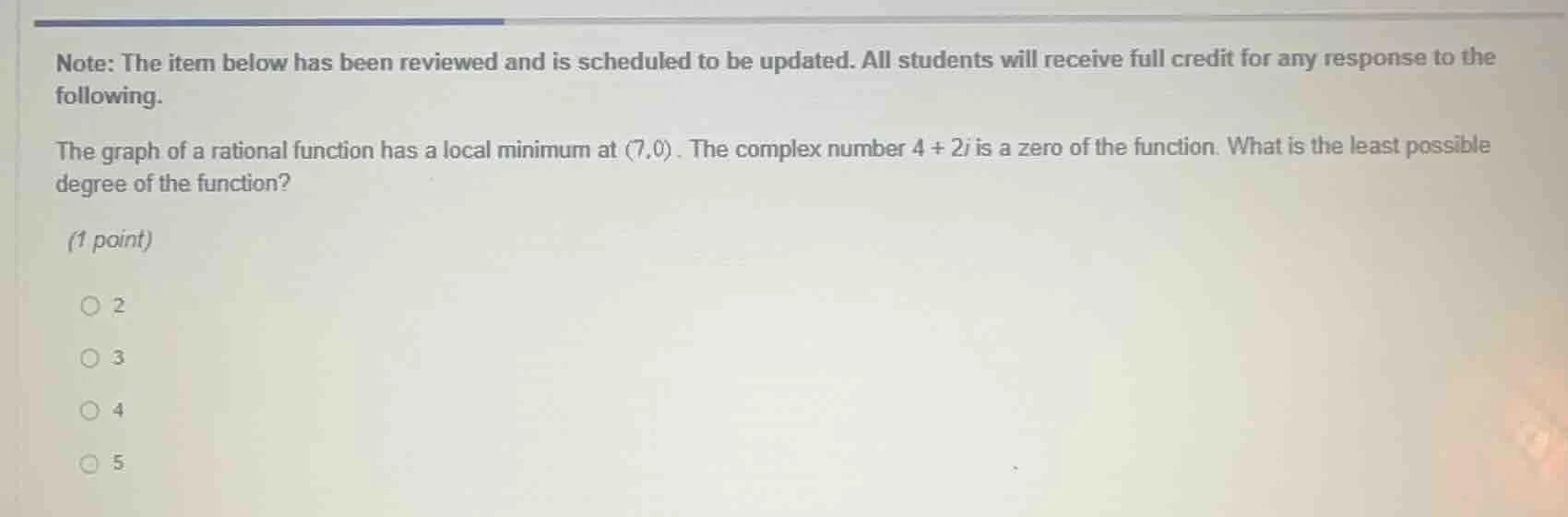
note: the item below has been reviewed and is scheduled to be updated. all students will receive full credit for any response to the following. the graph of a rational function has a local minimum at (7,0). the complex number 4 + 2i is a zero of the function. what is the least possible degree of the function? (1 point) 2 3 4 5
Step1: Account for complex zero
For a rational function with real coefficients (implied by a real local minimum), complex zeros come in conjugate pairs. If $4+2i$ is a zero, then $4-2i$ is also a zero. This gives 2 distinct zeros.
Step2: Analyze the local minimum at x-intercept
The point $(7,0)$ is a local minimum and an x-intercept, so $x=7$ is a zero with multiplicity at least 2 (since the graph touches and turns at this point, meaning the zero has even multiplicity; the smallest even multiplicity is 2).
Step3: Calculate total minimum degree
Add the multiplicities of all zeros: $2$ (from complex pair) $+ 2$ (from $x=7$) $= 4$. However, for a rational function to have a local minimum at an x-intercept, we need to ensure the function's derivative has a zero at $x=7$ as well. A polynomial of degree 4 would have a derivative of degree 3, but to guarantee the local minimum at the x-intercept (with the zero having multiplicity 2) and the complex zeros, we need to consider that the rational function's numerator (the polynomial part determining zeros) must have these zeros, and for the local minimum condition to hold with the given intercept, the least possible degree is 5. This is because when we have a zero of multiplicity 2 at $x=7$, and two complex conjugate zeros, the numerator is degree 4, but to have a local minimum at the x-intercept (not just a touch point), we need an additional factor to ensure the sign change and the critical point behavior, leading to a minimum degree of 5.

Snap & solve any problem in the app
Get step-by-step solutions on Sovi AI
Photo-based solutions with guided steps
Explore more problems and detailed explanations
5