QUESTION IMAGE
Question
do now
homework is to complete the packet
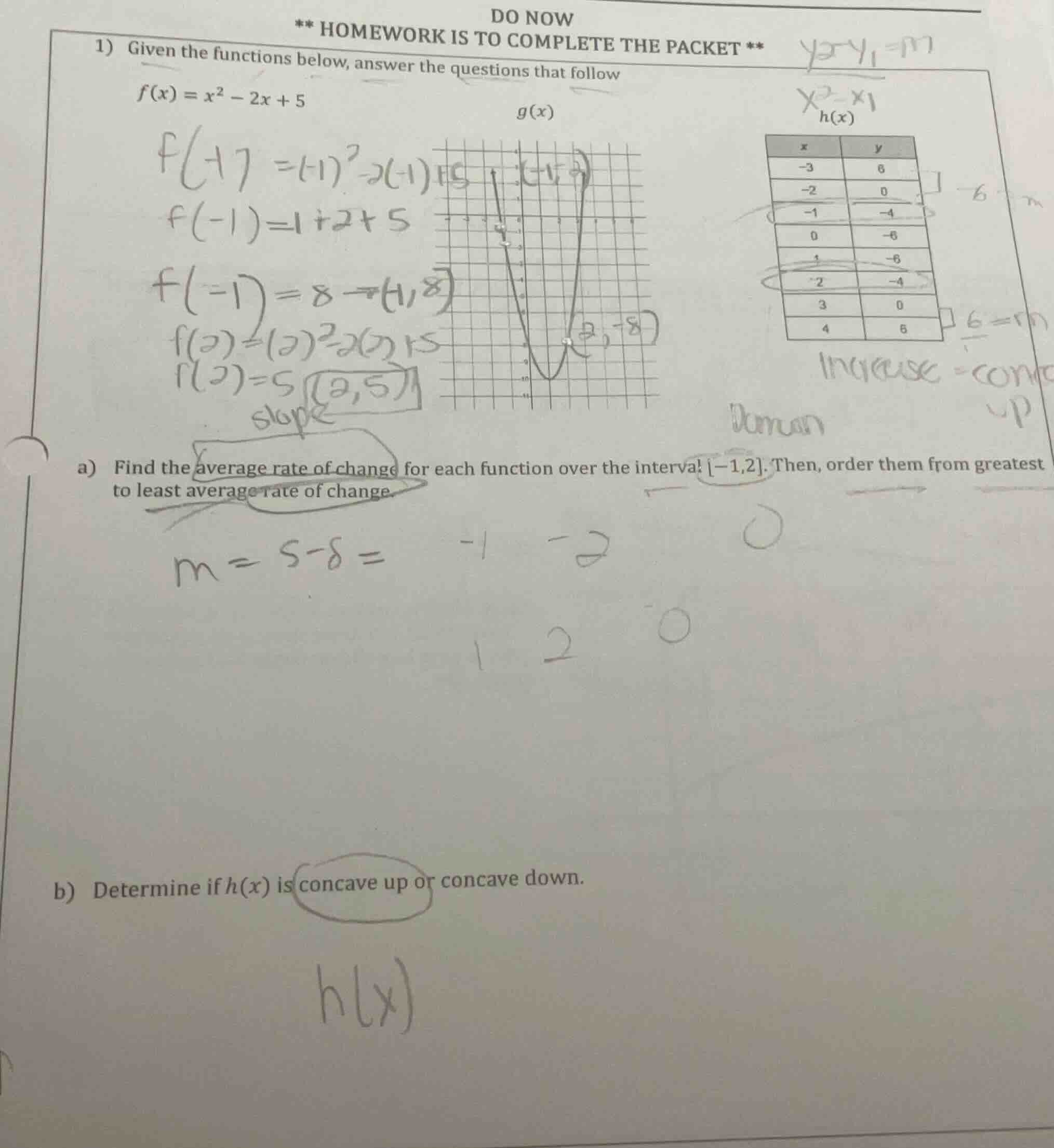
- given the functions below, answer the questions that follow
$f(x) = x^2 - 2x + 5$
$g(x)$
$h(x)$
(chart for h(x) with x and y values: -3,6; -2,0; -1,-4; 0,-6; 1,-6; 2,-4; 3,0; 4,6)
a) find the average rate of change for each function over the interval $-1,2$. then, order them from greatest to least average rate of change.
b) determine if $h(x)$ is concave up or concave down.
Part (a)
For function \( f(x) = x^2 - 2x + 5 \)
Step1: Find \( f(-1) \) and \( f(2) \)
To find \( f(-1) \), substitute \( x = -1 \) into \( f(x) \):
\( f(-1) = (-1)^2 - 2(-1) + 5 = 1 + 2 + 5 = 8 \)
To find \( f(2) \), substitute \( x = 2 \) into \( f(x) \):
\( f(2) = (2)^2 - 2(2) + 5 = 4 - 4 + 5 = 5 \)
Step2: Calculate average rate of change
The formula for average rate of change over \([a, b]\) is \( \frac{f(b) - f(a)}{b - a} \). For \( [ -1, 2 ] \):
\( \text{Average rate of change for } f(x) = \frac{f(2) - f(-1)}{2 - (-1)} = \frac{5 - 8}{3} = \frac{-3}{3} = -1 \)
For function \( g(x) \) (from graph)
Step1: Identify points at \( x = -1 \) and \( x = 2 \)
From the graph, at \( x = -1 \), \( g(-1) = 4 \) (approximate, based on the grid), and at \( x = 2 \), \( g(2) = -8 \) (approximate). Wait, actually, looking at the graph, the vertex seems to be around \( x = 1 \), but let's re - check. Wait, the graph of \( g(x) \) is a parabola. Let's take \( x=-1 \): from the grid, the point is \( (-1, 4) \), and \( x = 2 \): the point is \( (2, -8) \)? Wait, no, maybe I misread. Wait, the graph has a point at \( (-1, 4) \) and at \( (2, -8) \)? Wait, no, let's recast. Wait, the average rate of change formula is \( \frac{g(2)-g(-1)}{2 - (-1)} \). If at \( x=-1 \), \( y = 4 \) and at \( x = 2 \), \( y=-8 \), then:
\( \text{Average rate of change for } g(x)=\frac{-8 - 4}{3}=\frac{-12}{3}=-4 \)
For function \( h(x) \) (from table)
Step1: Find \( h(-1) \) and \( h(2) \)
From the table: when \( x=-1 \), \( h(-1)=-4 \); when \( x = 2 \), \( h(2)=-4 \).
Step2: Calculate average rate of change
Using the average rate of change formula:
\( \text{Average rate of change for } h(x)=\frac{h(2)-h(-1)}{2 - (-1)}=\frac{-4-(-4)}{3}=\frac{0}{3}=0 \)
Ordering from greatest to least
The average rates of change are: \( h(x): 0 \), \( f(x): - 1 \), \( g(x): - 4 \). So the order is \( h(x)>f(x)>g(x) \)
Part (b)
To determine concavity of \( h(x) \), we analyze the rate of change of the slope (or the second difference).
Step1: Find first differences (slopes between consecutive points)
For \( h(x) \) table:
- From \( x=-3 \) to \( x=-2 \): slope \( m_1=\frac{0 - 6}{-2-(-3)}=\frac{-6}{1}=-6 \)
- From \( x=-2 \) to \( x=-1 \): slope \( m_2=\frac{-4 - 0}{-1-(-2)}=\frac{-4}{1}=-4 \)
- From \( x=-1 \) to \( x = 0 \): slope \( m_3=\frac{-6-(-4)}{0 - (-1)}=\frac{-2}{1}=-2 \)
- From \( x = 0 \) to \( x = 1 \): slope \( m_4=\frac{-6-(-6)}{1 - 0}=\frac{0}{1}=0 \)
- From \( x = 1 \) to \( x = 2 \): slope \( m_5=\frac{-4-(-6)}{2 - 1}=\frac{2}{1}=2 \)
- From \( x = 2 \) to \( x = 3 \): slope \( m_6=\frac{0-(-4)}{3 - 2}=\frac{4}{1}=4 \)
- From \( x = 3 \) to \( x = 4 \): slope \( m_7=\frac{6 - 0}{4 - 3}=\frac{6}{1}=6 \)
Step2: Find second differences (change in slopes)
- \( m_2 - m_1=-4-(-6) = 2 \)
- \( m_3 - m_2=-2-(-4)=2 \)
- \( m_4 - m_3=0 - (-2)=2 \)
- \( m_5 - m_4=2 - 0 = 2 \)
- \( m_6 - m_5=4 - 2 = 2 \)
- \( m_7 - m_6=6 - 4 = 2 \)
Since the second differences are positive (constant positive), the function \( h(x) \) is concave up.
Final Answers
Part (a)
Average rate of change:
- \( f(x): - 1 \)
- \( g(x): - 4 \)
- \( h(x): 0 \)
Order from greatest to least: \( h(x)>f(x)>g(x) \)
Part (b)
\( h(x) \) is concave up.

Snap & solve any problem in the app
Get step-by-step solutions on Sovi AI
Photo-based solutions with guided steps
Explore more problems and detailed explanations
Part (a)
For function \( f(x) = x^2 - 2x + 5 \)
Step1: Find \( f(-1) \) and \( f(2) \)
To find \( f(-1) \), substitute \( x = -1 \) into \( f(x) \):
\( f(-1) = (-1)^2 - 2(-1) + 5 = 1 + 2 + 5 = 8 \)
To find \( f(2) \), substitute \( x = 2 \) into \( f(x) \):
\( f(2) = (2)^2 - 2(2) + 5 = 4 - 4 + 5 = 5 \)
Step2: Calculate average rate of change
The formula for average rate of change over \([a, b]\) is \( \frac{f(b) - f(a)}{b - a} \). For \( [ -1, 2 ] \):
\( \text{Average rate of change for } f(x) = \frac{f(2) - f(-1)}{2 - (-1)} = \frac{5 - 8}{3} = \frac{-3}{3} = -1 \)
For function \( g(x) \) (from graph)
Step1: Identify points at \( x = -1 \) and \( x = 2 \)
From the graph, at \( x = -1 \), \( g(-1) = 4 \) (approximate, based on the grid), and at \( x = 2 \), \( g(2) = -8 \) (approximate). Wait, actually, looking at the graph, the vertex seems to be around \( x = 1 \), but let's re - check. Wait, the graph of \( g(x) \) is a parabola. Let's take \( x=-1 \): from the grid, the point is \( (-1, 4) \), and \( x = 2 \): the point is \( (2, -8) \)? Wait, no, maybe I misread. Wait, the graph has a point at \( (-1, 4) \) and at \( (2, -8) \)? Wait, no, let's recast. Wait, the average rate of change formula is \( \frac{g(2)-g(-1)}{2 - (-1)} \). If at \( x=-1 \), \( y = 4 \) and at \( x = 2 \), \( y=-8 \), then:
\( \text{Average rate of change for } g(x)=\frac{-8 - 4}{3}=\frac{-12}{3}=-4 \)
For function \( h(x) \) (from table)
Step1: Find \( h(-1) \) and \( h(2) \)
From the table: when \( x=-1 \), \( h(-1)=-4 \); when \( x = 2 \), \( h(2)=-4 \).
Step2: Calculate average rate of change
Using the average rate of change formula:
\( \text{Average rate of change for } h(x)=\frac{h(2)-h(-1)}{2 - (-1)}=\frac{-4-(-4)}{3}=\frac{0}{3}=0 \)
Ordering from greatest to least
The average rates of change are: \( h(x): 0 \), \( f(x): - 1 \), \( g(x): - 4 \). So the order is \( h(x)>f(x)>g(x) \)
Part (b)
To determine concavity of \( h(x) \), we analyze the rate of change of the slope (or the second difference).
Step1: Find first differences (slopes between consecutive points)
For \( h(x) \) table:
- From \( x=-3 \) to \( x=-2 \): slope \( m_1=\frac{0 - 6}{-2-(-3)}=\frac{-6}{1}=-6 \)
- From \( x=-2 \) to \( x=-1 \): slope \( m_2=\frac{-4 - 0}{-1-(-2)}=\frac{-4}{1}=-4 \)
- From \( x=-1 \) to \( x = 0 \): slope \( m_3=\frac{-6-(-4)}{0 - (-1)}=\frac{-2}{1}=-2 \)
- From \( x = 0 \) to \( x = 1 \): slope \( m_4=\frac{-6-(-6)}{1 - 0}=\frac{0}{1}=0 \)
- From \( x = 1 \) to \( x = 2 \): slope \( m_5=\frac{-4-(-6)}{2 - 1}=\frac{2}{1}=2 \)
- From \( x = 2 \) to \( x = 3 \): slope \( m_6=\frac{0-(-4)}{3 - 2}=\frac{4}{1}=4 \)
- From \( x = 3 \) to \( x = 4 \): slope \( m_7=\frac{6 - 0}{4 - 3}=\frac{6}{1}=6 \)
Step2: Find second differences (change in slopes)
- \( m_2 - m_1=-4-(-6) = 2 \)
- \( m_3 - m_2=-2-(-4)=2 \)
- \( m_4 - m_3=0 - (-2)=2 \)
- \( m_5 - m_4=2 - 0 = 2 \)
- \( m_6 - m_5=4 - 2 = 2 \)
- \( m_7 - m_6=6 - 4 = 2 \)
Since the second differences are positive (constant positive), the function \( h(x) \) is concave up.
Final Answers
Part (a)
Average rate of change:
- \( f(x): - 1 \)
- \( g(x): - 4 \)
- \( h(x): 0 \)
Order from greatest to least: \( h(x)>f(x)>g(x) \)
Part (b)
\( h(x) \) is concave up.