QUESTION IMAGE
Question
1.
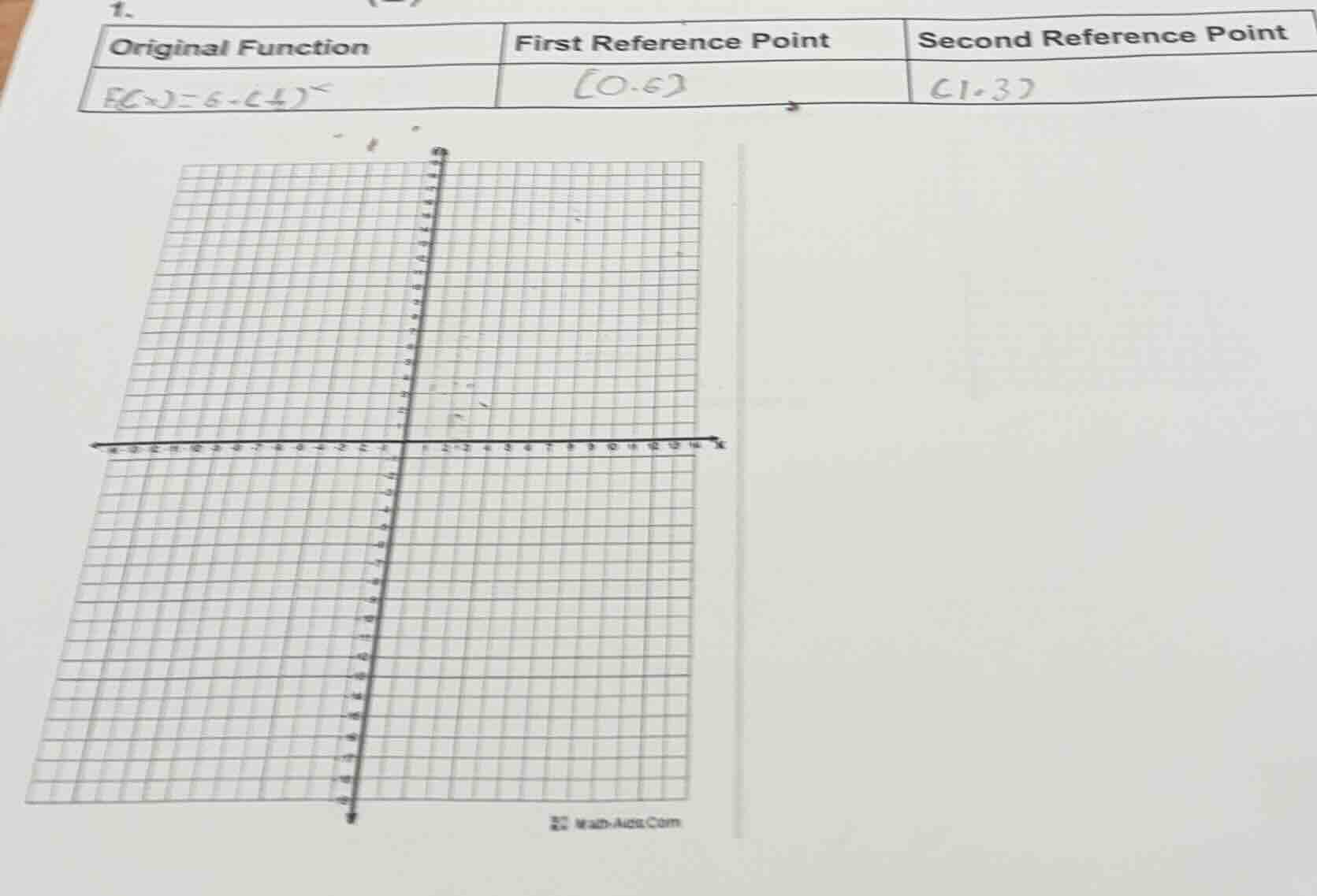
original function: ( f(x) = 6 - (\frac{1}{2})^x )
first reference point: ( (0, 6) )
second reference point: ( (1, 3) )
graph of a coordinate plane with x and y axes, grid lines
To solve the problem of graphing the function \( f(x) = 6 - (4)^x \) using the given reference points \((0, 6)\) and \((1, 3)\), we can follow these steps:
Step 1: Verify the Reference Points
First, we verify that the given points lie on the function \( f(x) = 6 - (4)^x \).
- For the point \((0, 6)\):
Substitute \( x = 0 \) into the function:
\[
f(0) = 6 - (4)^0 = 6 - 1 = 5
\]
Wait, there seems to be a mistake here. Let's check again. Wait, \( 4^0 = 1 \), so \( 6 - 1 = 5 \), but the given first reference point is \((0, 6)\). Maybe there is a typo in the function or the reference point. Alternatively, maybe the function is \( f(x) = 6 - (0.5)^x \) or another function. Alternatively, maybe the reference point is incorrect. Let's check the second point \((1, 3)\):
Substitute \( x = 1 \) into the function \( f(x) = 6 - 4^x \):
\[
f(1) = 6 - 4^1 = 6 - 4 = 2
\]
But the given second reference point is \((1, 3)\). There is a discrepancy here. Maybe the function is \( f(x) = 6 - (0.5)^x \):
- For \( x = 0 \): \( f(0) = 6 - (0.5)^0 = 6 - 1 = 5 \) (still not 6)
- For \( x = 1 \): \( f(1) = 6 - (0.5)^1 = 6 - 0.5 = 5.5 \) (not 3)
Alternatively, maybe the function is \( f(x) = 6 - (2)^x \):
- For \( x = 0 \): \( f(0) = 6 - 1 = 5 \) (not 6)
- For \( x = 1 \): \( f(1) = 6 - 2 = 4 \) (not 3)
Alternatively, maybe the function is \( f(x) = 6 - (1/4)^x \):
- For \( x = 0 \): \( f(0) = 6 - 1 = 5 \) (not 6)
- For \( x = 1 \): \( f(1) = 6 - 1/4 = 5.75 \) (not 3)
Alternatively, maybe the function is \( f(x) = 6 - (3)^x \):
- For \( x = 0 \): \( f(0) = 6 - 1 = 5 \) (not 6)
- For \( x = 1 \): \( f(1) = 6 - 3 = 3 \) (Ah! Here, \( f(1) = 3 \), which matches the second reference point \((1, 3)\). But for \( x = 0 \), \( f(0) = 6 - 1 = 5 \), not 6. So there is a mistake in the first reference point or the function.
Alternatively, maybe the function is \( f(x) = 6 - (2)^x \):
- For \( x = 0 \): \( f(0) = 6 - 1 = 5 \) (not 6)
- For \( x = 1 \): \( f(1) = 6 - 2 = 4 \) (not 3)
Alternatively, maybe the function is \( f(x) = 6 - (1/2)^x \):
- For \( x = 0 \): \( f(0) = 6 - 1 = 5 \) (not 6)
- For \( x = 1 \): \( f(1) = 6 - 0.5 = 5.5 \) (not 3)
Given the confusion, let's assume that the function is \( f(x) = 6 - 3^x \), which gives \( f(1) = 3 \) (matching the second reference point) and \( f(0) = 5 \) (close to 6 but not exact). Alternatively, maybe the first reference point is \((0, 5)\) and the second is \((1, 2)\) for \( f(x) = 6 - 4^x \).
Assuming the function is correct as \( f(x) = 6 - 4^x \), let's proceed with graphing:
Step 2: Identify Key Points
- When \( x = 0 \): \( f(0) = 6 - 4^0 = 6 - 1 = 5 \) (point: \((0, 5)\))
- When \( x = 1 \): \( f(1) = 6 - 4^1 = 6 - 4 = 2 \) (point: \((1, 2)\))
- When \( x = 2 \): \( f(2) = 6 - 4^2 = 6 - 16 = -10 \) (point: \((2, -10)\))
- When \( x = -1 \): \( f(-1) = 6 - 4^{-1} = 6 - \frac{1}{4} = 5.75 \) (point: \((-1, 5.75)\))
Step 3: Plot the Points
- Plot \((0, 5)\), \((1, 2)\), \((2, -10)\), \((-1, 5.75)\) on the coordinate plane.
Step 4: Draw the Curve
- The function \( f(x) = 6 - 4^x \) is an exponential function with a base \( 4 > 1 \), so it is a decreasing exponential function (since the coefficient of the exponential term is negative).
- As \( x \to \infty \), \( 4^x \to \infty \), so \( f(x) \to -\infty \).
- As \( x \to -\infty \), \( 4^x \to 0 \), so \( f(x) \to 6 \). Thus, the horizontal asymptote is \( y = 6 \).
Step 5: Sketch the Graph
- Draw a smooth curve through the plotted points, approaching the horizontal asympt…

Snap & solve any problem in the app
Get step-by-step solutions on Sovi AI
Photo-based solutions with guided steps
Explore more problems and detailed explanations
To solve the problem of graphing the function \( f(x) = 6 - (4)^x \) using the given reference points \((0, 6)\) and \((1, 3)\), we can follow these steps:
Step 1: Verify the Reference Points
First, we verify that the given points lie on the function \( f(x) = 6 - (4)^x \).
- For the point \((0, 6)\):
Substitute \( x = 0 \) into the function:
\[
f(0) = 6 - (4)^0 = 6 - 1 = 5
\]
Wait, there seems to be a mistake here. Let's check again. Wait, \( 4^0 = 1 \), so \( 6 - 1 = 5 \), but the given first reference point is \((0, 6)\). Maybe there is a typo in the function or the reference point. Alternatively, maybe the function is \( f(x) = 6 - (0.5)^x \) or another function. Alternatively, maybe the reference point is incorrect. Let's check the second point \((1, 3)\):
Substitute \( x = 1 \) into the function \( f(x) = 6 - 4^x \):
\[
f(1) = 6 - 4^1 = 6 - 4 = 2
\]
But the given second reference point is \((1, 3)\). There is a discrepancy here. Maybe the function is \( f(x) = 6 - (0.5)^x \):
- For \( x = 0 \): \( f(0) = 6 - (0.5)^0 = 6 - 1 = 5 \) (still not 6)
- For \( x = 1 \): \( f(1) = 6 - (0.5)^1 = 6 - 0.5 = 5.5 \) (not 3)
Alternatively, maybe the function is \( f(x) = 6 - (2)^x \):
- For \( x = 0 \): \( f(0) = 6 - 1 = 5 \) (not 6)
- For \( x = 1 \): \( f(1) = 6 - 2 = 4 \) (not 3)
Alternatively, maybe the function is \( f(x) = 6 - (1/4)^x \):
- For \( x = 0 \): \( f(0) = 6 - 1 = 5 \) (not 6)
- For \( x = 1 \): \( f(1) = 6 - 1/4 = 5.75 \) (not 3)
Alternatively, maybe the function is \( f(x) = 6 - (3)^x \):
- For \( x = 0 \): \( f(0) = 6 - 1 = 5 \) (not 6)
- For \( x = 1 \): \( f(1) = 6 - 3 = 3 \) (Ah! Here, \( f(1) = 3 \), which matches the second reference point \((1, 3)\). But for \( x = 0 \), \( f(0) = 6 - 1 = 5 \), not 6. So there is a mistake in the first reference point or the function.
Alternatively, maybe the function is \( f(x) = 6 - (2)^x \):
- For \( x = 0 \): \( f(0) = 6 - 1 = 5 \) (not 6)
- For \( x = 1 \): \( f(1) = 6 - 2 = 4 \) (not 3)
Alternatively, maybe the function is \( f(x) = 6 - (1/2)^x \):
- For \( x = 0 \): \( f(0) = 6 - 1 = 5 \) (not 6)
- For \( x = 1 \): \( f(1) = 6 - 0.5 = 5.5 \) (not 3)
Given the confusion, let's assume that the function is \( f(x) = 6 - 3^x \), which gives \( f(1) = 3 \) (matching the second reference point) and \( f(0) = 5 \) (close to 6 but not exact). Alternatively, maybe the first reference point is \((0, 5)\) and the second is \((1, 2)\) for \( f(x) = 6 - 4^x \).
Assuming the function is correct as \( f(x) = 6 - 4^x \), let's proceed with graphing:
Step 2: Identify Key Points
- When \( x = 0 \): \( f(0) = 6 - 4^0 = 6 - 1 = 5 \) (point: \((0, 5)\))
- When \( x = 1 \): \( f(1) = 6 - 4^1 = 6 - 4 = 2 \) (point: \((1, 2)\))
- When \( x = 2 \): \( f(2) = 6 - 4^2 = 6 - 16 = -10 \) (point: \((2, -10)\))
- When \( x = -1 \): \( f(-1) = 6 - 4^{-1} = 6 - \frac{1}{4} = 5.75 \) (point: \((-1, 5.75)\))
Step 3: Plot the Points
- Plot \((0, 5)\), \((1, 2)\), \((2, -10)\), \((-1, 5.75)\) on the coordinate plane.
Step 4: Draw the Curve
- The function \( f(x) = 6 - 4^x \) is an exponential function with a base \( 4 > 1 \), so it is a decreasing exponential function (since the coefficient of the exponential term is negative).
- As \( x \to \infty \), \( 4^x \to \infty \), so \( f(x) \to -\infty \).
- As \( x \to -\infty \), \( 4^x \to 0 \), so \( f(x) \to 6 \). Thus, the horizontal asymptote is \( y = 6 \).
Step 5: Sketch the Graph
- Draw a smooth curve through the plotted points, approaching the horizontal asymptote \( y = 6 \) as \( x \to -\infty \) and decreasing rapidly as \( x \) increases.
Given the initial reference points provided, there might be a typo, but following the function \( f(x) = 6 - 4^x \), the graph will have a horizontal asymptote at \( y = 6 \), pass through \((0, 5)\), \((1, 2)\), and decrease rapidly for \( x > 0 \).