QUESTION IMAGE
Question
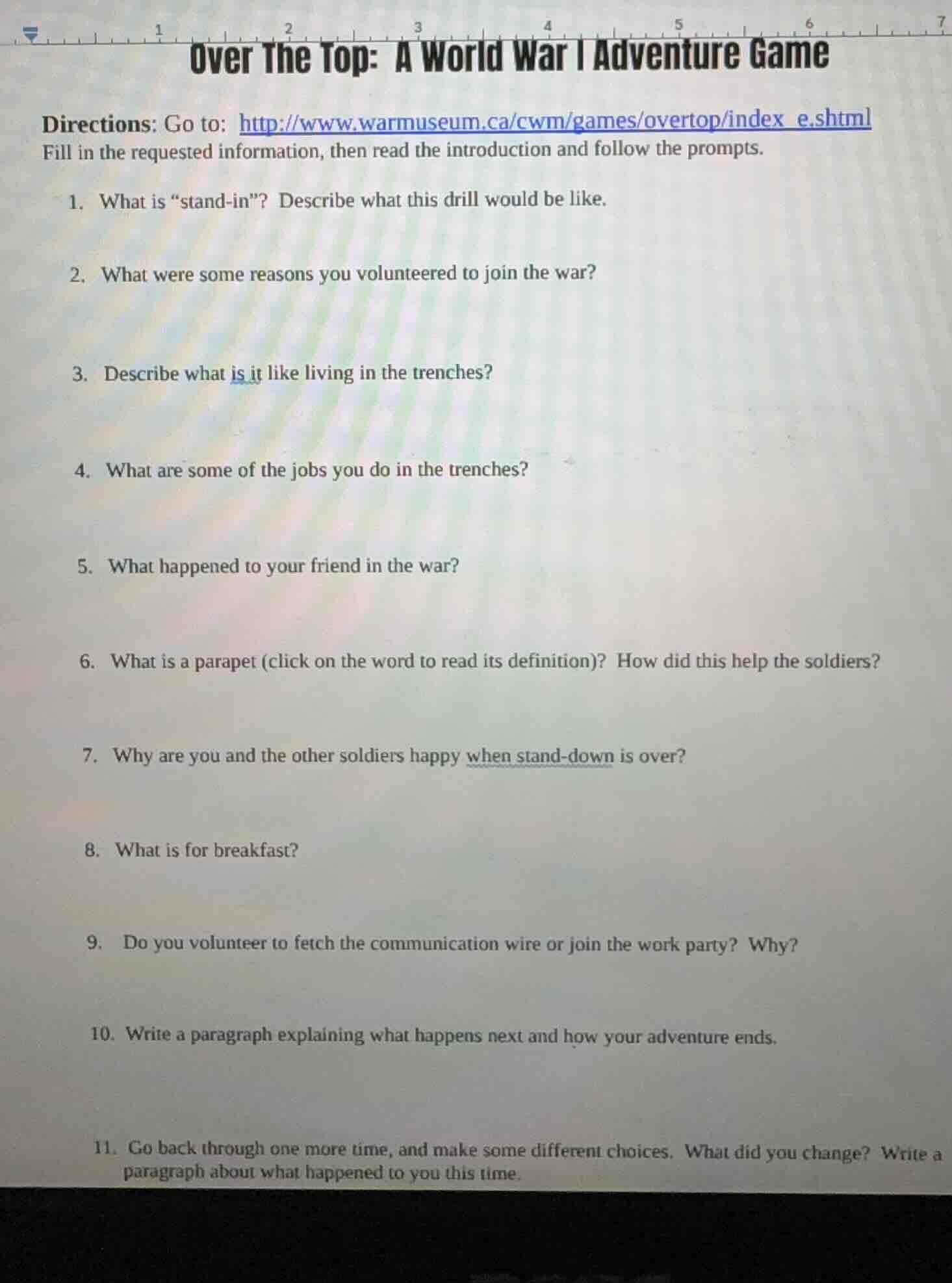
over the top: a world war i adventure game
directions: go to: http://www.warmuseum.ca/cwm/games/overtop/index_e.shtml
fill in the requested information, then read the introduction and follow the prompts.
- what is \stand - in\? describe what this drill would be like.
- what were some reasons you volunteered to join the war?
- describe what is it like living in the trenches?
- what are some of the jobs you do in the trenches?
- what happened to your friend in the war?
- what is a parapet (click on the word to read its definition)? how did this help the soldiers?
- why are you and the other soldiers happy when stand - down is over?
- what is for breakfast?
- do you volunteer to fetch the communication wire or join the work party? why?
- write a paragraph explaining what happens next and how your adventure ends.
- go back through one more time, and make some different choices. what did you change? write a paragraph about what happened to you this time.
To answer these questions, you need to access the provided website (http://www.warmuseum.ca/cwm/games/overtop/index_e.shtml) and follow the game's prompts and information. Here's a general approach for each question:
Question 1: “Stand - in” Drill
- Visit the website, navigate to the relevant section about drills. A “stand - in” drill in WWI context likely involved soldiers practicing replacing casualties or filling temporary roles. Describe the drill’s steps (e.g., quick role - taking, mimicking combat tasks) based on the game’s info.
Question 2: Reasons to Volunteer
- In the game, your “character” volunteers. Common WWI volunteer reasons (per historical context and game narrative) include patriotism, duty, adventure, or social pressure. Extract the game’s stated or implied reasons.
Question 3: Living in Trenches
- The game will detail trench life: mud, rats, poor food, constant danger, camaraderie, and harsh conditions. Summarize the game’s description of daily life (sleep, work, fear, etc.).
Question 4: Trench Jobs
- Trench duties (from WWI and game) include sentry duty, digging, carrying supplies, repairing barbed wire, or medical aid. List the jobs the game assigns to your character.
Question 5: Friend’s Fate
- The game’s narrative will show what happens to your in - game friend (e.g., injury, death, promotion, transfer). Report the outcome from the game.
Question 6: Parapet Definition and Use
- Click “parapet” on the site for its definition (a protective wall in trenches). Explain how it shielded soldiers from enemy fire/snipers, using the game’s details.
Question 7: Happy After Stand - Down
- “Stand - down” likely means ending a state of alert. Soldiers are happy for rest, resupply, or relief from tension; use the game’s context to explain.
Question 8: Breakfast
- The game will list rations (e.g., hardtack, bully beef, tea). Report the breakfast items from the game.
Question 9: Volunteer Choice (Wire or Work Party)
- Evaluate risks/rewards: Fetching wire is dangerous (enemy fire), work party may be safer but tedious. Choose based on the game’s context (e.g., “I volunteer for [choice] because [reason, like ‘I want to support communication’ or ‘avoid front - line danger’]”).
Question 10: Adventure’s End
- After game choices, write a paragraph: “After [event, e.g., a battle or mission], my character [outcome, e.g., survived, was wounded, or returned home]. The adventure ended with [resolution, e.g., reflection on war’s impact or reunion].”
Question 11: Different Choices
- Rerun the game, change a choice (e.g., job, mission), and describe the new outcome (e.g., “I changed my choice to [new action], so my character [new event, e.g., was captured, saved a comrade].”)
To get precise answers, interact with the game on the provided website and extract details from its narrative and prompts.

Snap & solve any problem in the app
Get step-by-step solutions on Sovi AI
Photo-based solutions with guided steps
Explore more problems and detailed explanations
To answer these questions, you need to access the provided website (http://www.warmuseum.ca/cwm/games/overtop/index_e.shtml) and follow the game's prompts and information. Here's a general approach for each question:
Question 1: “Stand - in” Drill
- Visit the website, navigate to the relevant section about drills. A “stand - in” drill in WWI context likely involved soldiers practicing replacing casualties or filling temporary roles. Describe the drill’s steps (e.g., quick role - taking, mimicking combat tasks) based on the game’s info.
Question 2: Reasons to Volunteer
- In the game, your “character” volunteers. Common WWI volunteer reasons (per historical context and game narrative) include patriotism, duty, adventure, or social pressure. Extract the game’s stated or implied reasons.
Question 3: Living in Trenches
- The game will detail trench life: mud, rats, poor food, constant danger, camaraderie, and harsh conditions. Summarize the game’s description of daily life (sleep, work, fear, etc.).
Question 4: Trench Jobs
- Trench duties (from WWI and game) include sentry duty, digging, carrying supplies, repairing barbed wire, or medical aid. List the jobs the game assigns to your character.
Question 5: Friend’s Fate
- The game’s narrative will show what happens to your in - game friend (e.g., injury, death, promotion, transfer). Report the outcome from the game.
Question 6: Parapet Definition and Use
- Click “parapet” on the site for its definition (a protective wall in trenches). Explain how it shielded soldiers from enemy fire/snipers, using the game’s details.
Question 7: Happy After Stand - Down
- “Stand - down” likely means ending a state of alert. Soldiers are happy for rest, resupply, or relief from tension; use the game’s context to explain.
Question 8: Breakfast
- The game will list rations (e.g., hardtack, bully beef, tea). Report the breakfast items from the game.
Question 9: Volunteer Choice (Wire or Work Party)
- Evaluate risks/rewards: Fetching wire is dangerous (enemy fire), work party may be safer but tedious. Choose based on the game’s context (e.g., “I volunteer for [choice] because [reason, like ‘I want to support communication’ or ‘avoid front - line danger’]”).
Question 10: Adventure’s End
- After game choices, write a paragraph: “After [event, e.g., a battle or mission], my character [outcome, e.g., survived, was wounded, or returned home]. The adventure ended with [resolution, e.g., reflection on war’s impact or reunion].”
Question 11: Different Choices
- Rerun the game, change a choice (e.g., job, mission), and describe the new outcome (e.g., “I changed my choice to [new action], so my character [new event, e.g., was captured, saved a comrade].”)
To get precise answers, interact with the game on the provided website and extract details from its narrative and prompts.