QUESTION IMAGE
Question
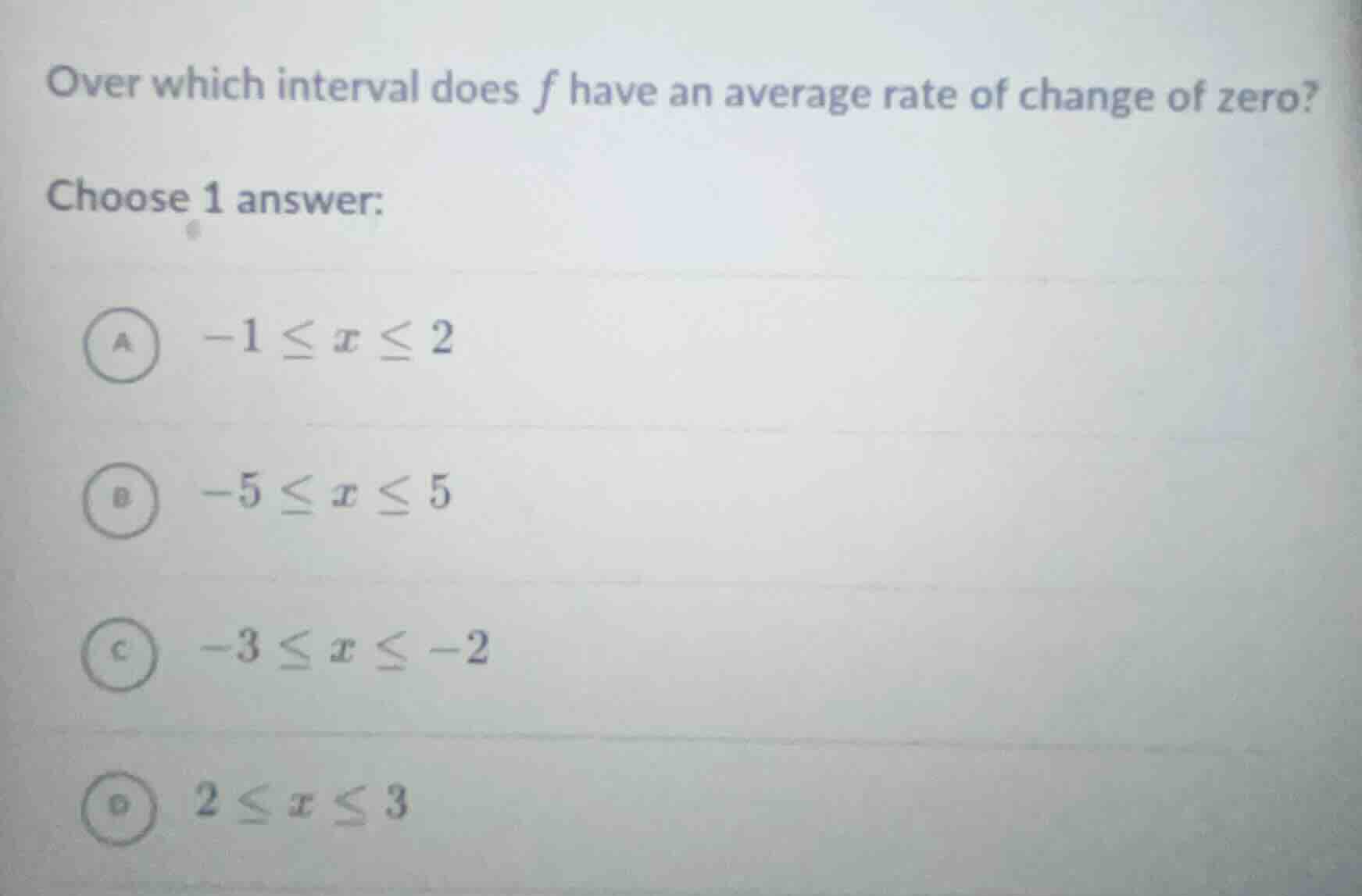
over which interval does f have an average rate of change of zero? choose 1 answer: a -1 ≤ x ≤ 2 b -5 ≤ x ≤ 5 c -3 ≤ x ≤ -2 d 2 ≤ x ≤ 3
Response
To determine the interval where the average rate of change of \( f \) is zero, we use the formula for the average rate of change: \( \text{Average Rate of Change} = \frac{f(b) - f(a)}{b - a} \). A zero average rate of change means \( f(b) = f(a) \) (since \( b - a
eq 0 \) for an interval \( [a, b] \)). This implies the function's value at the endpoints of the interval is the same.
Analyzing Each Option:
- Option A (\( -1 \leq x \leq 2 \)): The function likely increases or decreases over this interval, so \( f(2)
eq f(-1) \).
- Option B (\( -5 \leq x \leq 5 \)): The function will likely have a net change (not zero) over this large interval.
- Option C (\( -3 \leq x \leq -2 \)): If the function is constant or symmetric here, \( f(-2) = f(-3) \). This is the most plausible interval where the function’s value at the endpoints is equal (e.g., a horizontal segment or symmetric curve).
- Option D (\( 2 \leq x \leq 3 \)): The function likely changes value here, so \( f(3)
eq f(2) \).

Snap & solve any problem in the app
Get step-by-step solutions on Sovi AI
Photo-based solutions with guided steps
Explore more problems and detailed explanations
C. \( -3 \leq x \leq -2 \)