QUESTION IMAGE
Question
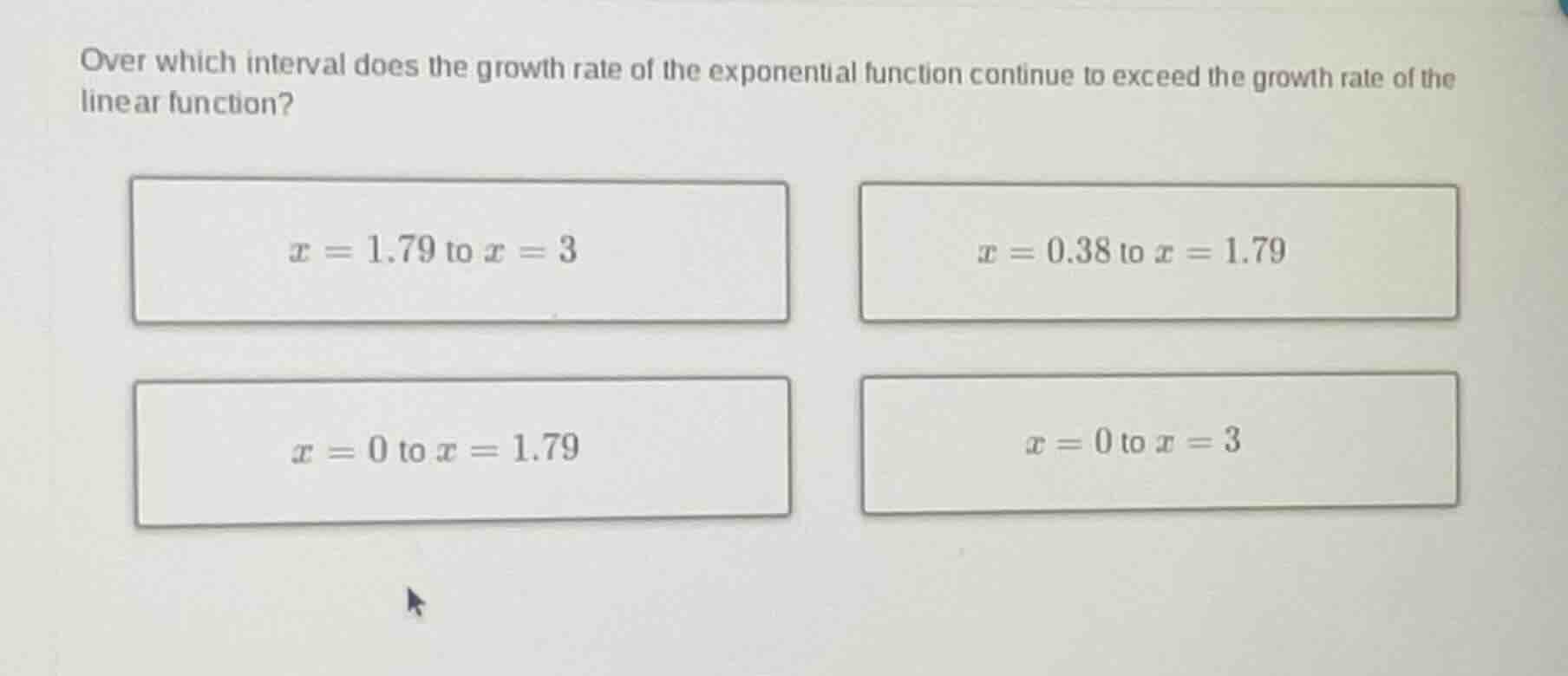
over which interval does the growth rate of the exponential function continue to exceed the growth rate of the linear function?
$x = 1.79$ to $x = 3$
$x = 0.38$ to $x = 1.79$
$x = 0$ to $x = 1.79$
$x = 0$ to $x = 3$
Response
To determine the interval where the exponential function's growth rate exceeds the linear function's, we analyze the behavior of exponential (which grows faster over time, especially as \( x \) increases) and linear (constant growth rate) functions.
- Recall the nature of exponential (\( f(x) = a^x \), \( a > 1 \)) and linear (\( f(x) = mx + b \)) growth:
- Exponential growth rate (derivative) is \( \frac{d}{dx}(a^x) = a^x \ln a \), which increases with \( x \).
- Linear growth rate (slope) is constant (\( m \)).
- Analyze the intervals:
- For \( x = 1.79 \) to \( x = 3 \): As \( x \) increases beyond \( 1.79 \), the exponential function’s growth rate (increasing) will continue to outpace the linear function’s constant growth rate.
- For \( x = 0.38 \) to \( x = 1.79 \) or \( x = 0 \) to \( x = 1.79 \): Early on, the linear function might still have a competitive growth rate, or the exponential has not yet "taken off" enough to consistently exceed the linear rate.
- For \( x = 0 \) to \( x = 3 \): The linear function could outpace the exponential at the start, so the exponential does not continue to exceed it over the entire interval.

Snap & solve any problem in the app
Get step-by-step solutions on Sovi AI
Photo-based solutions with guided steps
Explore more problems and detailed explanations
\( x = 1.79 \) to \( x = 3 \)