QUESTION IMAGE
Question
this is a 2 - page document!
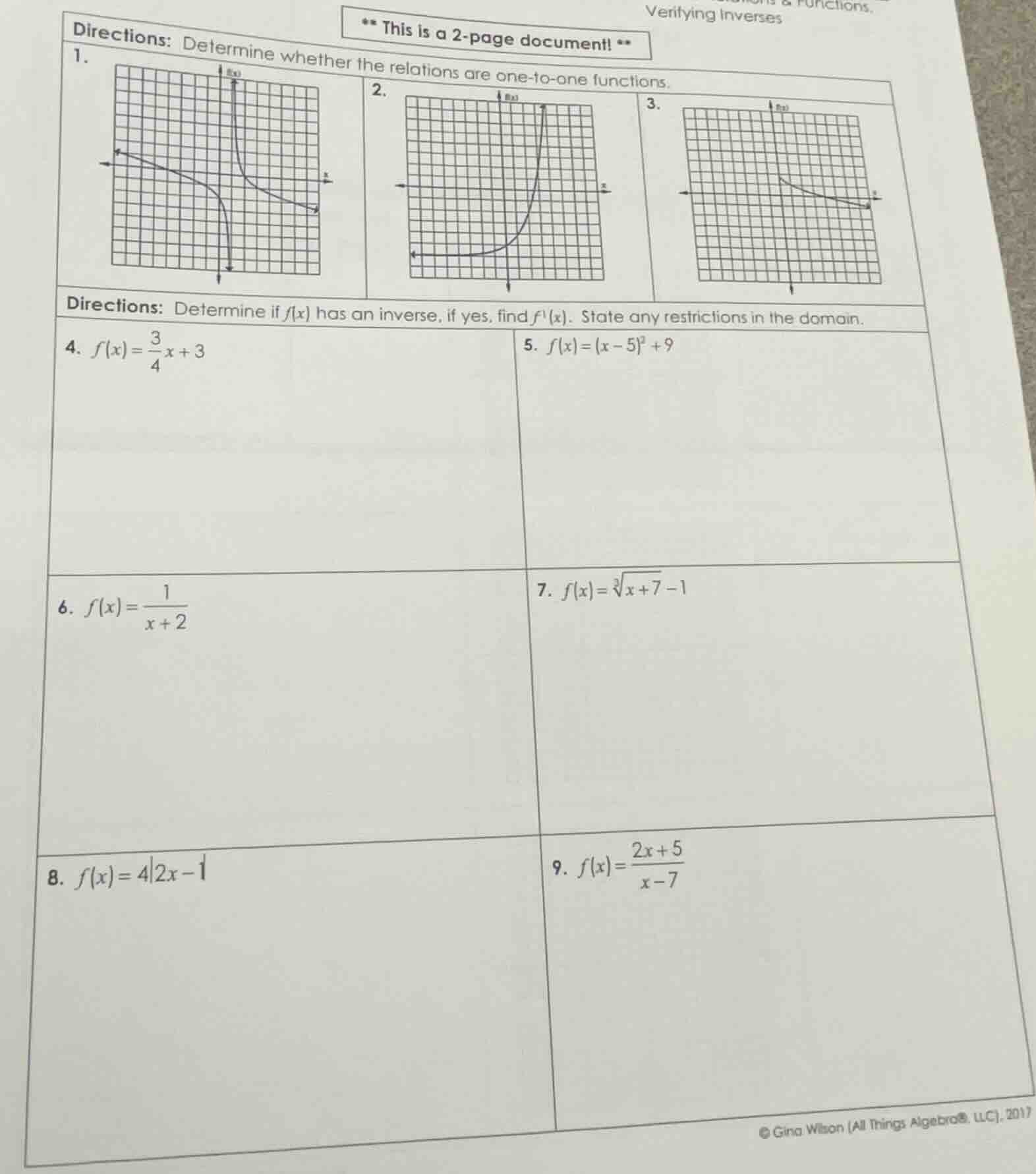
verifying inverses
directions: determine whether the relations are one - to - one functions.
- graph 1
- graph 2
- graph 3
directions: determine if ( f(x) ) has an inverse, if yes, find ( f^{-1}(x) ). state any restrictions in the domain.
- ( f(x)=\frac{3}{4}x + 3 )
- ( f(x)=(x - 5)^2+9 )
- ( f(x)=\frac{1}{x + 2} )
- ( f(x)=sqrt3{x + 7}-1 )
- ( f(x)=4|2x - 1| )
- ( f(x)=\frac{2x + 5}{x - 7} )
© gina wilson (all things algebra®, llc), 2017
Let's solve question 4: \( f(x) = \frac{3}{4}x + 3 \)
Step 1: Check if the function is one - to - one (invertible)
A linear function of the form \( y=mx + b\) where \(m
eq0\) is a one - to - one function. For \(f(x)=\frac{3}{4}x + 3\), the slope \(m = \frac{3}{4}
eq0\), so it is one - to - one and has an inverse.
Step 2: Replace \(f(x)\) with \(y\)
We have \(y=\frac{3}{4}x + 3\)
Step 3: Swap \(x\) and \(y\)
We get \(x=\frac{3}{4}y+3\)
Step 4: Solve for \(y\)
First, subtract 3 from both sides:
\(x - 3=\frac{3}{4}y\)
Then, multiply both sides by \(\frac{4}{3}\) to isolate \(y\):
\(y=\frac{4}{3}(x - 3)=\frac{4}{3}x-4\)
Step 5: Replace \(y\) with \(f^{-1}(x)\)
So, \(f^{-1}(x)=\frac{4}{3}x - 4\)
The domain of the original function \(f(x)=\frac{3}{4}x + 3\) is all real numbers (\((-\infty,\infty)\)) since it is a linear function. There are no restrictions on the domain for the inverse function \(f^{-1}(x)\) other than the domain being all real numbers as well (because the range of \(f(x)\) is all real numbers).

Snap & solve any problem in the app
Get step-by-step solutions on Sovi AI
Photo-based solutions with guided steps
Explore more problems and detailed explanations
The function \(f(x)=\frac{3}{4}x + 3\) has an inverse. The inverse function is \(f^{-1}(x)=\frac{4}{3}x - 4\) and the domain of \(f(x)\) (and the range of \(f^{-1}(x)\)) is \((-\infty,\infty)\), and the domain of \(f^{-1}(x)\) (and the range of \(f(x)\)) is \((-\infty,\infty)\)