QUESTION IMAGE
Question
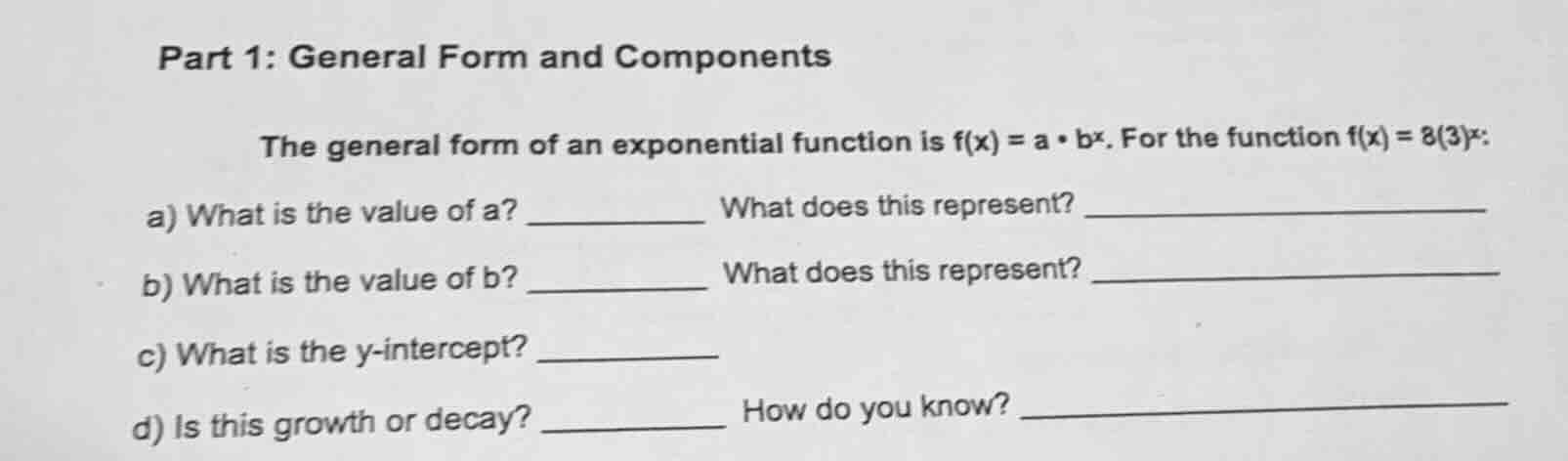
part 1: general form and components
the general form of an exponential function is $f(x) = a \cdot b^x$. for the function $f(x) = 8(3)^x$:
a) what is the value of $a$? \underline{\qquad\qquad} what does this represent? \underline{\qquad\qquad\qquad\qquad\qquad}
b) what is the value of $b$? \underline{\qquad\qquad} what does this represent? \underline{\qquad\qquad\qquad\qquad\qquad}
c) what is the $y$-intercept? \underline{\qquad\qquad}
d) is this growth or decay? \underline{\qquad\qquad} how do you know? \underline{\qquad\qquad\qquad\qquad\qquad}
Step1: Identify parameter $a$
Compare $f(x)=8(3)^x$ to $f(x)=a\cdot b^x$.
$a = 8$
This is the initial value (when $x=0$).
Step2: Identify parameter $b$
Compare $f(x)=8(3)^x$ to $f(x)=a\cdot b^x$.
$b = 3$
This is the base/growth factor.
Step3: Calculate y-intercept
Set $x=0$: $f(0)=8(3)^0=8\cdot1=8$
Step4: Classify growth/decay
Check $b$: $b=3>1$, so it is growth.

Snap & solve any problem in the app
Get step-by-step solutions on Sovi AI
Photo-based solutions with guided steps
Explore more problems and detailed explanations
a) $a = 8$; It represents the initial value (the value of the function when $x=0$)
b) $b = 3$; It represents the growth factor of the exponential function
c) $8$
d) Growth; Because the base $b=3$ is greater than 1