QUESTION IMAGE
Question
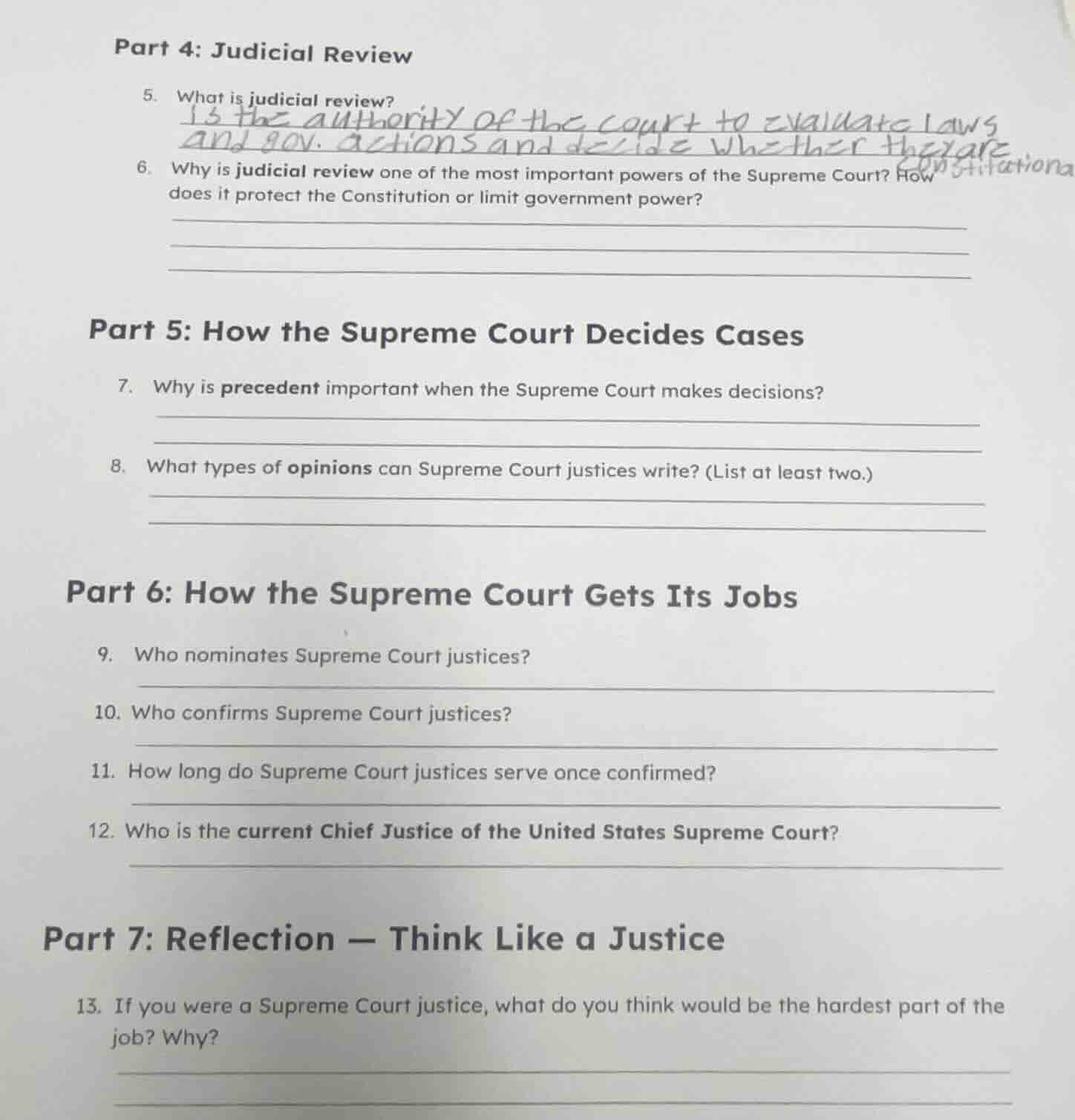
part 4: judicial review
- what is judicial review?
- why is judicial review one of the most important powers of the supreme court? how does it protect the constitution or limit government power?
part 5: how the supreme court decides cases
- why is precedent important when the supreme court makes decisions?
- what types of opinions can supreme court justices write? (list at least two.)
part 6: how the supreme court gets its jobs
- who nominates supreme court justices?
- who confirms supreme court justices?
- how long do supreme court justices serve once confirmed?
- who is the current chief justice of the united states supreme court?
part 7: reflection — think like a justice
- if you were a supreme court justice, what do you think would be the hardest part of the job? why?
Brief Explanations
- Judicial review is the authority of courts to evaluate laws, executive actions, and government policies to determine if they align with the Constitution; if found unconstitutional, the court can strike them down.
- It is critical because it acts as a check on the legislative and executive branches, preventing them from overstepping constitutional limits. It protects the Constitution by upholding its supremacy, and limits government power by invalidating actions that violate constitutional principles.
- Precedent (stare decisis) ensures consistency, predictability, and fairness in Supreme Court decisions. It provides a stable legal framework so individuals and institutions can understand and follow the law, and it respects prior judicial reasoning.
- Supreme Court justices write majority opinions (which represent the Court's official ruling and reasoning) and dissenting opinions (which explain why a justice disagrees with the majority ruling). They may also write concurring opinions (agreeing with the outcome but not the full reasoning of the majority).
- The President of the United States nominates Supreme Court justices.
- The United States Senate confirms Supreme Court justices, requiring a majority vote.
- Supreme Court justices serve lifetime (tenure during "good Behaviour") terms once confirmed, with no mandatory retirement age.
- As of 2024, the current Chief Justice of the U.S. Supreme Court is John Roberts.
- A common hardest part is balancing legal precedent with evolving societal values. Justices must respect prior rulings to maintain legal stability, but may face pressure to adapt the law to address modern social, technological, or ethical changes, creating a conflict between tradition and progress.

Snap & solve any problem in the app
Get step-by-step solutions on Sovi AI
Photo-based solutions with guided steps
Explore more problems and detailed explanations
- Judicial review is the power of courts to assess laws and government actions against the Constitution, and invalidate those found unconstitutional.
- It is a core check on legislative/executive overreach; it protects the Constitution by enforcing its supremacy, and limits government power by striking down unconstitutional acts.
- It ensures consistent, predictable, fair legal outcomes and upholds legal stability.
- 1. Majority opinion (official Court ruling)
- Dissenting opinion (disagreement with majority)
- The President of the United States
- The United States Senate
- Lifetime tenure (during "good Behaviour")
- John Roberts (as of 2024)
- Example: Balancing precedent and societal change. Respecting prior rulings for stability while addressing modern needs creates difficult ethical and legal trade-offs.