QUESTION IMAGE
Question
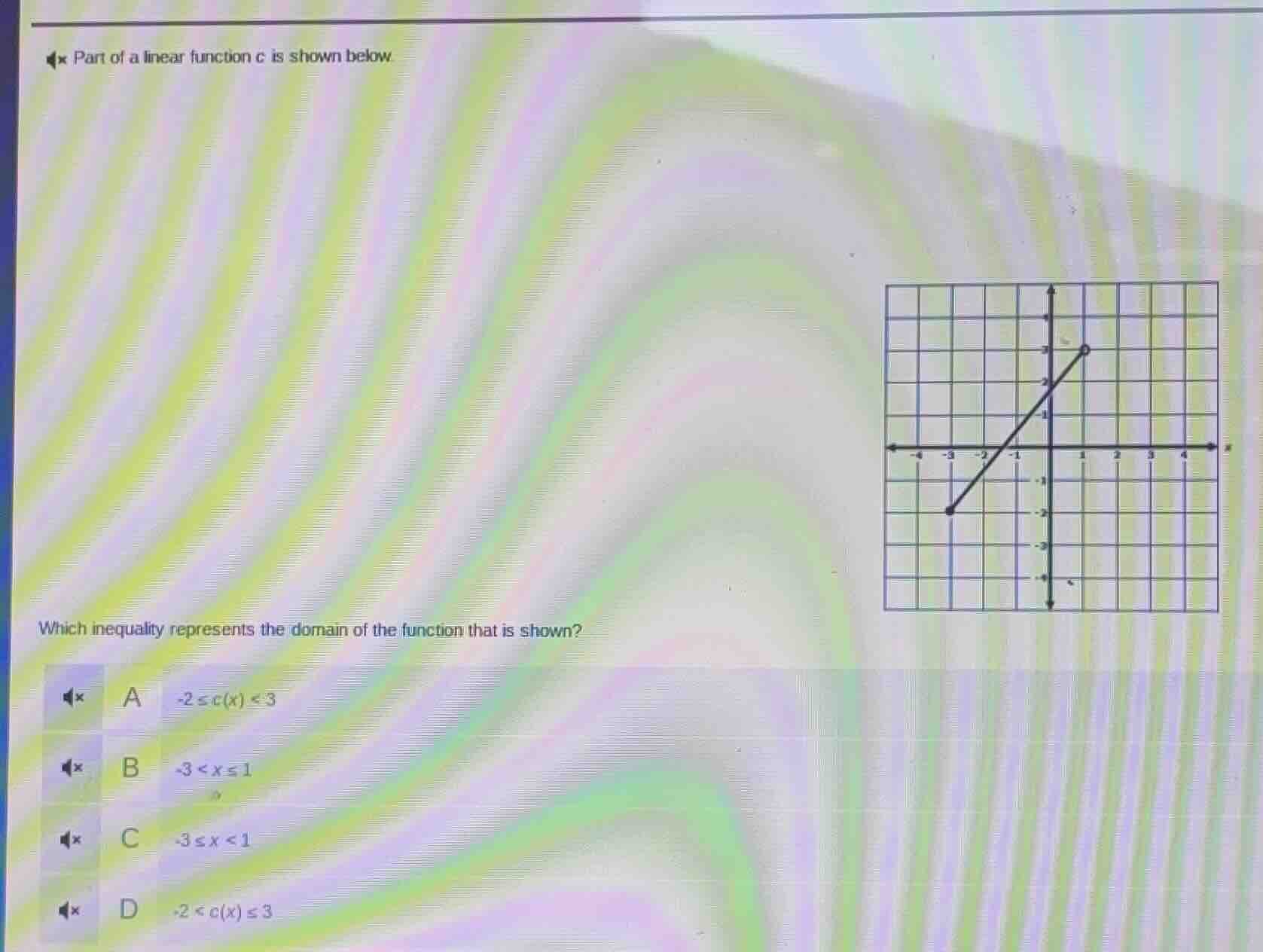
part of a linear function c is shown below
which inequality represents the domain of the function that is shown?
a (-2 leq c(x) < 3)
b (-3 < x leq 1)
c (-3 leq x < 1)
d (-2 < c(x) leq 3)
Step1: Recall the definition of domain
The domain of a function is the set of all possible \( x \)-values (input values) for which the function is defined. So we need to look at the \( x \)-coordinates of the points on the graph.
Step2: Analyze the graph's \( x \)-values
Looking at the graph, the leftmost point (the closed dot) is at \( x = - 3 \) (since the closed dot means \( x=-3 \) is included), and the rightmost point (the open dot) is at \( x = 1 \) (the open dot means \( x = 1 \) is not included). So the \( x \)-values range from \( - 3 \) (inclusive) to \( 1 \) (exclusive).
Step3: Match with the options
- Option A and D are about \( c(x) \) (the range, since \( c(x) \) is the output or \( y \)-value), so they are incorrect.
- Option B: \( - 3
- Option C: \( - 3\leq x<1 \) matches our analysis, as \( x=-3 \) is included (closed dot) and \( x = 1 \) is not included (open dot).

Snap & solve any problem in the app
Get step-by-step solutions on Sovi AI
Photo-based solutions with guided steps
Explore more problems and detailed explanations
C. \( -3 \leq x < 1 \)