QUESTION IMAGE
Question
part a – numerical expressions (order of operations)
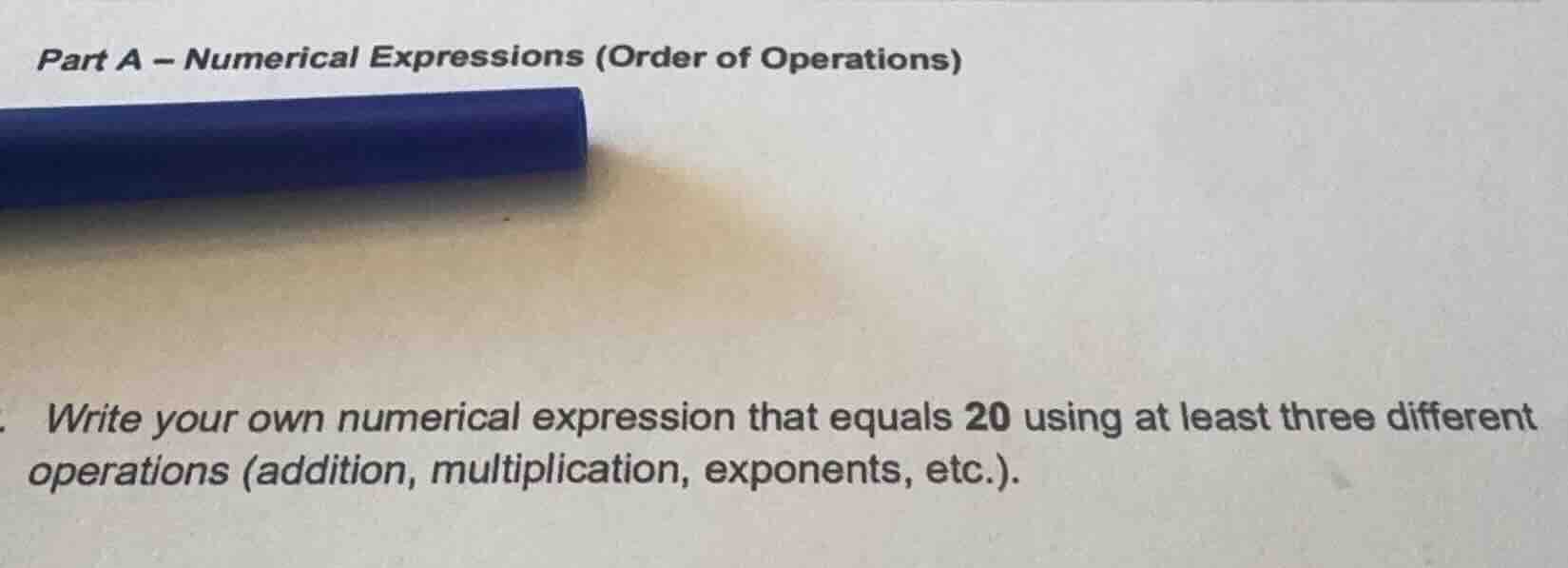
write your own numerical expression that equals 20 using at least three different operations (addition, multiplication, exponents, etc.).
Step1: Choose operations and numbers
Let's use addition, multiplication, and exponentiation. Start with a small exponent, like \(2^2 = 4\), then multiply by a number, say 3, and add the remaining to reach 20.
Step2: Construct the expression
We know \(2^2 = 4\), then \(4\times3 = 12\), and then add 8 (but we can also build 8 from operations). Wait, maybe a better way: \(2^2\times(3 + 2)\). Let's check: \(2^2=4\), \(3 + 2 = 5\), then \(4\times5 = 20\). Wait, but that's two operations? Wait, no, exponentiation, addition, and multiplication. Wait, \(2^2\) is exponentiation, \(3 + 2\) is addition, and then multiplication. So the expression is \(2^2\times(3 + 2)\). Let's verify:
First, calculate the exponent: \(2^2 = 4\).
Then, calculate the addition inside the parentheses: \(3 + 2 = 5\).
Then, multiply the two results: \(4\times5 = 20\).
Another example: \( (5 - 2)^2 + (4\times1) \). Let's check: \(5 - 2 = 3\), \(3^2 = 9\), \(4\times1 = 4\), then \(9 + 4 = 13\). No, that's not 20. Wait, let's try \( (6 - 2)^2 - (4\times1) \). \(6 - 2 = 4\), \(4^2 = 16\), \(4\times1 = 4\), \(16 + 4 = 20\) (wait, minus? No, \(16 - 4 = 12\). Oops. Let's correct: \( (5 - 1)^2 + (2\times2) \). \(5 - 1 = 4\), \(4^2 = 16\), \(2\times2 = 4\), \(16 + 4 = 20\). Here we have subtraction, exponentiation, multiplication, and addition. But we need at least three different operations. Let's go back to the first one: \(2^2\times(3 + 2)\) has exponentiation, addition, and multiplication (three operations).
Or \( (10\div2) + (3\times5) - 5 \). Wait, \(10\div2 = 5\), \(3\times5 = 15\), then \(5 + 15 = 20\), then \(20 - 5 = 15\). No, that's not. Wait, \( (10\div2) + (3\times5) - 5 \) is wrong. Let's do \( (10\div2) + (3\times5) - 0 \), but 0 is not helpful. Wait, better: \( (8\div2) + (4\times3) - 4 \). \(8\div2 = 4\), \(4\times3 = 12\), \(4 + 12 = 16\), \(16 + 4 = 20\) (wait, minus 4? No, \(16 - 4 = 12\). Oops. Let's try \( (9 - 4)^2 - (5\times1) \). \(9 - 4 = 5\), \(5^2 = 25\), \(5\times1 = 5\), \(25 - 5 = 20\). Here we have subtraction, exponentiation, and multiplication (and subtraction again, but we need at least three different operations: subtraction, exponentiation, multiplication).
But the first example \(2^2\times(3 + 2)\) has exponentiation, addition, and multiplication (three different operations) and equals 20.

Snap & solve any problem in the app
Get step-by-step solutions on Sovi AI
Photo-based solutions with guided steps
Explore more problems and detailed explanations
One possible numerical expression is \(2^2\times(3 + 2)\) (which equals 20 using exponentiation, addition, and multiplication as three different operations). Another is \((9 - 4)^2 - (5\times1)\) (using subtraction, exponentiation, and multiplication).