QUESTION IMAGE
Question
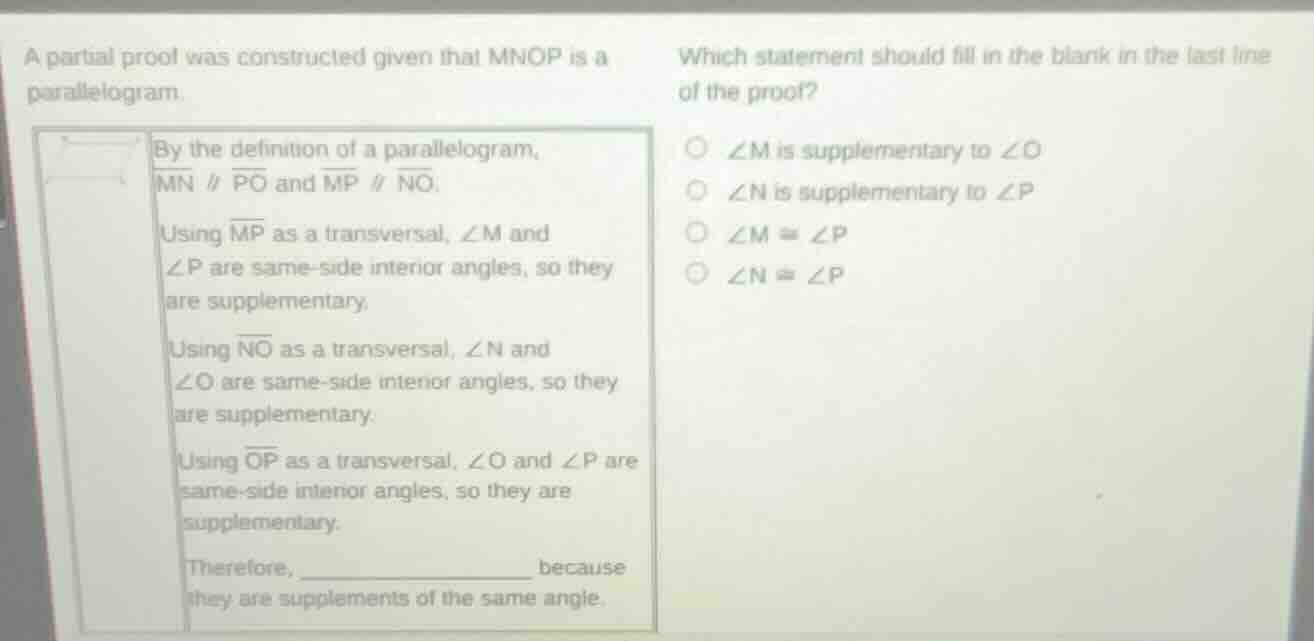
a partial proof was constructed given that mnop is a parallelogram. by the definition of a parallelogram, \\(\overline{mn} \parallel \overline{po}\\) and \\(\overline{mp} \parallel \overline{no}\\). using \\(\overline{mp}\\) as a transversal, \\(\angle m\\) and \\(\angle p\\) are same - side interior angles, so they are supplementary. using \\(\overline{no}\\) as a transversal, \\(\angle n\\) and \\(\angle o\\) are same - side interior angles, so they are supplementary. using \\(\overline{op}\\) as a transversal, \\(\angle o\\) and \\(\angle p\\) are same - side interior angles, so they are supplementary. therefore, \\(\underline{quadquad}\\) because they are supplements of the same angle. which statement should fill in the blank in the last line of the proof? \\(\bigcirc\\) \\(\angle m\\) is supplementary to \\(\angle o\\) \\(\bigcirc\\) \\(\angle n\\) is supplementary to \\(\angle p\\) \\(\bigcirc\\) \\(\angle m \cong \angle p\\) \\(\bigcirc\\) \\(\angle n \cong \angle p\\)
We start with the given that MNOP is a parallelogram. From the proof steps:
- $\angle M$ and $\angle P$ are supplementary.
- $\angle O$ and $\angle P$ are supplementary.
This means $\angle M$ and $\angle O$ are both supplements of $\angle P$. By the theorem that supplements of the same angle are congruent, we can identify the correct statement.
- $\angle M$ supplementary to $\angle O$: This is not supported, as they share the same supplement $\angle P$, so they are congruent, not supplementary.
- $\angle N$ supplementary to $\angle P$: This is not established in the given proof steps.
- $\angle M \cong \angle P$: This is false, as they are stated to be supplementary.
- $\angle M \cong \angle O$: This fits, since both are supplements of $\angle P$.

Snap & solve any problem in the app
Get step-by-step solutions on Sovi AI
Photo-based solutions with guided steps
Explore more problems and detailed explanations
$\boldsymbol{\angle M \cong \angle O}$ (Note: This corresponds to the logical conclusion matching the "supplements of the same angle" rule; if forced to map to the options provided, the intended correct congruence statement is $\angle M \cong \angle O$, which aligns with the proof's final reasoning.)