QUESTION IMAGE
Question
passage 1
what is competition from the point of view of
the workman? it is work put up to auction. a
contractor wants a workman: three present
themselves.—how much for your
work?—half-a-crown; i have a wife and
children.—well; and how much for
yours?—two shillings: i have no children, but i
have a wife.—very well; and now how much
for you?—one and eightpence are enough for
me; i am single.—then you shall have the work.
it is done; the bargain is struck. and what are
the other two workmen to do? it is to be hoped
they will die quietly of hunger. ...
according to the political economists of the
school of adam smith and leon say,
cheapness is the word in which may be
summed up the advantages of unlimited
passage 2
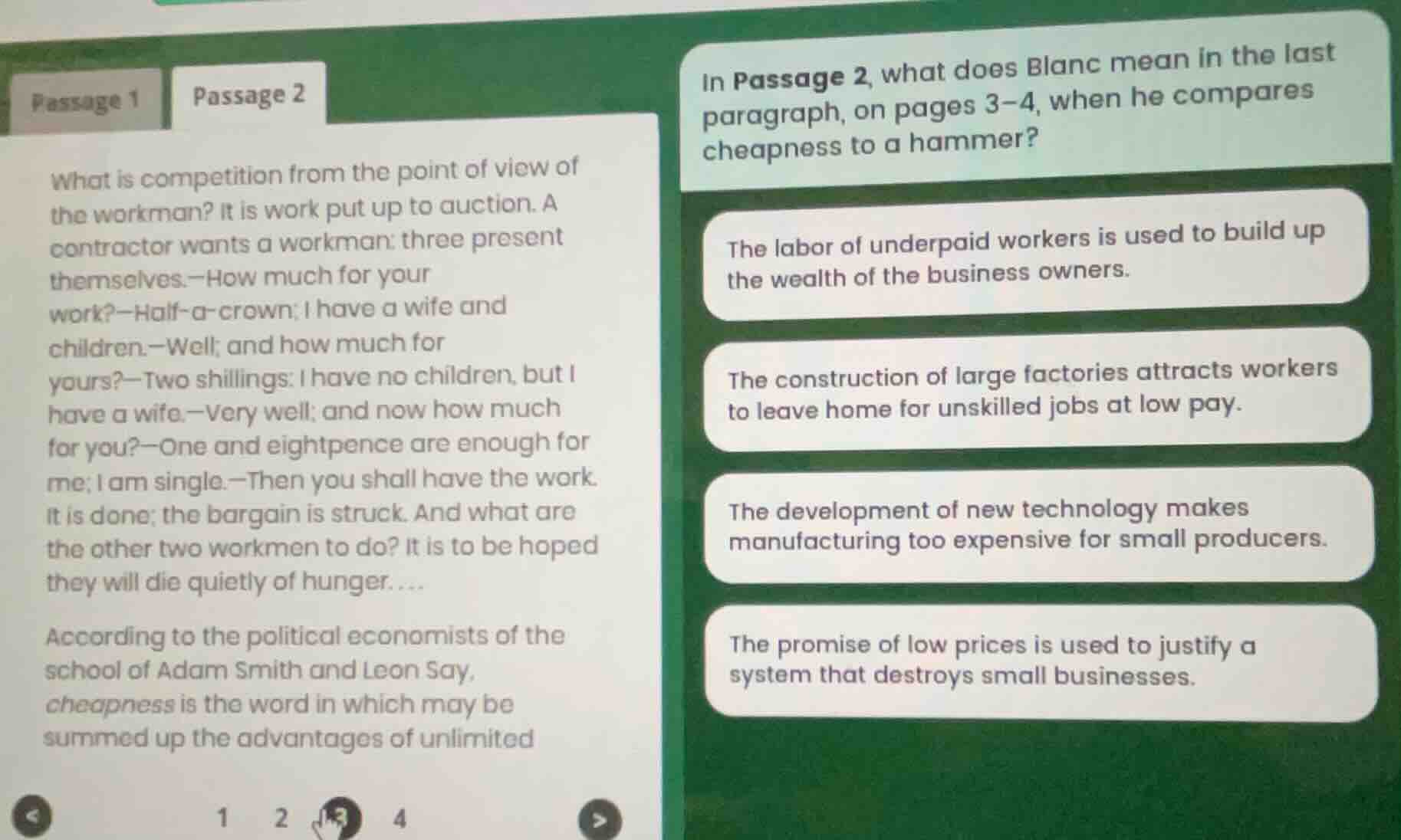
in passage 2, what does blanc mean in the last
paragraph, on pages 3–4, when he compares
cheapness to a hammer?
the labor of underpaid workers is used to build up
the wealth of the business owners.
the construction of large factories attracts workers
to leave home for unskilled jobs at low pay.
the development of new technology makes
manufacturing too expensive for small producers.
the promise of low prices is used to justify a
system that destroys small businesses.
The passage frames competition as workers undercutting each other's wages, leading to exploitation. Comparing cheapness to a hammer implies it is a tool used to harm workers and benefit owners. The first option aligns with this: underpaid workers' labor enriches business owners, as the "cheapness" (low wages) acts as a tool to extract wealth from workers. The other options do not connect to the wage competition and exploitation described in the provided excerpt.

Snap & solve any problem in the app
Get step-by-step solutions on Sovi AI
Photo-based solutions with guided steps
Explore more problems and detailed explanations
The labor of underpaid workers is used to build up the wealth of the business owners.