QUESTION IMAGE
Question
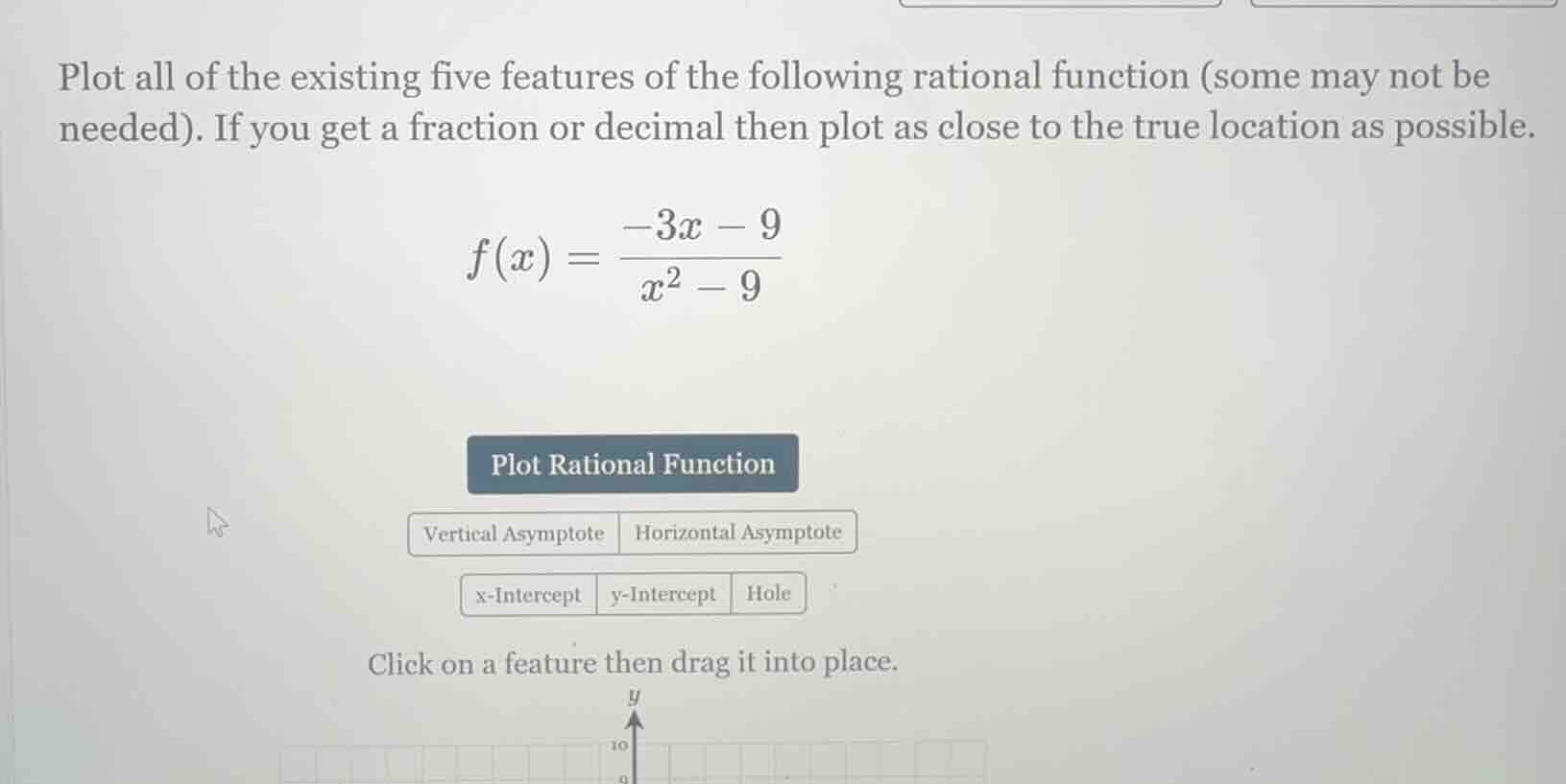
plot all of the existing five features of the following rational function (some may not be needed). if you get a fraction or decimal then plot as close to the true location as possible. f(x) = (-3x - 9)/(x² - 9) plot rational function vertical asymptote horizontal asymptote x-intercept y-intercept hole click on a feature then drag it into place. y
Step1: Simplify the function
First, factor the numerator and the denominator. The numerator \( -3x - 9=-3(x + 3) \), and the denominator \( x^{2}-9=(x + 3)(x - 3) \). Then, cancel out the common factor \( (x + 3) \) (note that \( x
eq - 3 \) to avoid division by zero), so the simplified function is \( f(x)=\frac{-3}{x - 3} \) with a hole at \( x=-3 \).
Step2: Find Vertical Asymptote
Vertical asymptotes occur where the denominator of the simplified function is zero (and the numerator is not zero there). For \( f(x)=\frac{-3}{x - 3} \), set \( x - 3 = 0 \), so \( x = 3 \) is the vertical asymptote.
Step3: Find Horizontal Asymptote
For a rational function \( f(x)=\frac{ax^{n}+...}{bx^{m}+...} \), if \( n To find the x - intercept, set \( f(x)=0 \). But for \( f(x)=\frac{-3}{x - 3} \), \( \frac{-3}{x - 3}=0 \) has no solution because the numerator is - 3 (non - zero), so there is no x - intercept. To find the y - intercept, set \( x = 0 \) in the original function (or simplified function). Using the simplified function \( f(0)=\frac{-3}{0 - 3}=\frac{-3}{-3}=1 \), so the y - intercept is at \( (0,1) \). A hole occurs where the common factor is zero. We had a common factor of \( (x + 3) \), so set \( x+3 = 0\Rightarrow x=-3 \). To find the y - coordinate of the hole, substitute \( x=-3 \) into the simplified function (before canceling the common factor, we can also use the simplified form? Wait, no, when we cancel \( (x + 3) \), the original function is undefined at \( x=-3 \), but the limit as \( xStep4: Find x - intercept
Step5: Find y - intercept
Step6: Find Hole
ightarrow - 3 \) of \( \frac{-3(x + 3)}{(x + 3)(x - 3)} \) (for \( x
eq - 3 \)) is \( \frac{-3}{-3 - 3}=\frac{-3}{-6}=\frac{1}{2} \)? Wait, no, wait: \( \lim_{x
ightarrow - 3}\frac{-3(x + 3)}{(x + 3)(x - 3)}=\lim_{x
ightarrow - 3}\frac{-3}{x - 3}=\frac{-3}{-3 - 3}=\frac{-3}{-6}=\frac{1}{2} \). Wait, I made a mistake earlier. Wait, original numerator: \( -3x - 9=-3(x + 3) \), denominator: \( x^{2}-9=(x + 3)(x - 3) \). So when we cancel \( (x + 3) \), the function is \( f(x)=\frac{-3}{x - 3} \), \( x
eq - 3 \). So the hole is at \( x=-3 \), and to find the y - value, we substitute \( x = - 3 \) into the simplified function (since the limit exists there). So \( f(-3)=\frac{-3}{-3 - 3}=\frac{-3}{-6}=\frac{1}{2} \). So the hole is at \( (-3,\frac{1}{2}) \).

Snap & solve any problem in the app
Get step-by-step solutions on Sovi AI
Photo-based solutions with guided steps
Explore more problems and detailed explanations
- Vertical Asymptote: \( x = 3 \)
- Horizontal Asymptote: \( y = 0 \)
- x - intercept: None
- y - intercept: \( (0,1) \)
- Hole: \( (-3,\frac{1}{2}) \)