QUESTION IMAGE
Question
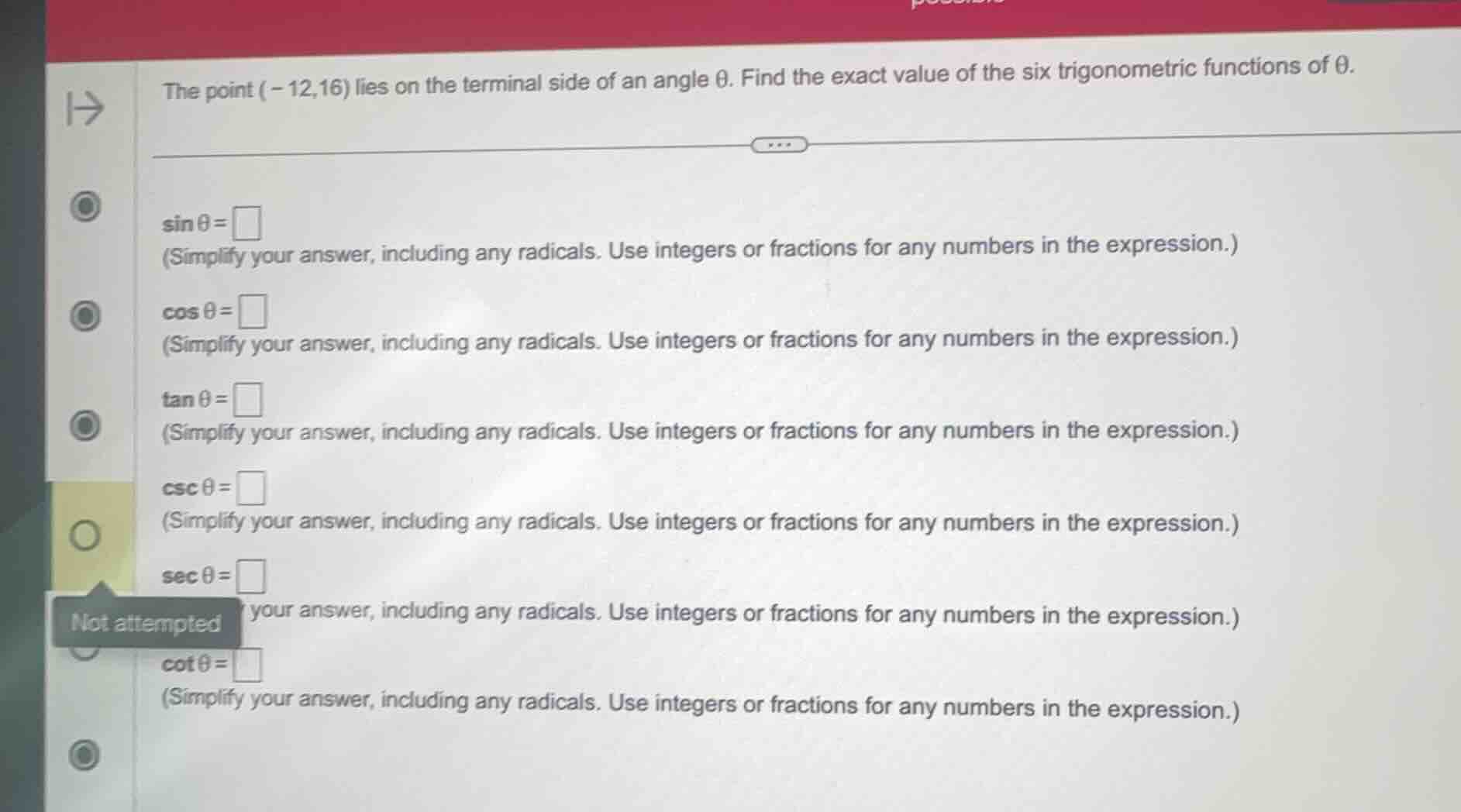
the point (-12,16) lies on the terminal side of an angle θ. find the exact value of the six trigonometric functions of θ.
sin θ =
(simplify your answer, including any radicals. use integers or fractions for any numbers in the expression.)
cos θ =
(simplify your answer, including any radicals. use integers or fractions for any numbers in the expression.)
tan θ =
(simplify your answer, including any radicals. use integers or fractions for any numbers in the expression.)
csc θ =
(simplify your answer, including any radicals. use integers or fractions for any numbers in the expression.)
sec θ =
(simplify your answer, including any radicals. use integers or fractions for any numbers in the expression.)
cot θ =
(simplify your answer, including any radicals. use integers or fractions for any numbers in the expression.)
Step1: Find the radius \( r \)
For a point \((x, y)\) on the terminal side of an angle, \( r=\sqrt{x^{2}+y^{2}} \). Here, \( x = - 12\), \( y = 16 \). So \( r=\sqrt{(-12)^{2}+16^{2}}=\sqrt{144 + 256}=\sqrt{400}=20 \).
Step2: Calculate \( \sin\theta \)
\(\sin\theta=\frac{y}{r}\), substituting \( y = 16 \), \( r = 20 \), we get \(\sin\theta=\frac{16}{20}=\frac{4}{5}\).
Step3: Calculate \( \cos\theta \)
\(\cos\theta=\frac{x}{r}\), substituting \( x=-12 \), \( r = 20 \), we get \(\cos\theta=\frac{-12}{20}=-\frac{3}{5}\).
Step4: Calculate \( \tan\theta \)
\(\tan\theta=\frac{y}{x}\), substituting \( y = 16 \), \( x=-12 \), we get \(\tan\theta=\frac{16}{-12}=-\frac{4}{3}\).
Step5: Calculate \( \csc\theta \)
\(\csc\theta=\frac{1}{\sin\theta}\), since \(\sin\theta=\frac{4}{5}\), then \(\csc\theta=\frac{5}{4}\).
Step6: Calculate \( \sec\theta \)
\(\sec\theta=\frac{1}{\cos\theta}\), since \(\cos\theta=-\frac{3}{5}\), then \(\sec\theta=\frac{1}{-\frac{3}{5}}=-\frac{5}{3}\).
Step7: Calculate \( \cot\theta \)
\(\cot\theta=\frac{1}{\tan\theta}\), since \(\tan\theta=-\frac{4}{3}\), then \(\cot\theta=\frac{1}{-\frac{4}{3}}=-\frac{3}{4}\).

Snap & solve any problem in the app
Get step-by-step solutions on Sovi AI
Photo-based solutions with guided steps
Explore more problems and detailed explanations
\(\sin\theta=\frac{4}{5}\)
\(\cos\theta=-\frac{3}{5}\)
\(\tan\theta=-\frac{4}{3}\)
\(\csc\theta=\frac{5}{4}\)
\(\sec\theta=-\frac{5}{3}\)
\(\cot\theta=-\frac{3}{4}\)