QUESTION IMAGE
Question
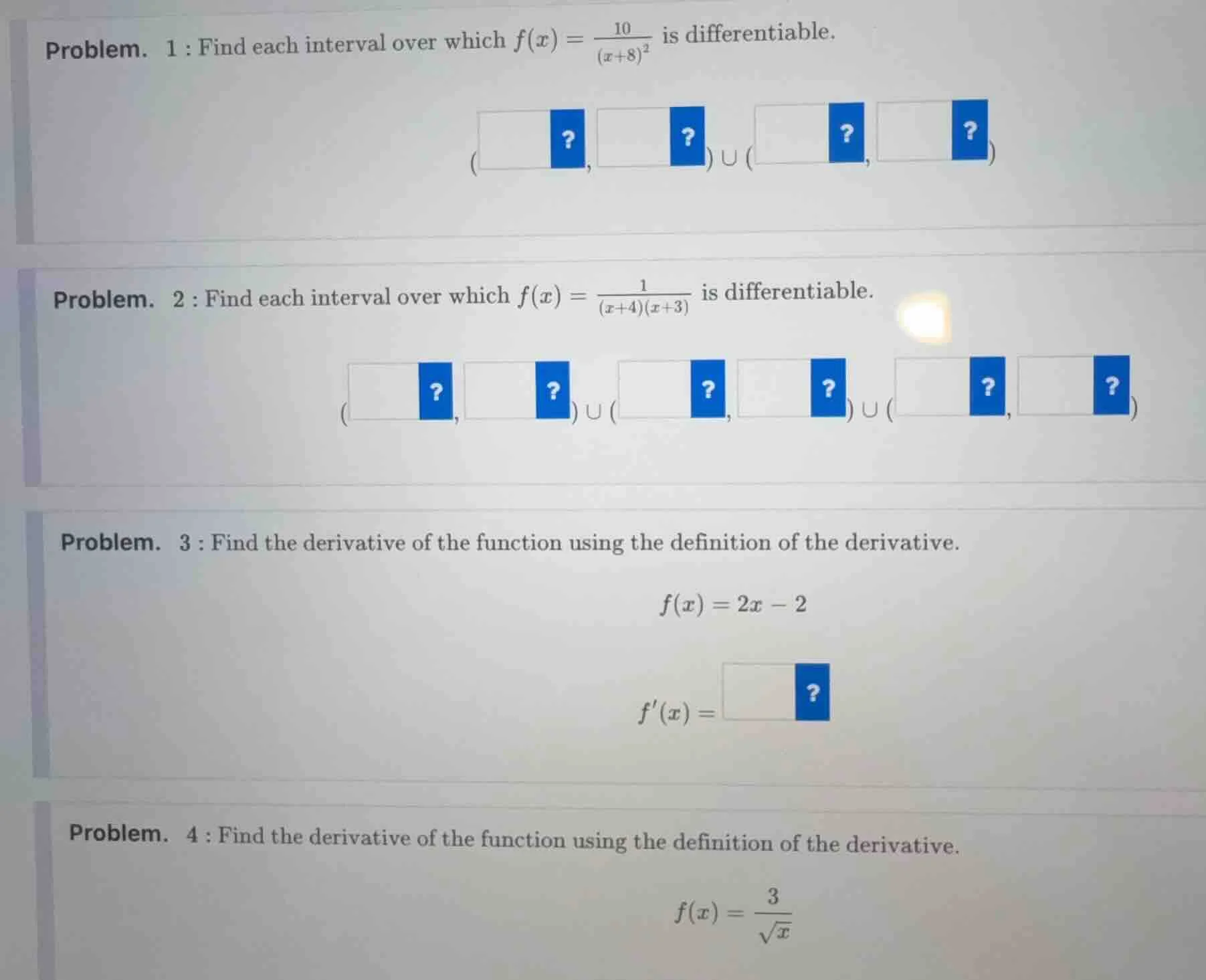
problem. 1 : find each interval over which $f(x) = \frac{10}{(x + 8)^2}$ is differentiable.
(\boxed{?}, \boxed{?}) \cup (\boxed{?}, \boxed{?})
problem. 2 : find each interval over which $f(x) = \frac{1}{(x + 4)(x + 3)}$ is differentiable.
(\boxed{?}, \boxed{?}) \cup (\boxed{?}, \boxed{?}) \cup (\boxed{?}, \boxed{?})
problem. 3 : find the derivative of the function using the definition of the derivative.
$f(x) = 2x - 2$
$f(x) = \boxed{?}$
problem. 4 : find the derivative of the function using the definition of the derivative.
$f(x) = \frac{3}{\sqrt{x}}$
Problem 1
Step1: Find where the function is undefined
The function \( f(x)=\frac{10}{(x + 8)^2} \) is undefined when the denominator is zero. So, solve \((x + 8)^2=0\). This gives \(x=-8\).
Step2: Determine differentiable intervals
A function is differentiable on intervals where it is continuous and defined. Since the function has a discontinuity at \(x = - 8\), the function is differentiable on \((-\infty,-8)\cup(-8,\infty)\).
Step1: Find where the function is undefined
The function \( f(x)=\frac{1}{(x + 4)(x + 3)} \) is undefined when \((x + 4)(x + 3)=0\). Solving \(x+4 = 0\) gives \(x=-4\) and solving \(x + 3=0\) gives \(x=-3\).
Step2: Determine differentiable intervals
The function has discontinuities at \(x=-4\) and \(x=-3\). So, the function is differentiable on \((-\infty,-4)\cup(-4,-3)\cup(-3,\infty)\).
Step1: Recall the definition of the derivative
The definition of the derivative is \(f^{\prime}(x)=\lim_{h
ightarrow0}\frac{f(x + h)-f(x)}{h}\).
Step2: Substitute \(f(x)=2x - 2\) into the formula
First, find \(f(x + h)=2(x + h)-2=2x+2h - 2\). Then, \(\frac{f(x + h)-f(x)}{h}=\frac{(2x + 2h-2)-(2x - 2)}{h}\).
Step3: Simplify the expression
Simplify the numerator: \((2x + 2h-2)-(2x - 2)=2x+2h - 2-2x + 2 = 2h\). Then \(\frac{2h}{h}=2\) (for \(h
eq0\)).
Step4: Take the limit
\(f^{\prime}(x)=\lim_{h
ightarrow0}2 = 2\).

Snap & solve any problem in the app
Get step-by-step solutions on Sovi AI
Photo-based solutions with guided steps
Explore more problems and detailed explanations
\((-\infty, - 8)\cup(-8, \infty)\)