QUESTION IMAGE
Question
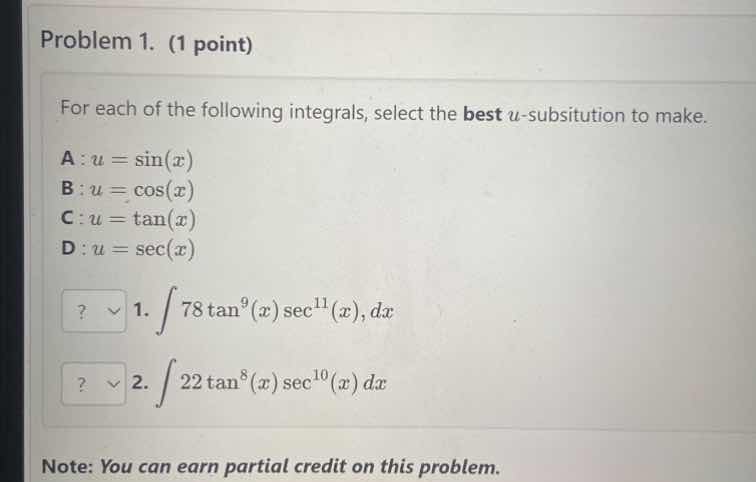
problem 1. (1 point) for each of the following integrals, select the best ( u )-substitution to make. a : ( u = sin(x) ) b : ( u = cos(x) ) c : ( u = \tan(x) ) d : ( u = sec(x) ) 1. ( int 78 \tan^9(x) sec^{11}(x) dx ) 2. ( int 22 \tan^8(x) sec^{10}(x) dx ) note: you can earn partial credit on this problem.
Problem 1
Step1: Analyze the integral $\int 78\tan^{9}(x)\sec^{11}(x)dx$
We know that the derivative of $\sec(x)$ is $\sec(x)\tan(x)$, i.e., $du = \sec(x)\tan(x)dx$ if $u=\sec(x)$. Let's rewrite the integral:
$\int 78\tan^{9}(x)\sec^{11}(x)dx=78\int\tan^{8}(x)\sec^{10}(x)\cdot\sec(x)\tan(x)dx$
If we let $u = \sec(x)$, then $du=\sec(x)\tan(x)dx$ and $\tan^{2}(x)=\sec^{2}(x) - 1$, but here we can also note that the power of $\sec(x)$ is 11 and power of $\tan(x)$ is 9. The derivative of $\sec(x)$ involves $\sec(x)\tan(x)$, so when we substitute $u = \sec(x)$, the integral can be transformed. Also, if we consider the form of the integral which is a product of $\tan^{n}(x)$ and $\sec^{m}(x)$, when $m$ is odd (here $m = 11$ is odd), we can split off a $\sec(x)\tan(x)$ term for substitution. But also, if we let $u=\sec(x)$, then $du=\sec(x)\tan(x)dx$, and we can rewrite $\tan^{9}(x)=\tan^{8}(x)\tan(x)=(\sec^{2}(x)- 1)^{4}\tan(x)$. But another way: Let's check the options. If we take $u = \sec(x)$, then $du=\sec(x)\tan(x)dx$, and the integral becomes $78\int u^{10}\cdot\tan^{8}(x)du$. But $\tan^{8}(x)=(\sec^{2}(x)-1)^{4}=(u^{2}-1)^{4}$. However, also, if we consider the integral of the form $\int\tan^{n}(x)\sec^{m}(x)dx$, when $m$ is even or odd, but in this case, the best substitution is $u = \sec(x)$? Wait, no, wait. Wait, the derivative of $\tan(x)$ is $\sec^{2}(x)$, i.e., $du=\sec^{2}(x)dx$ if $u = \tan(x)$. Wait, let's re - examine.
Wait, the integral is $\int\tan^{9}(x)\sec^{11}(x)dx$. Let's write $\sec^{11}(x)=\sec^{10}(x)\sec(x)$ and $\tan^{9}(x)=\tan^{8}(x)\tan(x)$. Then $\tan^{8}(x)=(\sec^{2}(x)-1)^{4}$. So if we let $u=\sec(x)$, then $du=\sec(x)\tan(x)dx$, and $\tan^{8}(x)=(\ u^{2}-1)^{4}$. Then the integral becomes $78\int(u^{2}-1)^{4}u^{10}du$, which is a polynomial in $u$. But if we let $u = \tan(x)$, then $du=\sec^{2}(x)dx$, and $\sec^{11}(x)=\sec^{9}(x)\sec^{2}(x)=(1 + \tan^{2}(x))^{4.5}\sec^{2}(x)$, which is not as nice. Wait, but the power of $\sec(x)$ is 11 (odd) and power of $\tan(x)$ is 9 (odd). Wait, maybe I made a mistake. Let's recall the standard substitutions for $\int\tan^{n}(x)\sec^{m}(x)dx$:
- If $m$ is even, we can let $u=\tan(x)$ (since $du=\sec^{2}(x)dx$ and $\sec^{2}(x)=1+\tan^{2}(x)$)
- If $n$ is odd, we can let $u = \sec(x)$ (since $du=\sec(x)\tan(x)dx$ and we can split off a $\sec(x)\tan(x)$ term)
In the first integral, $n = 9$ (odd) and $m = 11$ (odd). But let's check the options. The options are $u=\sin(x),\cos(x),\tan(x),\sec(x)$.
Wait, let's compute the derivative of each option:
- If $u=\sin(x)$, $du=\cos(x)dx$, not related to the integrand.
- If $u=\cos(x)$, $du=-\sin(x)dx$, not related.
- If $u=\tan(x)$, $du=\sec^{2}(x)dx$
- If $u=\sec(x)$, $du=\sec(x)\tan(x)dx$
The integrand is $78\tan^{9}(x)\sec^{11}(x)dx=78\tan^{8}(x)\sec^{10}(x)\cdot\sec(x)\tan(x)dx$. If we let $u = \sec(x)$, then $du=\sec(x)\tan(x)dx$ and $\tan^{8}(x)=(\sec^{2}(x)-1)^{4}=(u^{2}-1)^{4}$. So the integral becomes $78\int(u^{2}-1)^{4}u^{10}du$, which is a polynomial integral. Alternatively, if we let $u=\tan(x)$, $du=\sec^{2}(x)dx$, and $\sec^{11}(x)=\sec^{9}(x)\sec^{2}(x)=(1 + \tan^{2}(x))^{4.5}\sec^{2}(x)$, which is more complicated. So the best substitution is $u=\sec(x)$? Wait, no, wait the power of $\sec(x)$ is 11 (odd) and power of $\tan(x)$ is 9 (odd). Wait, maybe the answer is $u = \sec(x)$ (option D) for the first integral? Wait, no, let's check the second integral.
Step2: Analyze the integral $\int22\tan^{8}(x)\sec^{10}(x)dx$
$\int22\tan^{8}(x)\sec^{10}(x)dx=22\int\tan^{8}(x)\sec^{8}(x)\cdot\sec^{2}(x)dx$
If we let $u…

Snap & solve any problem in the app
Get step-by-step solutions on Sovi AI
Photo-based solutions with guided steps
Explore more problems and detailed explanations
- D. $u = \sec(x)$
- C. $u=\tan(x)$