QUESTION IMAGE
Question
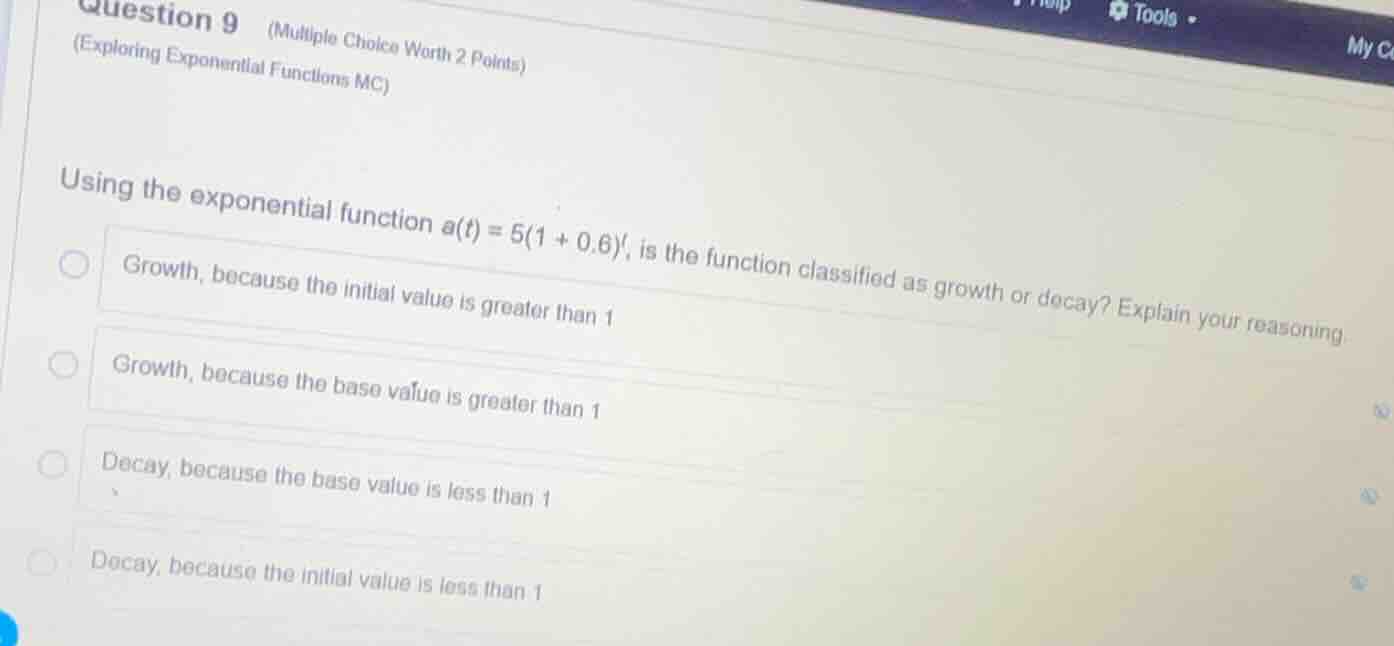
question 9 (multiple choice worth 2 points) (exploring exponential functions mc) using the exponential function $a(t) = 5(1 + 0.6)^t$, is the function classified as growth or decay? explain your reasoning. growth, because the initial value is greater than 1 growth, because the base value is greater than 1 decay, because the base value is less than 1 decay, because the initial value is less than 1
Step1: Recall exponential function form
The general form of an exponential function is \( a(t)=a_0(1 + r)^t \) (for growth) or \( a(t)=a_0(1 - r)^t \) (for decay), where \( a_0 \) is the initial value and the base \( (1 + r) \) or \( (1 - r) \) determines growth/decay. If the base \( b>1 \), it's growth; if \( 0 < b<1 \), it's decay.
Step2: Identify the base in given function
Given \( a(t)=5(1 + 0.6)^t \), the base of the exponential part is \( 1 + 0.6=1.6 \).
Step3: Compare base to 1
Since \( 1.6>1 \), by the rule of exponential functions, when the base is greater than 1, the function represents growth. Now check the options:
- First option: Wrong, initial value is 5, growth/decay depends on base, not initial value.
- Second option: Correct, base \( 1.6>1 \), so growth.
- Third option: Wrong, base is greater than 1, not less.
- Fourth option: Wrong, initial value doesn't determine growth/decay, and 5 is not less than 1.

Snap & solve any problem in the app
Get step-by-step solutions on Sovi AI
Photo-based solutions with guided steps
Explore more problems and detailed explanations
B. Growth, because the base value is greater than 1 (assuming the second option is labeled B, if original labels were different, adjust the label but the text is "Growth, because the base value is greater than 1")