QUESTION IMAGE
Question
question 4 (1 point)
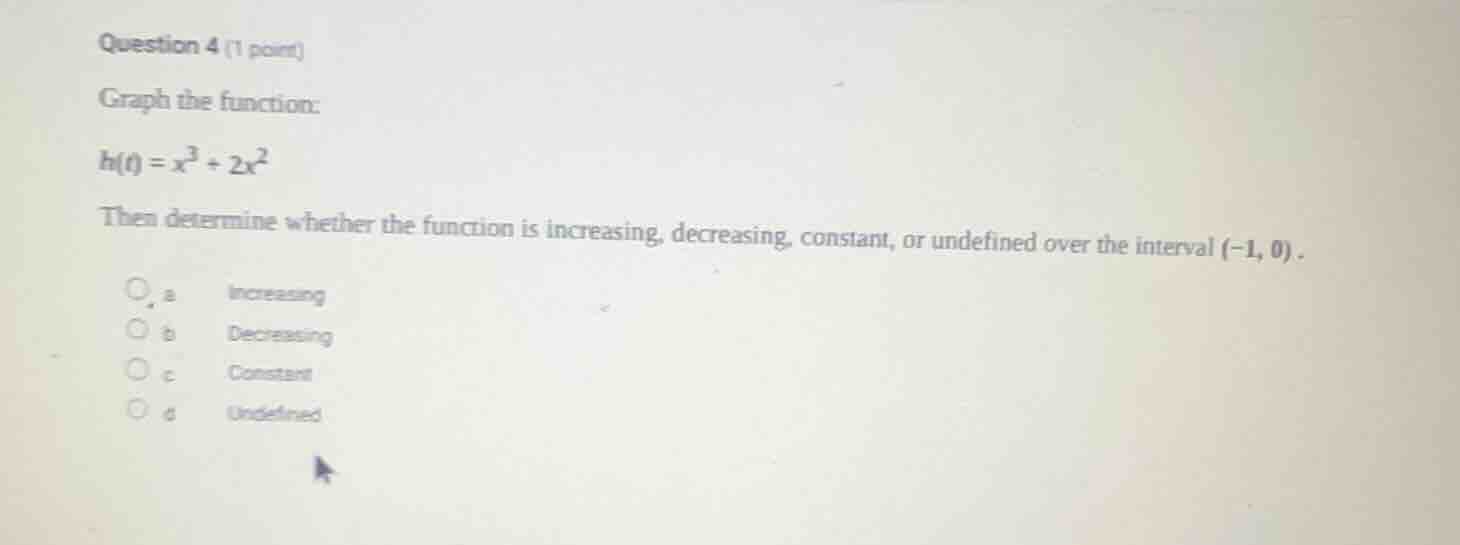
graph the function:
h(x) = x³ + 2x²
then determine whether the function is increasing, decreasing, constant, or undefined over the interval (-1, 0).
a increasing
b decreasing
c constant
d undefined
Step1: Find the derivative of \( h(x) \)
To determine if a function is increasing or decreasing on an interval, we can use the derivative. The function is \( h(x)=x^{3}+2x^{2} \). The derivative \( h^{\prime}(x) \) is found using the power rule. The power rule states that if \( f(x)=x^{n} \), then \( f^{\prime}(x)=nx^{n - 1} \).
For \( h(x)=x^{3}+2x^{2} \), the derivative \( h^{\prime}(x)=3x^{2}+4x \) (since the derivative of \( x^{3} \) is \( 3x^{2} \) and the derivative of \( 2x^{2} \) is \( 2\times2x=4x \)).
Step2: Evaluate the derivative on the interval \( (-1,0) \)
We need to check the sign of \( h^{\prime}(x) \) for \( x\in(-1,0) \). Let's take a test point in the interval \( (-1,0) \), say \( x = - 0.5 \).
Substitute \( x=-0.5 \) into \( h^{\prime}(x) \):
\( h^{\prime}(-0.5)=3\times(-0.5)^{2}+4\times(-0.5) \)
First, calculate \( (-0.5)^{2}=0.25 \), so \( 3\times0.25 = 0.75 \).
Then, \( 4\times(-0.5)=-2 \).
Now, add these two results: \( 0.75-2=-1.25 \). Wait, that's negative? Wait, maybe I made a mistake. Wait, no, wait, let's re - evaluate. Wait, the derivative is \( h^{\prime}(x)=3x^{2}+4x=x(3x + 4) \).
For \( x\in(-1,0) \), \( x\) is negative. Now, let's look at \( 3x + 4 \). When \( x=-1 \), \( 3\times(-1)+4 = 1 \). When \( x = 0 \), \( 3\times0+4=4 \). So for \( x\in(-1,0) \), \( 3x + 4>0 \) (because when \( x=-1 \), it's 1, and as \( x \) increases towards 0, \( 3x + 4 \) increases from 1 to 4). And \( x\) is negative in \( (-1,0) \). So the product \( x(3x + 4) \): negative times positive is negative? Wait, but that contradicts? Wait, no, wait, let's take another test point. Wait, maybe my first test point was wrong. Wait, let's take \( x=-0.2 \).
\( h^{\prime}(-0.2)=3\times(-0.2)^{2}+4\times(-0.2)=3\times0.04-0.8 = 0.12 - 0.8=-0.68 \), still negative? Wait, but that can't be. Wait, maybe I made a mistake in the derivative. Wait, no, the derivative of \( x^{3} \) is \( 3x^{2} \), derivative of \( 2x^{2} \) is \( 4x \), so \( h^{\prime}(x)=3x^{2}+4x \) is correct.
Wait, but let's analyze the function \( h(x)=x^{3}+2x^{2}=x^{2}(x + 2) \). The critical points are found by setting \( h^{\prime}(x)=0 \), so \( 3x^{2}+4x=0\Rightarrow x(3x + 4)=0\Rightarrow x = 0 \) or \( x=-\frac{4}{3}\approx - 1.333 \).
The interval \( (-1,0) \) is to the right of \( x =-\frac{4}{3} \) and to the left of \( x = 0 \). Let's consider the sign of \( h^{\prime}(x) \) in the intervals:
- For \( x<-\frac{4}{3} \), say \( x=-2 \), \( h^{\prime}(-2)=3\times(-2)^{2}+4\times(-2)=12 - 8 = 4>0 \)
- For \( -\frac{4}{3}
- For \( x>0 \), say \( x = 1 \), \( h^{\prime}(1)=3\times1^{2}+4\times1=3 + 4 = 7>0 \)
Wait, but the interval in question is \( (-1,0) \), which is within \( -\frac{4}{3} For \( x=-0.8 \), \( h(-0.8)=(-0.8)^{3}+2\times(-0.8)^{2}=(-0.512)+2\times0.64=-0.512 + 1.28 = 0.768 \) For \( x=-0.1 \), \( h(-0.1)=(-0.1)^{3}+2\times(-0.1)^{2}=(-0.001)+2\times0.01=-0.001 + 0.02 = 0.019 \) Wait, as \( x \) increases from - 0.8 to - 0.1 (moving from left to right in the interval \( (-1,0) \)), the function value decreases from 0.768 to 0.019. Wait, that means the function is decreasing? But that contradicts my initial thought. Wait, but let's…

Snap & solve any problem in the app
Get step-by-step solutions on Sovi AI
Photo-based solutions with guided steps
Explore more problems and detailed explanations
b. Decreasing