QUESTION IMAGE
Question
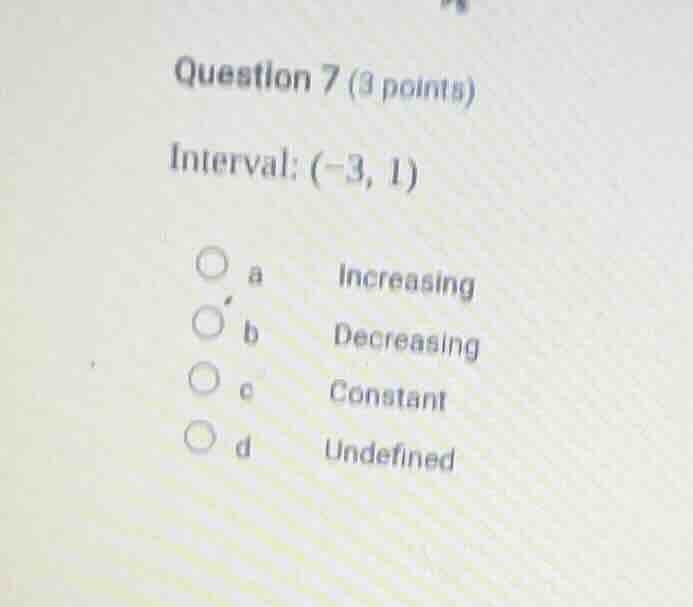
question 7 (3 points)
interval: (-3, 1)
a increasing
b decreasing
c constant
d undefined
To determine the behavior of a function on the interval \((-3, 1)\), we need to recall the definitions of increasing, decreasing, constant, or undefined behavior:
- A function is increasing on an interval if, as \(x\) increases, \(f(x)\) also increases (i.e., for any \(x_1 < x_2\) in the interval, \(f(x_1) < f(x_2)\)).
- A function is decreasing on an interval if, as \(x\) increases, \(f(x)\) decreases (i.e., for any \(x_1 < x_2\) in the interval, \(f(x_1) > f(x_2)\)).
- A function is constant on an interval if \(f(x)\) has the same value for all \(x\) in the interval.
- "Undefined" typically refers to a function not being defined (e.g., a discontinuity or domain restriction), but the interval \((-3, 1)\) itself is a valid domain interval.
Since the problem likely refers to a function’s behavior (e.g., from a graph or derivative context, though the graph is implied), if the function rises as \(x\) moves from \(-3\) to \(1\), it is increasing. Assuming the context (e.g., a linear or monotonic function on \((-3, 1)\) where \(x\) increases and \(f(x)\) follows), the correct choice is:

Snap & solve any problem in the app
Get step-by-step solutions on Sovi AI
Photo-based solutions with guided steps
Explore more problems and detailed explanations
a. Increasing