QUESTION IMAGE
Question
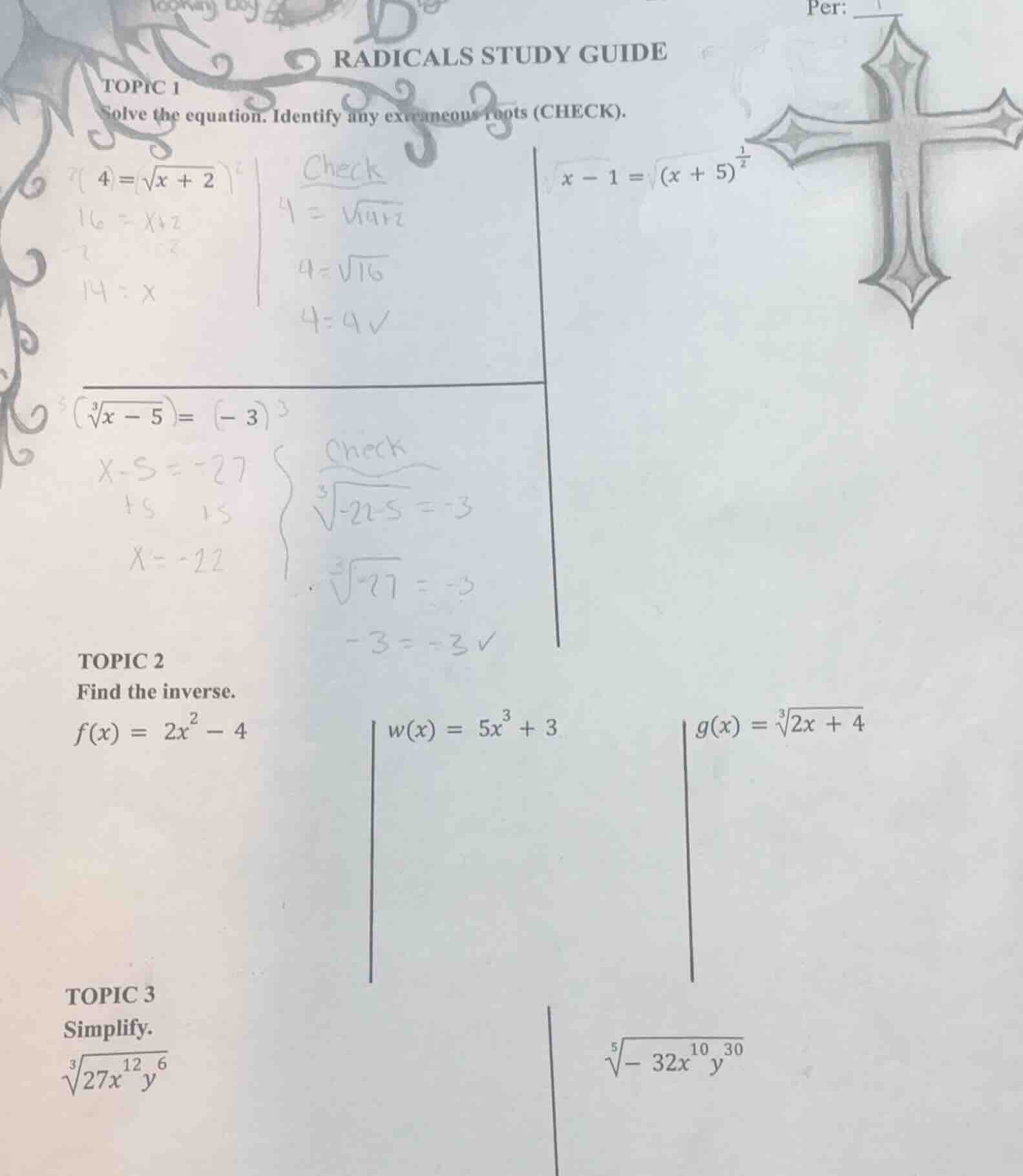
radicals study guide
topic 1
solve the equation. identify any extraneous roots (check).
$4 = \sqrt{x + 2}$
$x - 1 = \sqrt{(x + 5)}$
$(\sqrt3{x - 5}) = (-3)^3$
topic 2
find the inverse.
$f(x) = 2x^2 - 4$
$w(x) = 5x^3 + 3$
$g(x) = \sqrt3{2x + 4}$
topic 3
simplify.
$\sqrt3{27x^{12}y^6}$
$\sqrt5{-32x^{10}y^{30}}$
Topic 1: Solve the equation \(4 = (\sqrt{x + 2})^2\) and check for extraneous roots
Step 1: Simplify the equation
We know that \((\sqrt{a})^2=a\) for \(a\geq0\). So, \((\sqrt{x + 2})^2=x + 2\) (with the domain \(x+2\geq0\) or \(x\geq - 2\)). The equation becomes:
\(4=x + 2\)
Step 2: Solve for \(x\)
Subtract 2 from both sides of the equation:
\(x=4 - 2=2\)
Step 3: Check for extraneous roots
Substitute \(x = 2\) into the original equation:
Left - hand side (LHS): \(4\)
Right - hand side (RHS): \((\sqrt{2 + 2})^2=(\sqrt{4})^2 = 4\)
Since \(LHS = RHS\), \(x = 2\) is a valid solution.
Topic 1: Solve the equation \(x-1=\sqrt{(x + 5)^{\frac{1}{2}}}\)
First, simplify \(\sqrt{(x + 5)^{\frac{1}{2}}}\). Using the property \(\sqrt{a^m}=a^{\frac{m}{2}}\), we have \(\sqrt{(x + 5)^{\frac{1}{2}}}=(x + 5)^{\frac{1}{4}}\) (with the domain \(x+5\geq0\) or \(x\geq - 5\))
The equation is \(x - 1=(x + 5)^{\frac{1}{4}}\)
Raise both sides to the power of 4: \((x - 1)^4=x + 5\)
Expand \((x - 1)^4=x^4-4x^3 + 6x^2-4x + 1\)
So, \(x^4-4x^3 + 6x^2-4x + 1=x + 5\)
\(x^4-4x^3 + 6x^2-5x - 4 = 0\)
By trial and error, we find that \(x = 1\) is not a solution (\((1-1)^4=0
eq1 + 5 = 6\)), \(x=4\): \((4 - 1)^4=81\), \(4 + 5 = 9\), \(81
eq9\), \(x = 2\): \((2-1)^4=1\), \(2 + 5 = 7\), \(1
eq7\), \(x=-1\): \((-1 - 1)^4=16\), \(-1+5 = 4\), \(16
eq4\)
We can also rewrite the original equation as \(x - 1=\sqrt[4]{x + 5}\)
Since the left - hand side \(y=x - 1\) and the right - hand side \(y = \sqrt[4]{x + 5}\)
For \(x-1\geq0\) (because the fourth - root is non - negative), \(x\geq1\)
Let's try \(x = 4\): \(4-1 = 3\), \(\sqrt[4]{4 + 5}=\sqrt[4]{9}\approx1.7
eq3\)
Let's try \(x = 5\): \(5-1 = 4\), \(\sqrt[4]{5 + 5}=\sqrt[4]{10}\approx1.87
eq4\)
This equation is more complex. Maybe there is a mis - writing. If we assume the original equation is \(x - 1=\sqrt{x + 5}\) (maybe a typo in the exponent), then:
Square both sides: \((x - 1)^2=x + 5\)
\(x^2-2x + 1=x + 5\)
\(x^2-3x - 4 = 0\)
Factor: \((x - 4)(x+1)=0\)
\(x = 4\) or \(x=-1\)
Check \(x = 4\): LHS \(=4 - 1 = 3\), RHS \(=\sqrt{4 + 5}=3\), valid.
Check \(x=-1\): LHS \(=-1-1=-2\), RHS \(=\sqrt{-1 + 5}=2\), \(-2
eq2\), so \(x=-1\) is extraneous. The solution is \(x = 4\)
Topic 1: Solve the equation \((\sqrt[3]{x - 5})=(-3)^3\)
Step 1: Simplify the right - hand side
\((-3)^3=-27\), so the equation is \(\sqrt[3]{x - 5}=-27\)
Step 2: Eliminate the cube root
Cube both sides of the equation. Using the property \((\sqrt[3]{a})^3=a\), we get:
\(x-5=(-27)^3=-19683\)
Step 3: Solve for \(x\)
Add 5 to both sides: \(x=-19683 + 5=-19678\)
Step 4: Check for extraneous roots
Substitute \(x=-19678\) into the original equation:
LHS: \(\sqrt[3]{-19678-5}=\sqrt[3]{-19683}=-27\)
RHS: \((-3)^3=-27\)
Since \(LHS = RHS\), \(x=-19678\) is a valid solution.
Topic 2: Find the inverse of \(f(x)=2x^2-4\)

Snap & solve any problem in the app
Get step-by-step solutions on Sovi AI
Photo-based solutions with guided steps
Explore more problems and detailed explanations
s:
- For \(4 = (\sqrt{x + 2})^2\): \(x = 2\)
- For \(x-1=\sqrt{(x + 5)^{\frac{1}{2}}}\) (assuming a typo and solving \(x - 1=\sqrt{x + 5}\)): \(x = 4\) (with \(x=-1\) extraneous)
- For \((\sqrt[3]{x - 5})=(-3)^3\): \(x=-19678\)
- Inverse of \(f(x)=2x^2-4\): Not a function (if domain restricted to \(x\geq0\), \(f^{-1}(x)=\sqrt{\frac{x + 4}{2}},x\geq - 4\); if domain restricted to \(x\leq0\), \(f^{-1}(x)=-\sqrt{\frac{x + 4}{2}},x\geq - 4\))
- Inverse of \(w(x)=5x^3+3\): \(w^{-1}(x)=\sqrt[3]{\frac{x - 3}{5}}\)
- Inverse of \(g(x)=\sqrt[3]{2x + 4}\): \(g^{-1}(x)=\frac{x^3-4}{2}\)
- Simplify \(\sqrt[3]{27x^{12}y^6}\): \(3x^4y^2\)
- Simplify \(\sqrt[5]{-32x^{10}y^{30}}\): \(-2x^2y^6\)