QUESTION IMAGE
Question
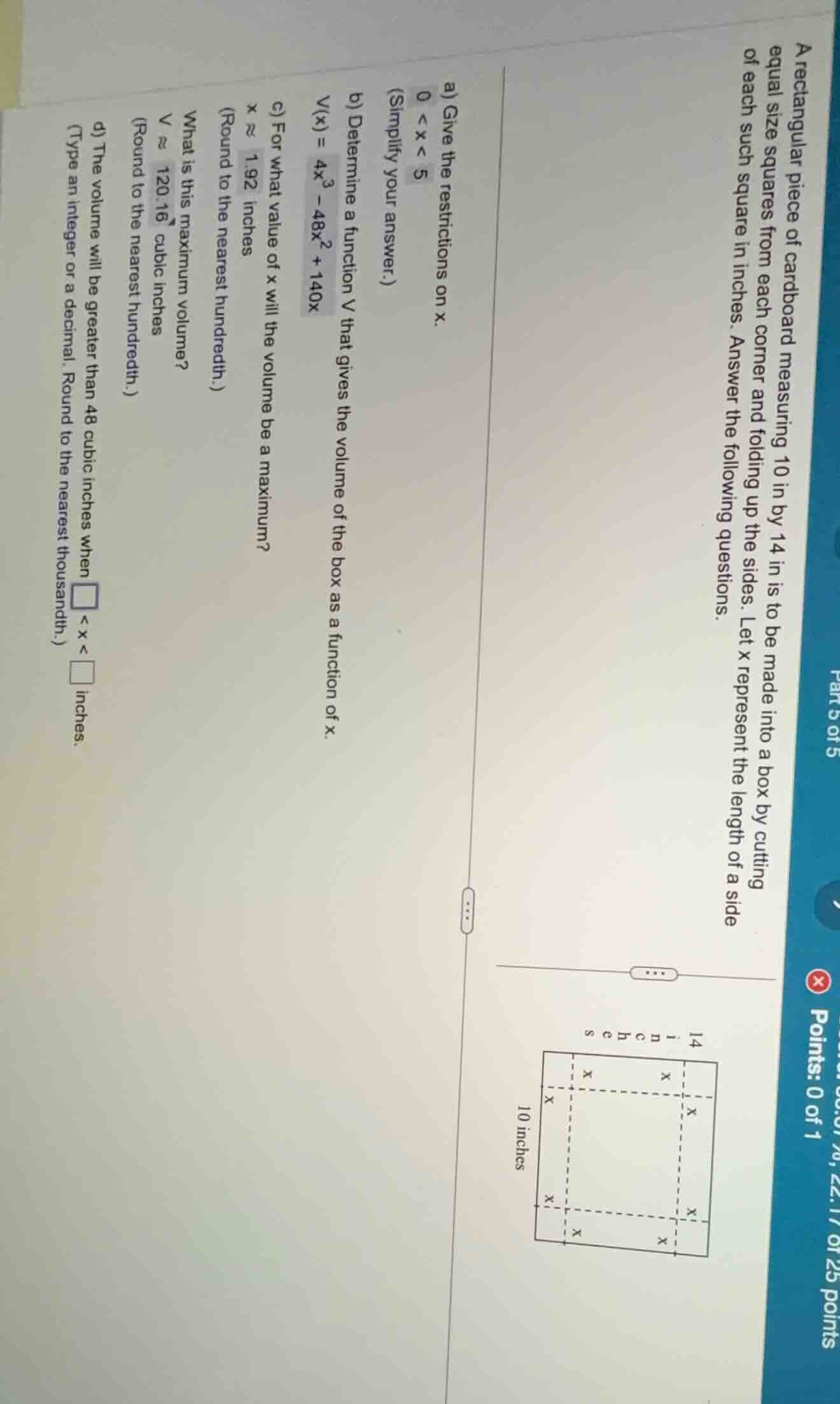
a rectangular piece of cardboard measuring 10 in by 14 in is to be made into a box by cutting equal size squares from each corner and folding up the sides. let x represent the length of a side of each such square in inches. answer the following questions.
a) give the restrictions on x.
0 < x < 5
(simplify your answer.)
b) determine a function v that gives the volume of the box as a function of x.
v(x) = 4x³ - 48x² + 140x
c) for what value of x will the volume be a maximum?
x ≈ 1.92 inches
(round to the nearest hundredth.)
what is this maximum volume?
v ≈ 120.16 cubic inches
(round to the nearest hundredth.)
d) the volume will be greater than 48 cubic inches when
square < x < square inches.
(type an integer or a decimal. round to the nearest thousandth.)
Part d)
To solve part (d), we need to find the interval of \( x \) where \( V(x) > 48 \). The volume function is \( V(x) = 4x^3 - 48x^2 + 140x \). So we set up the inequality:
\[
4x^3 - 48x^2 + 140x > 48
\]
First, rewrite it as:
\[
4x^3 - 48x^2 + 140x - 48 > 0
\]
Divide both sides by 4:
\[
x^3 - 12x^2 + 35x - 12 > 0
\]
We can try to find the roots of the cubic equation \( x^3 - 12x^2 + 35x - 12 = 0 \) by testing possible rational roots (using Rational Root Theorem). Possible roots are \( \pm1, \pm2, \pm3, \pm4, \pm6, \pm12 \).
- Testing \( x = 1 \): \( 1 - 12 + 35 - 12 = 12
eq 0 \)
- Testing \( x = 2 \): \( 8 - 48 + 70 - 12 = 18
eq 0 \)
- Testing \( x = 3 \): \( 27 - 108 + 105 - 12 = 12
eq 0 \)
- Testing \( x = 4 \): \( 64 - 192 + 140 - 12 = 0 \). So \( x = 4 \) is a root.
Now we can factor the cubic as \( (x - 4)(x^2 - 8x + 3) = 0 \) (using polynomial division or synthetic division).
Next, solve \( x^2 - 8x + 3 = 0 \) using the quadratic formula \( x = \frac{-b \pm \sqrt{b^2 - 4ac}}{2a} \), where \( a = 1 \), \( b = -8 \), \( c = 3 \):
\[
x = \frac{8 \pm \sqrt{64 - 12}}{2} = \frac{8 \pm \sqrt{52}}{2} = \frac{8 \pm 2\sqrt{13}}{2} = 4 \pm \sqrt{13}
\]
\( \sqrt{13} \approx 3.6055 \), so the roots are:
- \( x = 4 + \sqrt{13} \approx 7.6055 \) (but our domain is \( 0 < x < 5 \), so this is outside)
- \( x = 4 - \sqrt{13} \approx 0.3945 \)
- \( x = 4 \) (inside the domain \( 0 < x < 5 \))
Now we analyze the sign of \( (x - 4)(x^2 - 8x + 3) \) in the interval \( (0, 5) \):
- For \( 0 < x < 4 - \sqrt{13} \approx 0.3945 \): Let's pick \( x = 0.1 \). \( (0.1 - 4)(0.01 - 0.8 + 3) = (-3.9)(2.21) < 0 \)
- For \( 4 - \sqrt{13} \approx 0.3945 < x < 4 \): Let's pick \( x = 1 \). \( (1 - 4)(1 - 8 + 3) = (-3)(-4) > 0 \)
- For \( 4 < x < 5 \): Let's pick \( x = 4.5 \). \( (4.5 - 4)(20.25 - 36 + 3) = (0.5)(-12.75) < 0 \)
We want where \( V(x) > 48 \), which is where the cubic is positive. From the sign analysis, this is in \( (4 - \sqrt{13}, 4) \approx (0.3945, 4) \).
Rounding \( 4 - \sqrt{13} \approx 0.39 \) (to the nearest hundredth) and the upper bound is 4 (but since our domain is \( 0 < x < 5 \), and we saw at \( x = 4 \) the volume is \( V(4) = 4(64) - 48(16) + 140(4) = 256 - 768 + 560 = 48 \), so we need \( x < 4 \) for \( V(x) > 48 \)).
So the interval is approximately \( 0.39 < x < 4 \) (rounded to the nearest hundredth).

Snap & solve any problem in the app
Get step-by-step solutions on Sovi AI
Photo-based solutions with guided steps
Explore more problems and detailed explanations
The volume will be greater than 48 cubic inches when \( \boldsymbol{0.39} < x < \boldsymbol{4} \) inches (rounded to the nearest hundredth).