QUESTION IMAGE
Question
score on last try: 0 of 1 pt. see details for more.
at least one scored part is incorrect. jump to first changable incorrect part.
next question get a similar question you can retry this question below
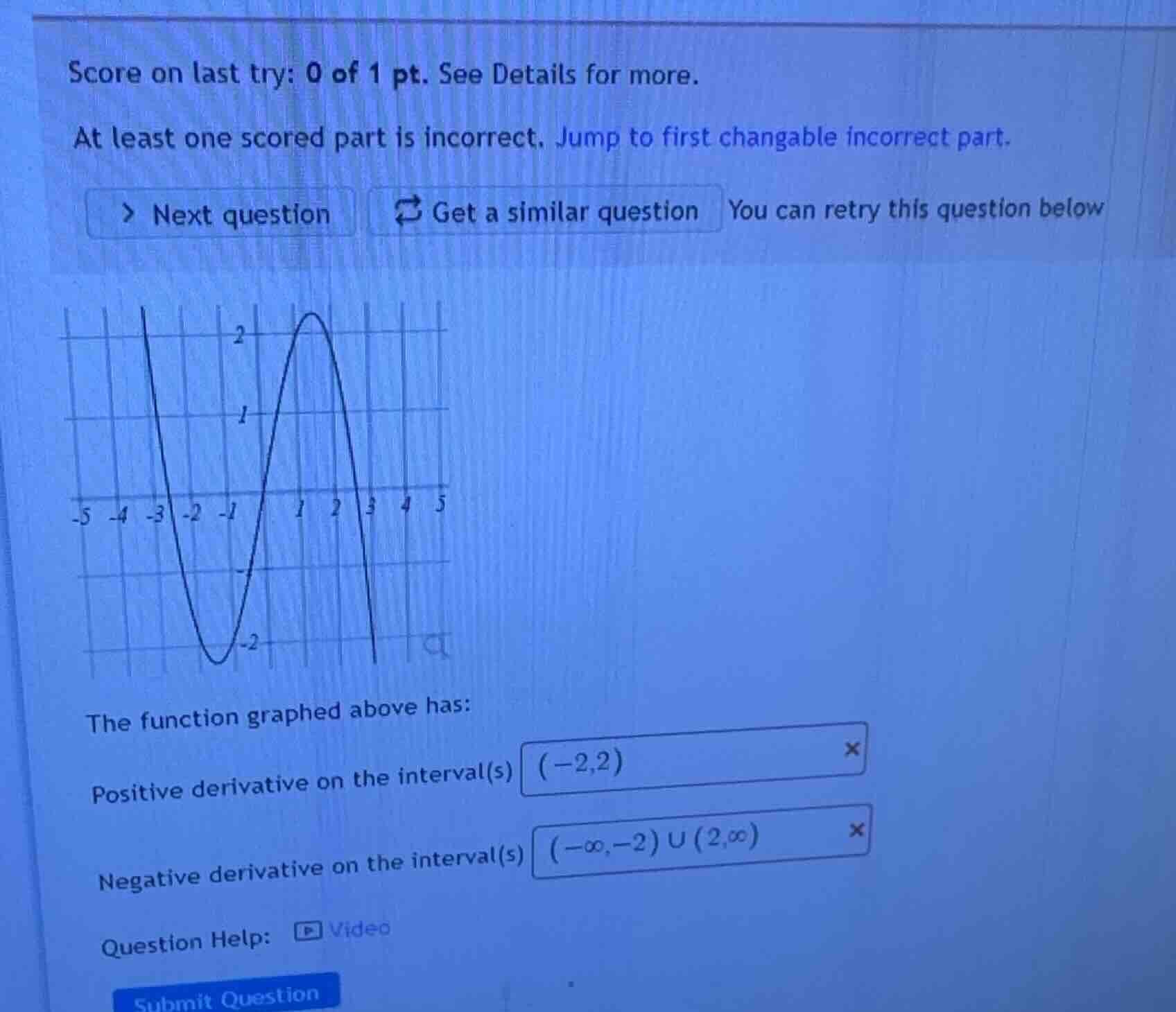
the function graphed above has:
positive derivative on the interval(s)
negative derivative on the interval(s)
question help: video
submit question
Step1: Analyze positive derivative interval
A positive derivative means the function is increasing. From the graph, we see the function increases from \( x = -2 \) to \( x = 2 \)? Wait, no, wait. Wait, looking at the graph: the left part (before \( x=-2 \)): the function is decreasing? Wait, no, let's re-examine. Wait, the graph has a minimum at \( x=-2 \), then increases to a maximum at \( x=2 \), then decreases. Wait, no, the left side: when \( x < -2 \), the function is decreasing (going down to \( x=-2 \)), then from \( x=-2 \) to \( x=2 \), it's increasing (going up to the peak at \( x=2 \)), then from \( x=2 \) onwards, it's decreasing (going down). Wait, no, the original graph: let's see the x-axis. The left curve: starts from the top left, goes down to a minimum at \( x=-2 \), then goes up to a maximum at \( x=2 \), then goes down. Wait, so the derivative (slope) is positive when the function is increasing. So when is the function increasing? From \( x=-2 \) to \( x=2 \)? Wait, no, wait: when \( x < -2 \), the slope is negative (function decreasing), at \( x=-2 \), slope is zero (minimum), then from \( x=-2 \) to \( x=2 \), slope is positive (function increasing), then at \( x=2 \), slope is zero (maximum), then for \( x > 2 \), slope is negative (function decreasing). Wait, but the original answer for positive derivative was \( (-2,2) \), but it was marked wrong. Wait, maybe I misread the graph. Wait, the graph: the left curve (before \( x=-2 \)): is it increasing or decreasing? Let's check the y-values. At \( x=-3 \), the function is high, then at \( x=-2 \), it's at the minimum (lowest point). So from \( x=-\infty \) to \( x=-2 \), the function is decreasing (slope negative). Then from \( x=-2 \) to \( x=2 \), the function is increasing (slope positive). Then from \( x=2 \) to \( \infty \), the function is decreasing (slope negative). Wait, but the original positive derivative interval was \( (-2,2) \), but it was marked wrong. Wait, maybe the graph is different. Wait, maybe the left part (before \( x=-2 \)) is increasing? Wait, no, the graph shows that at \( x=-3 \), the function is above, then at \( x=-2 \), it's at the bottom (minimum). So from \( x=-\infty \) to \( x=-2 \), it's decreasing (slope negative). Then from \( x=-2 \) to \( x=2 \), increasing (slope positive). Then from \( x=2 \) to \( \infty \), decreasing (slope negative). Wait, but the original answer for positive derivative was \( (-2,2) \), but it's marked wrong. Wait, maybe the graph is two parts: the left curve (maybe a different function). Wait, no, the graph has two curves? Wait, no, the graph is a single function? Wait, the image shows two curves? Wait, no, looking at the graph: there's a left curve (from \( x=-3 \) left, going down to \( x=-2 \)), then a right curve (from \( x=-2 \) to \( x=3 \), going up to \( x=2 \), then down). Wait, maybe the function is defined as two parts? No, it's a single function. Wait, maybe I made a mistake. Wait, the positive derivative (function increasing) should be when the slope is positive. So let's re-express:
- When \( x < -2 \): function is decreasing (slope negative)
- At \( x=-2 \): slope zero (minimum)
- When \( -2 < x < 2 \): function is increasing (slope positive)
- At \( x=2 \): slope zero (maximum)
- When \( x > 2 \): function is decreasing (slope negative)
So positive derivative interval should be \( (-2, 2) \), but it was marked wrong. Wait, maybe the graph is different. Wait, maybe the left part (before \( x=-2 \)) is increasing. Wait, if at \( x=-3 \), the function is low, then at \( x=-2 \), it…

Snap & solve any problem in the app
Get step-by-step solutions on Sovi AI
Photo-based solutions with guided steps
Explore more problems and detailed explanations
Positive derivative interval: \( (-2, 2) \)
Negative derivative interval: \( (-\infty, -2) \cup (2, \infty) \)